Tartufo di Pizzo is the legendary Calabrian frozen dessert – a ball of hazelnut-and-chocolate gelato with a molten chocolate heart, dusted in cocoa. Invented in the 1950s on the main square of Pizzo, it made this small seaside town famous around the world. No visit to Pizzo is complete without tasting the original.
Table of Contents
The history of tartufo – how Calabria’s most famous dessert was born
Around 1952, Don Pippo was preparing desserts for the many guests at a large patrician wedding. The ice cream shop of Giuseppe De Maria – known to everyone as Don Pippo – received an order for desserts, but the kitchen had run out of moulds. A Sicilian by birth, accustomed to shaping arancini by hand, he had an idea: he formed a ball from hazelnut and chocolate gelato, placed a portion of soft, liquid dark chocolate in the centre, and dusted the whole thing in cocoa.
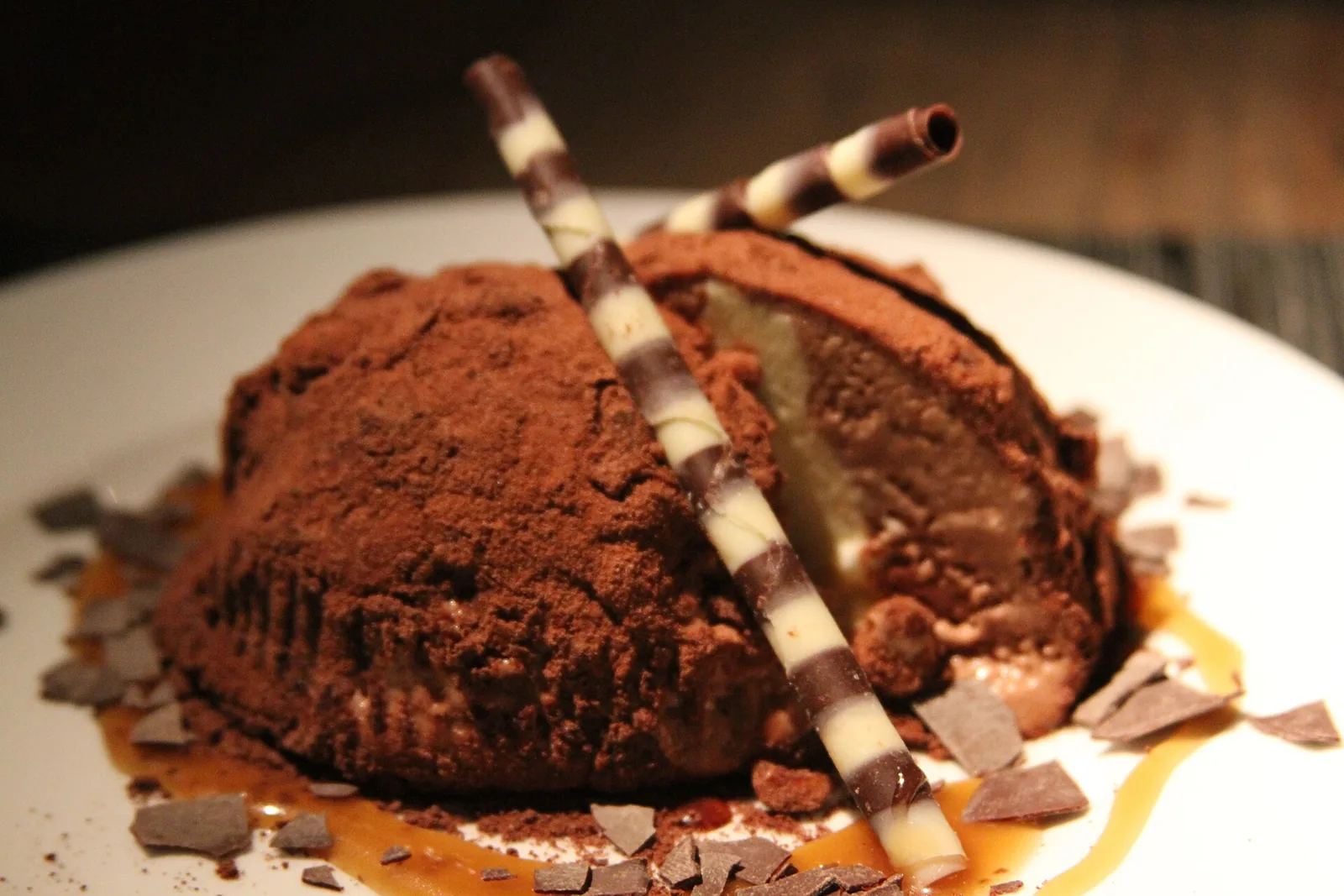
The result resembled a truffle – hence the name tartufo. The guests were delighted. Don Pippo added the dessert to the regular menu at his bar on Piazza della Repubblica, and within a few years tartufo became Pizzo’s signature. Word spread through Calabria, then Italy, and finally the world.
Tartufo di Pizzo is listed on Italy's PAT (Prodotti Agroalimentari Tradizionali) register maintained by the Ministry of Agriculture. This is a national recognition of a traditional food product, not an EU quality designation like IGP. In practice, it is important to distinguish the two: PAT confirms the dessert's link to its place and tradition, but it is not the same as European geographical protection.
Today Pizzo has just under 9,000 inhabitants, and the town has many gelaterias and cafés where tartufo is one of the main specialities. That scale shows how deeply the dessert has entered the everyday life of the town.
In Italy, Pizzo is associated above all with tartufo, and the dessert is sold mainly on Piazza della Repubblica – the main square of the historic centre. Eating it at a table on the square, in one of the historic gelaterias, is part of the local tourist ritual. This is exactly why tartufo has become one of the town's strongest symbols.
What the original tartufo tastes like – anatomy of the dessert
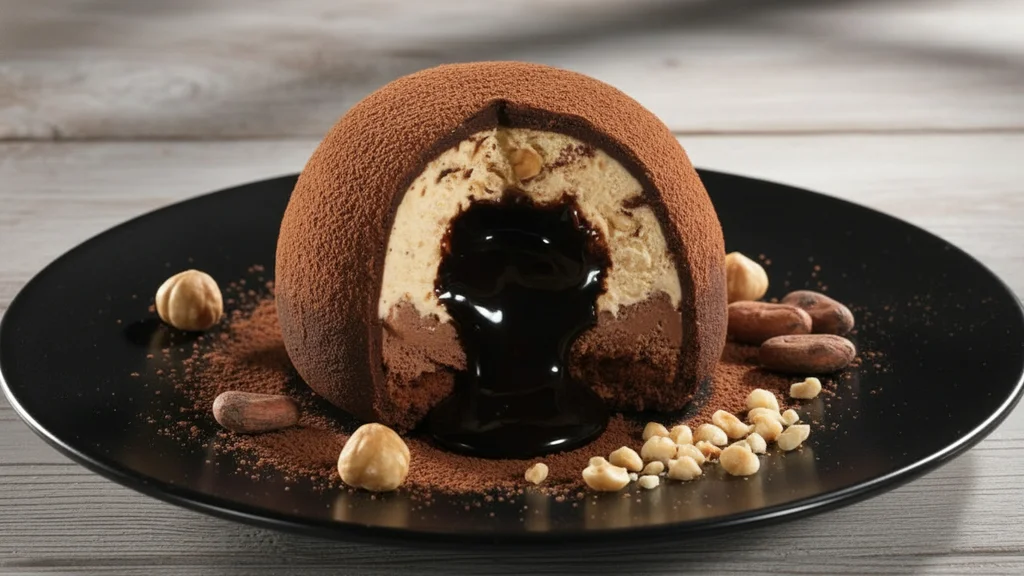
Authentic tartufo di Pizzo is a simple dessert in which the balance between the gelato, the chocolate centre and the bitter cocoa matters. Every element has a role:
Layer |
Ingredient |
Role |
|---|---|---|
Outer |
Cocoa powder |
Truffle appearance, bitter contrast |
Main body |
Hazelnut (nocciola) + chocolate gelato |
Two flavour layers, creamy texture |
Heart |
Soft or liquid dark chocolate |
Surprise centre – temperature contrast |
The key is hand-shaping. A real tartufo is never perfectly round – the uneven surface is a mark of authenticity. The proposed disciplinare describes Tartufo di Pizzo as an irregular hemisphere with a diameter of 4–6 cm and a weight of 120–200 g. It is served slightly frozen, so the chocolate heart is still dense but already soft inside.
The classic tartufo di Pizzo is considered to be a dessert made with nocciola gelato, cioccolato gelato, a chocolate centre described as composto di cacao, and a dusting of cocoa powder. A cherry in syrup inside is also allowed, as is a coating of cocoa mixed with sugar. Modern variants – pistachio, fruit, liquorice – are popular and easy to find on menus, but they are interpretations of the classic, not the original on equal terms.
Watch on YouTube
Where to try it – the best gelaterias in Pizzo
The most famous names and best-known gelaterias are around Piazza della Repubblica. This is where the history of tartufo is concentrated and where you can most easily compare different interpretations of the dessert on a single stroll through the centre.
Gelateria Dante – one of the addresses most frequently mentioned in conversations about tartufo di Pizzo. A table on the square overlooking the historic centre is a classic Pizzo experience.
Gelateria Ercole – another establishment that regularly appears among the most recognisable names in town. The rivalry between Dante and Ercole is part of local folklore – residents have their favourites, and the best approach is simply to try both.
The classic addresses also include Antica Gelateria Belvedere at Piazza della Repubblica 43, close to the castle. Gambero Rosso lists it alongside Dante, Ercole and Enrico as a long-established venue, operating since 1901. It is a good stop if you want to stay in the historic centre and compare tartufo without moving away from the square.
Also worth trying is Gelateria Enrico, which has gained recognition for its flavour variations. Keep in mind, however, that it is not on Piazza della Repubblica, but in località Marinella / Via Prangi. That is a practical difference: the venue lies outside the compact historic centre, closer to the sea, so it is best planned separately rather than as another stop during a walk around the square.
Tip: Most historic gelaterias are on Piazza della Repubblica in the centre of Pizzo. You typically park outside the compact centre and walk the last stretch through narrow streets. The busiest times are summer evenings and weekends, when tables on the square fill quickly.
Prices: Prices vary by gelateria and version of the dessert. If you want an up-to-date figure, check the current menus at the main gelaterias on Piazza della Repubblica – especially since prices for such classics can change from season to season.
PAT status – traditional product without EU IGP
Tartufo di Pizzo does not hold EU IGP status. It is, however, listed as a PAT – an Italian traditional food product linked to a specific territory and a documented practice of at least 25 years. This is an important distinction: IGP is a European geographical indication, while PAT is a national recognition of culinary tradition.
The confusion around IGP has a specific source. In 2007, the Gazzetta Ufficiale published a proposal to recognise the name “Tartufo di Pizzo” as IGP, and in 2008 provisional national protection was granted for the name submitted to the European Commission. This explains why older materials and some producers use “IGP” language, even though today it must be distinguished from actual EU status.
Thanks to this, tartufo remains a product deeply rooted in its place and recognised both regionally and across Italy. Its strength comes not from formal IGP protection but from history, local continuity, and the fact that for many people Pizzo simply means tartufo.
After your tasting, explore Castello Murat and Piedigrotta Church – the other two attractions that make Pizzo far more than just ice cream.
Tartufo di Pizzo – frequently asked questions
Who invented tartufo di Pizzo?
Giuseppe De Maria, known as Don Pippo, a Sicilian-born ice cream maker working in Pizzo. Around 1952, having no ice cream moulds, he hand-shaped a dessert from hazelnut and chocolate gelato with a chocolate centre and dusted it in cocoa. The dessert quickly became popular.
How much does a tartufo di Pizzo cost?
Prices vary by gelateria and version of the dessert. Check the current menu on the spot, especially around Piazza della Repubblica. Tartufo is served on a plate, often with a spoon, since the centre is soft or liquid.
What does the IGP status of tartufo di Pizzo mean?
Tartufo di Pizzo does not hold EU IGP status. It is listed on Italy's PAT register, a list of traditional food products linked to a specific territory and local practice. This is a national recognition of tradition, not a European geographical indication.
Which gelateria in Pizzo serves the best tartufo?
The two most famous are Gelateria Dante and Gelateria Ercole on Piazza della Repubblica – both names regularly come up in conversations about the best tartufo in town. Also try Antica Gelateria Belvedere on the same square and Gelateria Enrico in località Marinella / Via Prangi, closer to the sea.
Last updated: