Costa degli Dei, known as the Coast of the Gods, offers exceptional beaches of remarkable beauty stretching for approximately 55 kilometres in the province of Vibo Valentia. Turquoise waters, white sands and charming cliffs attract tourists from around the world along the stretch of coastline between Pizzo and the southern part of the Capo Vaticano and Nicotera area. Among them are gems such as Tropea, Grotticelle and Spiaggia di Michelino. The name Costa degli Dei refers to the legend that the beauty of this coastline enchanted the ancient gods. These are good places for relaxation, family holidays and active pursuits, where the granite rocks of Capo Vaticano meet the crystalline Tyrrhenian Sea.
Table of Contents
- Discovering the Treasures of Costa degli Dei – Tourist Attractions in the Area
- Northern and Central Coastal Segment – From Pizzo to Zambrone
- Water Sports – Discovering Activities on the Waters of Costa degli Dei
- Ecological Initiatives on the Coast of the Gods – Preserving Calabria's Natural Beauty
- Cultural Heritage and History of Costa degli Dei
- Logistics and Transport on the Coast of the Gods
Discovering the Treasures of Costa degli Dei – Tourist Attractions in the Area
Costa degli Dei is a strip of beaches, cliffs and small towns where the main attractions sit close to one another, but often require a descent down steps, a drive along a side road or an approach from the sea. The stretch between Pizzo, Tropea, Zambrone, Parghelia and Ricadi lets you combine swimming in coves with short visits to historic centres. The cliff-top position of many towns gives wide panoramas over the Tyrrhenian Sea and, in clear weather, also towards the Aeolian Islands.
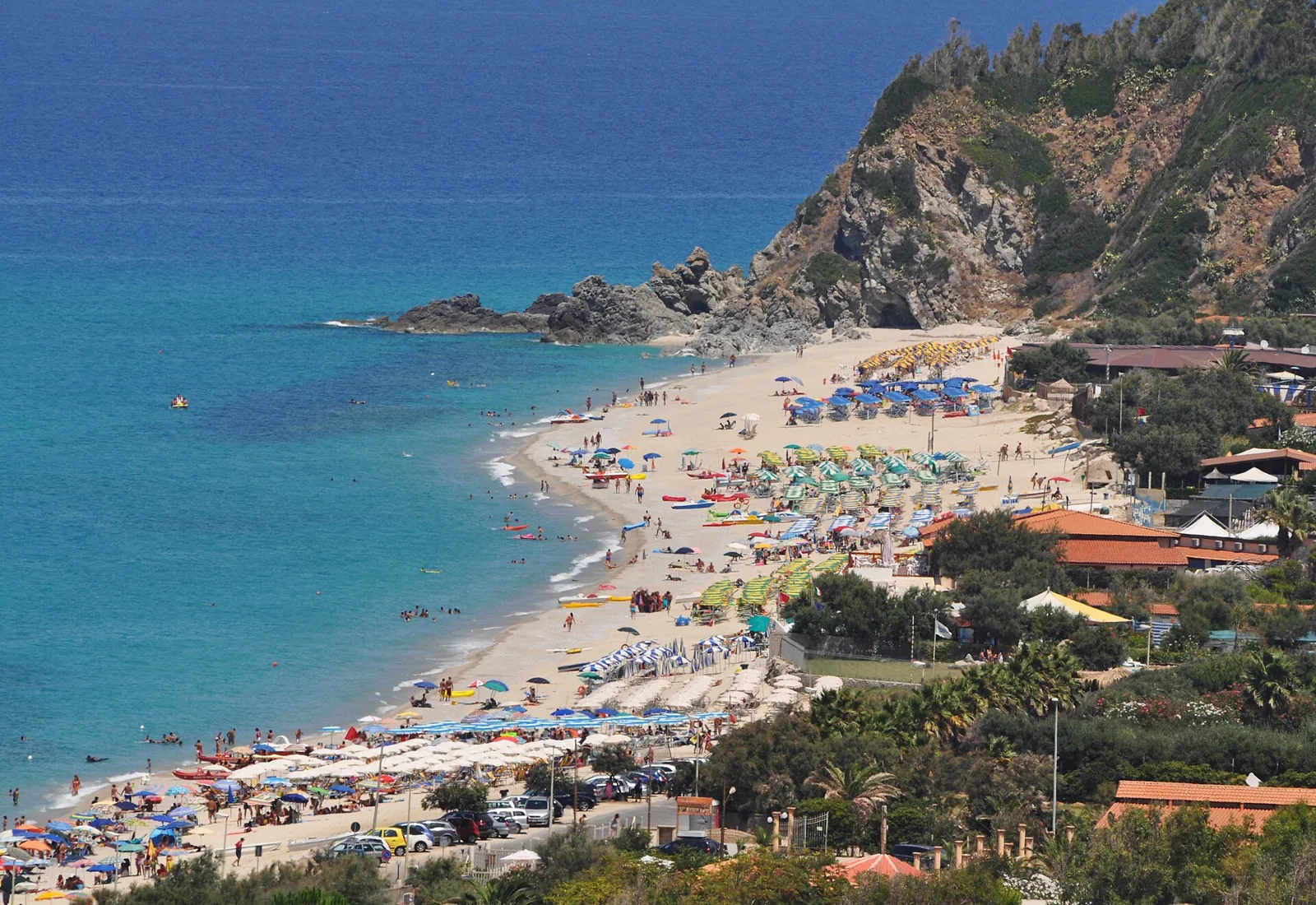
One of the most important places on the Costa degli Dei map is Capo Vaticano. This exceptional area is characterised by beaches hidden between rocks, best accessed from the sea. Grotticelle, one of the most beautiful beaches in the area, offers spectacular views of azure waters and surrounding rock formations. Visit the belvedere behind the lighthouse for views towards Sicily and the Stromboli volcano.
Tropea, often called the jewel of Calabria, is a town known for the Basilica of Santa Maria dell'Isola, perched on a cliff overlooking the sea. It is a good place for walks and for exploring streets full of local shops and restaurants. Tropea also makes a convenient base for Vespa scooter trips or longer routes that let you discover the Calabrian coast beyond the town centre. In local shops and restaurants, look out for the red onion of Tropea: Cipolla Rossa di Tropea Calabria has held IGP status since 2008 and is renowned for its mild, sweet flavour. It most commonly appears in salads, panini, fish dishes and as confettura di cipolla.
Another point worth visiting is Pizzo, known for the unique Tartufo di Pizzo dessert, best sampled at the iconic Bar Dante. The town also hides the historic Castello Murat and the mysterious Piedigrotta Church, a chapel carved in tuff by sailors in the 17th century. The town offers activities for sea lovers, especially snorkelling and fishing along the rocky coast.
If you want to see the coastline from a different perspective, consider a short boat trip. The most popular departures are organised from Tropea, Capo Vaticano and the Ricadi area, and routes typically head towards the cliffs, bays and bathing spots at Formicoli, Riaci or further towards Capo Vaticano. Shorter trips usually last 2.5–4 hours, and in July and August it is best to book in advance.
The current reference point for bathing water and beach quality is the Bandiera Blu programme. In the 2026 edition, beaches on Costa degli Dei recognised included Tropea's Marina del Convento, Marina dell’Isola and Rocca Nettuno. The list also included Parghelia beaches: Costa dei Monaci/Bordila, La Grazia/Vardano, Michelino and La Tonnara.
| Beach Name | Surface Characteristics | Accessibility | Infrastructure |
|---|---|---|---|
| Spiaggia della Marina | Light sand, fine gravel | Pizzo centre, easy access | Bars, lidos, promenade |
| Marinella di Zambrone | Granite formations, white sand | On foot (10–20 min descent) | Wild beach, no bars |
| Grotticelle | Fine white sand | By car, taxi or on foot from the area | Full service, rentals |
| Michelino Beach | Sandy cove | Over 200 steps | No infrastructure |
In practice, access to the beaches varies considerably. Spiaggia di Michelino in Parghelia requires descending over 200 steps from the car park or viewpoint, and facilities on site are limited, so it is worth bringing water and water shoes. Marinella di Zambrone, also known as Paradiso del Sub, can be reached by a path from above or by boat; at the height of summer the descent can be slippery and steep.
The easiest option for families remains Grotticelle in Capo Vaticano, where car parks and lidos operate. If Tropea is too crowded, the beaches of Santa Maria and Formicoli near Ricadi are a good alternative – usually quieter yet still very picturesque.
Northern and Central Coastal Segment – From Pizzo to Zambrone
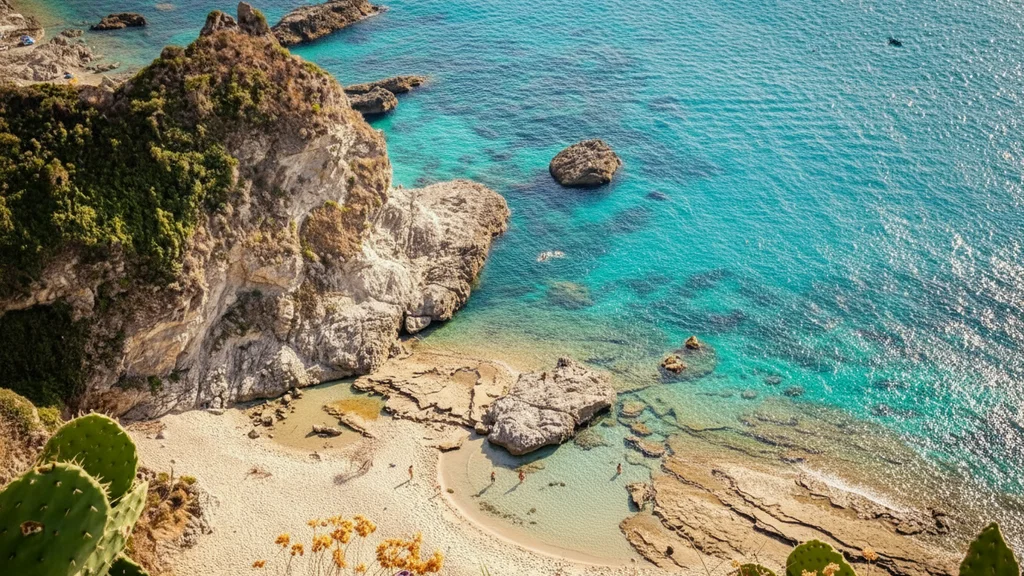
Exploring the Coast of the Gods is best started from the north, where Pizzo captivates with its defensive architecture and Spiaggia della Marina beach. Near Briatico, one can admire the ruins of Saracen towers, including the famous La Rocchetta, which once guarded residents against pirates. A particularly special place is Sant'Irene, where the remains of a Roman piscina, a fish pool, can be found.
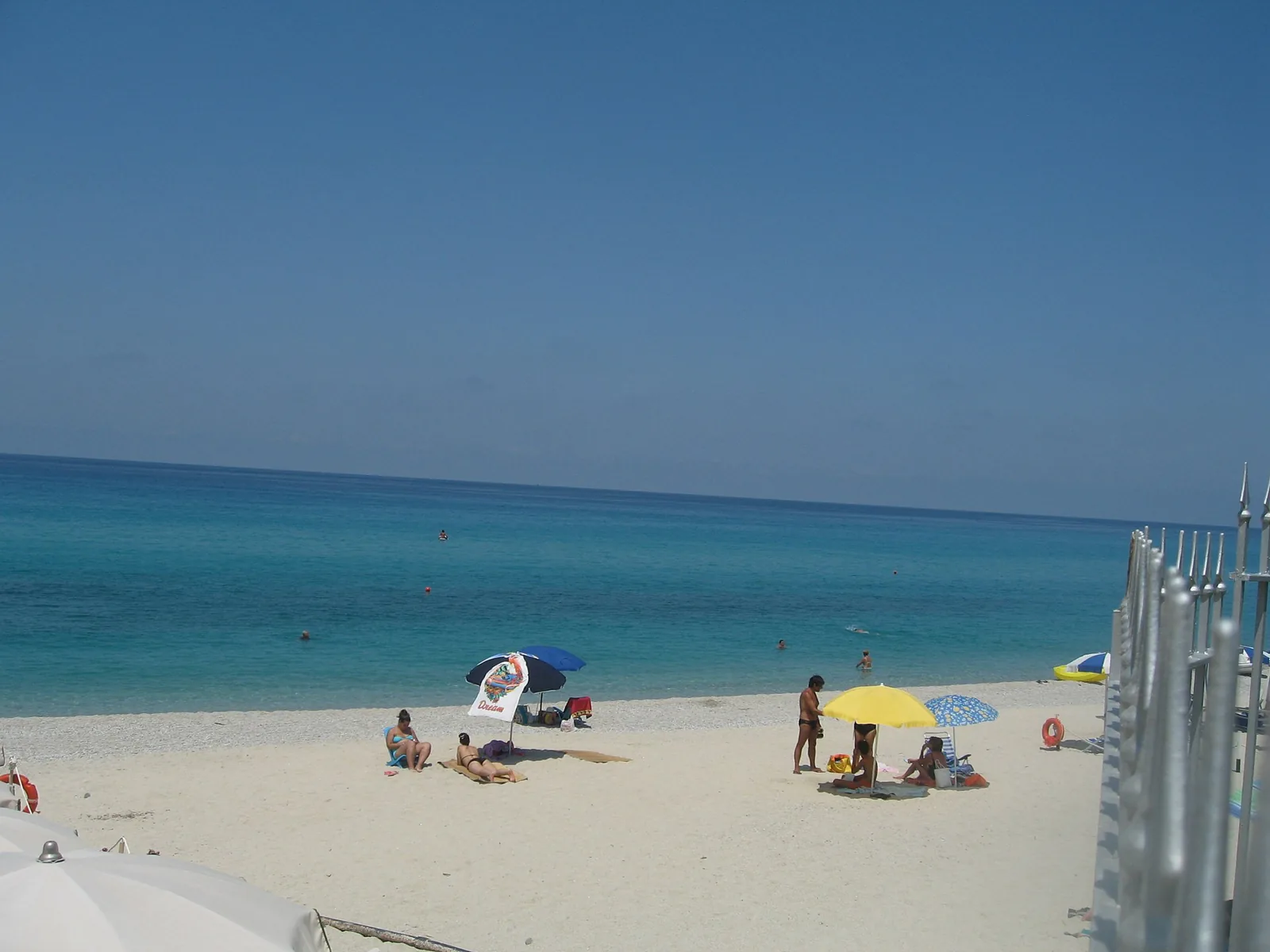
Continuing south, we reach Zambrone, which hides Marinella di Zambrone, known as Paradiso del Sub (Diver's Paradise). This is a wild cove surrounded by Mediterranean vegetation, reached via a steep path from the railway station. A distinctive landmark is Scoglio del Leone, a rock whose shape resembles a resting lion.
In Parghelia, Michelino Beach awaits – one of the most beautiful beaches in Italy, requiring a descent of over 200 steps. The absence of bars and rental facilities means it remains quiet, good for those looking for contact with nature without beach infrastructure. The water here can be very clear, and in calm conditions it is easy to spot typical coastal fish of the Tyrrhenian Sea.
Water Sports – Discovering Activities on the Waters of Costa degli Dei
Costa degli Dei attracts water sports enthusiasts with its combination of rocky coves, clear water and places best discovered from the sea. Beaches such as Tropea and Capo Vaticano are particularly popular among windsurfing and kitesurfing enthusiasts. In season there are local lesson and equipment hire options, though it is worth checking availability on the spot.
For those preferring calmer forms of activity, Parghelia and Zambrone create good conditions for paddleboarding (SUP) and kayaking. Ricadi and the southern part of the coast attract sailing enthusiasts and those who enjoy calm cruises along the bays. Underwater visibility in the Capo Vaticano/Tropea area is sometimes given by local diving centres as reaching around 30 metres, while lesson and equipment hire prices are best checked directly with operators before the season.
The most pleasant beach period usually runs from June to September, though in May and October conditions can still be very good, just more variable. Sea temperature in the Tropea area typically reaches around 23–26°C in July–September, and the best snorkelling clarity usually comes in the morning and in calm seas. In strong wind and swell, the western coast can be difficult for snorkelling, and in July and August beaches and car parks often fill up before 10:00.
Ecological Initiatives on the Coast of the Gods – Preserving Calabria's Natural Beauty
This stretch is home to the Parco Marino Regionale “Fondali di Capocozzo – S. Irene – Vibo Marina – Pizzo Calabro – Capo Vaticano – Tropea”, established by regional law no. 13/2008 and including, among others, the municipalities of Pizzo, Vibo Valentia, Briatico, Zambrone, Parghelia, Tropea and Ricadi. It is a specific marine protected area, not just a general declaration of concern for the beaches.
The marine park contains extensive Posidonia oceanica meadows, important as nurseries for fish and as natural protection against coastal erosion. The ZSC “Fondali di Capo Vaticano” IT9340093 covers seabeds from 5 to 50 m deep in the coastal part of the municipality of Ricadi. Arpacal documents indicate the presence of important Posidonia oceanica meadows here, as well as pressures such as illegal fishing, anchoring in sensitive areas, waste – especially plastic – and coastal erosion. In practice, much also depends on the everyday choices of visitors – from taking rubbish away to avoiding straying off marked paths.
An important element of protection is the presence of zones where boat traffic, anchoring and use of the most sensitive seabed areas should be subordinated to habitat protection. This matters especially in busy tourist areas, where a single bay in August may host swimmers, excursion boats and snorkellers at the same time. The most valuable corners of Calabria preserve their biodiversity when protection of the seabed goes hand in hand with sensible use of beaches and coves.
Watch on YouTube
Cultural Heritage and History of Costa degli Dei
The Costa degli Dei area has been inhabited since antiquity and was influenced by successive Mediterranean civilisations over the centuries. Ancient Hipponion, today's Vibo Valentia, was a Greek colony from the late 7th century BC, later falling under the control of Syracuse and then the Romans as Valentia/Vibo Valentia. The region has long served as a strategic point on the Tyrrhenian Sea, and a system of defensive towers was built along the coast, particularly in the 16th century, as protection against Ottoman and corsair raids.
Historical Sites and Architecture
In Vibo Valentia, the central point of the coastline, one can admire a castle with Norman and Swabian phases. The town is an archaeological treasure trove, and the Museo Archeologico Nazionale “Vito Capialbi” is housed in the medieval castle of Vibo Valentia. According to the Direzione regionale Musei Calabria, the castle was built on the initiative of Frederick II in the 13th century. The cathedral in Tropea, built around the 12th century, houses the venerated image of the Madonna di Romania, the patroness of the town.
The symbol of the region is the Santuario di Santa Maria dell'Isola, situated on a rocky promontory, formerly isolated from the mainland, with views of the Aeolian Islands. Santa Maria dell'Isola is the hallmark of Tropea, and the present form of the sanctuary is the result of many rebuilds following earthquakes. Tropea itself was an important centre on the coast as far back as Byzantine and Norman times.
Elements of Culture and Tradition
Costa degli Dei combines maritime, religious and culinary traditions that represent the quintessence of Calabrian customs. An important element is the Chiesa di Piedigrotta near Pizzo Calabro, a church carved in rock by shipwreck survivors. The rock sculptures inside the cave testify to deep faith and folk artistic craftsmanship.
The history of this region, complemented by its natural beauty like Spiaggia Paradiso del Sub, creates the unique identity of Costa degli Dei. Worth mentioning are figures such as Joachim Murat, who was executed by firing squad in Pizzo on 13 October 1815 after a failed attempt to reclaim the Kingdom of Naples, adding historical drama to the location. The region's culture is also about flavours, such as the famous red onion of Tropea or the spicy 'nduja from nearby Spilinga.
In Pizzo, the culinary tradition has another strong symbol – Tartufo di Pizzo. This ice-cream dessert comes in the shape of a ball, usually made of hazelnut and chocolate gelato, with a liquid chocolate centre and a layer of cocoa on top. In 2007, a proposal was published to recognise “Tartufo di Pizzo” as an IGP product, and in 2008 it was granted temporary national protection; it is safer to describe it as a traditional dessert of Pizzo and a product included in Calabria's culinary heritage.
Logistics and Transport on the Coast of the Gods
Effective exploration of the region requires understanding the local transport system, where regional Trenitalia trains running along the Tyrrhenian line play a key role. The most important stations for tourists are Pizzo, Vibo Valentia-Pizzo, Zambrone, Tropea, Parghelia, Ricadi and Nicotera. Many of them allow convenient travel between beaches and towns without needing to use a car every day.
For those staying in Ricadi or the Capo Vaticano area, reaching the beaches is easiest by car, taxi or on foot from nearby points. Driving can be difficult due to narrow roads and paid parking zones marked with blue lines. In Tropea itself, it is best to get around on foot, despite the numerous steps connecting the town with the shore.
From Lamezia Terme airport to Tropea is approximately 55–60 km by road, and the drive usually takes from 1 hour 10 minutes to 1 hour 30 minutes, depending on traffic. The main route for travel along the coast is the former SS522 di Tropea, now a provincial road, linking areas including Pizzo, Vibo Marina, Briatico, Zambrone and Tropea; the SS18 is important mainly as an access route from junctions and the inland part of the region.
Frequently Asked Questions
Which beaches on Costa degli Dei are the most beautiful?
The most beautiful are considered to be Grotticelle in Capo Vaticano (the Caribbean of Calabria), Marinella di Zambrone (Paradiso del Sub) and Spiaggia di Michelino in Parghelia. Each offers crystal-clear water and unique rock formations.
What is Costa degli Dei and where does the name come from?
Costa degli Dei, meaning the Coast of the Gods, is a 55-kilometre stretch of coastline in Calabria. The name comes from mythology and refers to the supernatural beauty of the landscape, said to have enchanted the gods themselves.
How do you get to Costa degli Dei beaches from Pizzo?
The most convenient way is by regional Trenitalia trains on the Tyrrhenian line, which connect Pizzo with Tropea, Zambrone, Parghelia, Ricadi and further south. You can also hire a car and drive along the former SS522 di Tropea, now a provincial road, bearing in mind that car parks near beaches fill up quickly in season.
Are the beaches on the Coast of the Gods suitable for children?
Yes, Nicotera Marina is particularly recommended due to its wide, sandy beach and gentle entry into the water. Spiaggia della Marina in Pizzo is also family-friendly thanks to easy access and infrastructure.
When is the best time to visit Costa degli Dei?
The best period is May to October. Peak season falls in July and August, when it is warmest but also most crowded. September offers optimal water temperatures and fewer tourists.
Last updated: