Cosenza, often called the Athens of Calabria, is a city with a strong historical and cultural layer. Located in southern Italy, between the Crati and Busento rivers, it is a good base for travellers looking for a Calabria less obvious than the seaside resorts. Its strength lies in the combination of the historic centre, traces of ancient Consentia, medieval architecture, and contemporary art on Corso Mazzini. This is a place best explored on foot: from the steep streets of Cosenza Vecchia to the new part of the city and the university area of Rende.
Table of Contents
Historical heritage of Cosenza – from antiquity to the present day
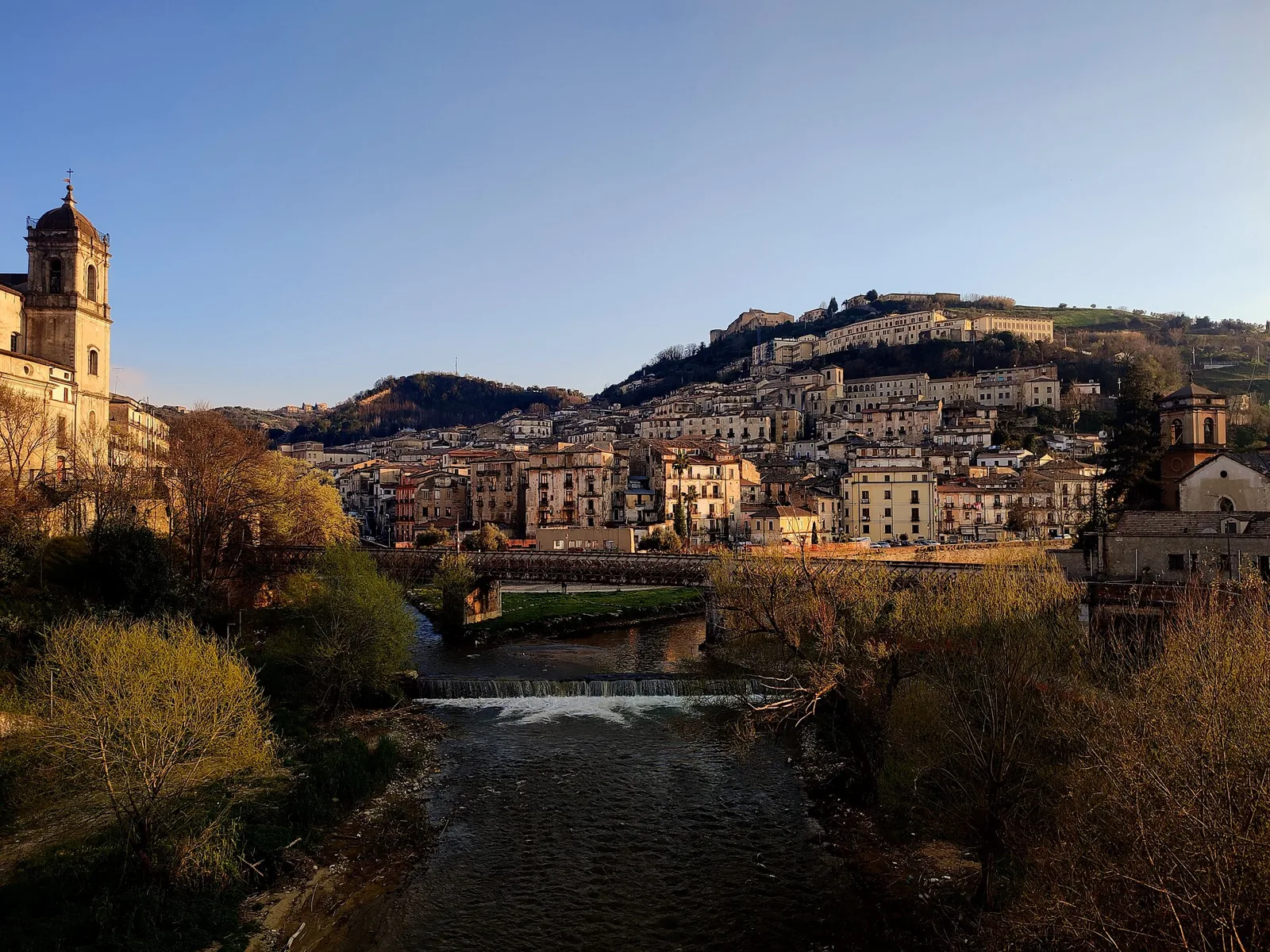
Cosenza, picturesquely situated in the valley between the rivers Crati and Busento, has a history visible in its street layout, ruins, churches, and the hilltop position of the old town. Its foundations reach back to pre-Christian times, when as Consentia it served as the capital of the Bruttian Confederation. For history lovers, it is one of those Calabrian cities where successive layers – ancient, Byzantine, Norman, Swabian, and Spanish – are not locked inside a single museum but scattered throughout the urban fabric.
Prehistoric origins and the Middle Ages
The origins of Cosenza date back to the period when it was one of the most important centres of Bruttian culture, the ancient inhabitants of Calabria. The city was repeatedly destroyed by earthquakes, and later reconstructions changed its appearance and the way it functioned. In the Middle Ages, Cosenza attracted attention as a religious and political centre where Byzantine, Norman, and later Spanish influences converged. A defining moment for the city's identity came in 410 AD, when, according to legend, Alaric, King of the Visigoths, was buried together with his legendary treasure in the waters of the river Busento.
Castello Normanno-Svevo and Swabian power
The dominant historical monument of Cosenza is the monumental Castello Normanno-Svevo. The fortification has earlier roots and was expanded in the Norman period; it owes its greatest development to Frederick II, who gave it the layout typical of Frederick's castles: a rectangular plan, corner towers, and defensive walkways. The castle rises above the city on the Pancrazio hill, offering a panorama of the Crati valley and the distant peaks of the Sila. Today the fortress is not only a historical attraction but also one of the best viewpoints over the old and new city at the same time.
Plan your visit in advance, as the castle has fixed opening hours. Castello Svevo di Cosenza is open from Tuesday to Saturday from 9:30 to 18:00, and on Sundays and public holidays from 10:00 to 18:00; it is closed on Mondays. In July and August there is a midday break from 13:00 to 16:00. A standard ticket costs €4, a reduced ticket €2, an audioguide €1, and a tablet audioguide €2.
The present day and its challenges
Today Cosenza, as an academic centre connected with the University of Calabria in Rende, attracts many young people. Its strategic location between two rivers also brings concrete challenges, particularly related to the risk of flooding. Recent weather events have forced local authorities to take evacuation measures, showing that adaptation to environmental conditions is a real task for the city. In recent years, the city has carried out regeneration projects and safety measures along the Crati and Busento, covering both Cosenza Vecchia and the newer districts.
Cosenza – gems of architecture and culture
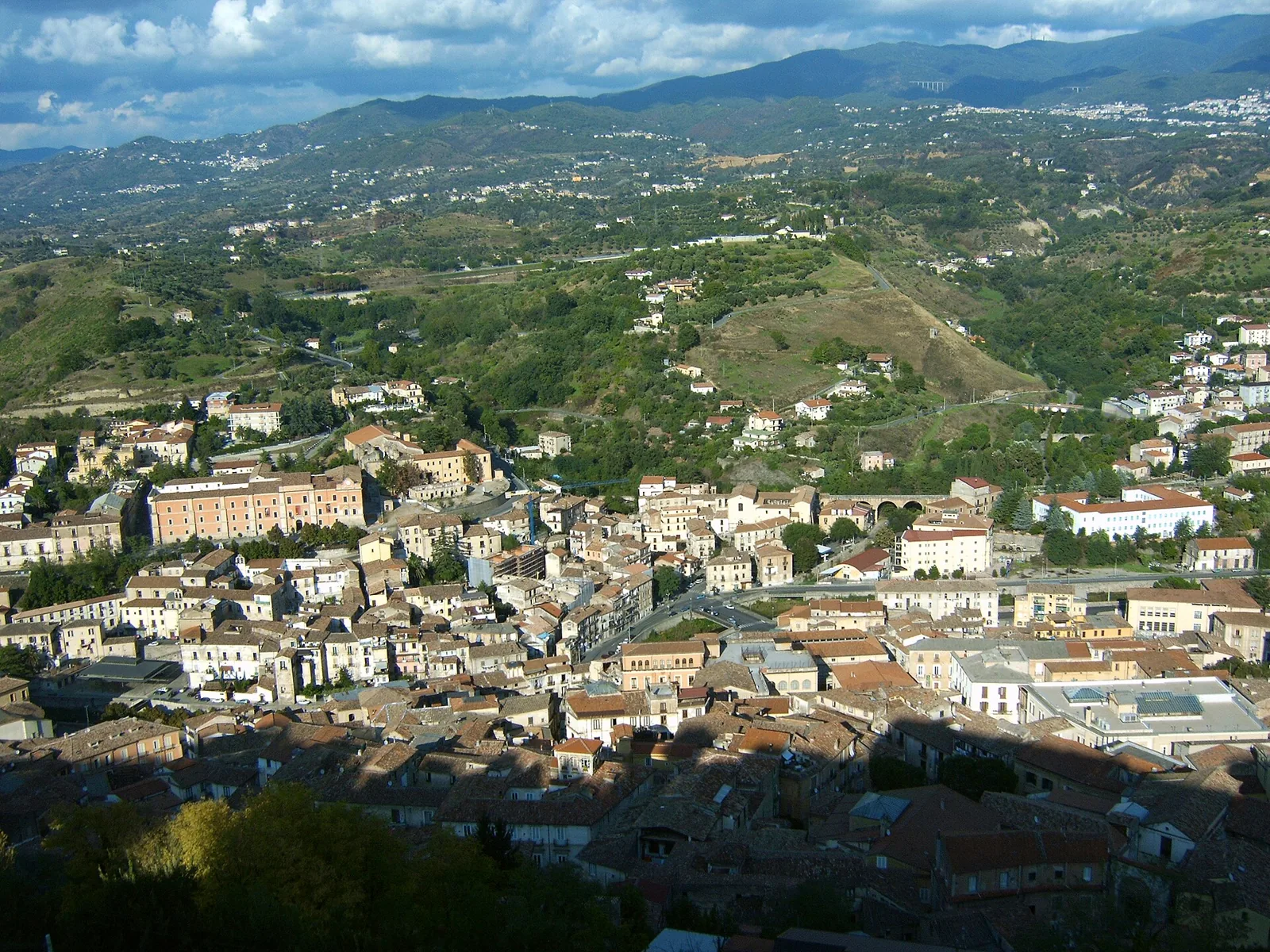
Cosenza, the heart of Calabria, captivates with the dualism of its urban structure. A walk through its streets is a passage from the medieval, sometimes austere architecture of Cosenza Vecchia to the wide, modern Corso Mazzini. In practice, this means that in a single day you can see the cathedral, castle, theatre, palaces, and an open-air sculpture route without long transfers between attractions.
The historic centre and Cosenza Vecchia
In the historic heart of the city, narrow winding streets lead visitors between palaces and churches. The Cathedral of Santa Maria Assunta, recognized by UNESCO in 2011 as Heritage Witness to a Culture of Peace, houses a Byzantine icon of the Madonna del Pilerio and the mausoleum of Isabella of Aragon. This is the city's most important religious site, and the austere Romanesque-Gothic façade recalls the importance of former dynasties. Nearby is Piazza XV Marzo, where a statue of the philosopher Bernardino Telesio stands, surrounded by the neoclassical Teatro Rendano.
Museums and the open-air MAB
Art lovers will find in Cosenza the Museo all'Aperto Bilotti (MAB). This is an open-air gallery on Corso Mazzini, where you can admire works by artists such as Salvador Dalí, Giorgio de Chirico, and Amedeo Modigliani. Museo all’Aperto Bilotti was created after Corso Mazzini was turned into a pedestrian street and opened in 2006 as an open-air sculpture route based on the collection of Carlo and Enzo Bilotti and later acquisitions. Because it is located in the open space of Corso Mazzini, it can be viewed without a standard museum ticket.
For those who prefer classical exhibitions, the National Gallery in Palazzo Arnone presents, among others, works by Mattia Preti, while the Museum of the Bruttians and Oenotrians in the S. Agostino complex offers a rich archaeological collection dedicated to Cosenza and its province. Museo dei Brettii e degli Enotri works seasonally on two opening schedules: from 1 October to 31 May, Tuesday to Friday 9:00–13:00 and 15:30–19:30, and Saturday and Sunday 10:00–13:00 and 15:30–19:30. From 1 June to 30 September, the museum is open Tuesday to Friday 9:00–13:00 and 16:30–19:30, and Saturday and Sunday 10:00–13:00 and 16:30–19:30. It is closed on Mondays, and the last evening admission is at 19:10.
| Attraction | Type | Key element |
|---|---|---|
| Cathedral (Duomo) | UNESCO-recognized heritage | Icon of the Madonna del Pilerio |
| Castello Svevo | Defensive fortress | View over the Crati valley and Sila |
| MAB | Open-air museum | Sculptures by Dalí and de Chirico |
| Palazzo Arnone | Art gallery | Works by Mattia Preti |
| Teatro Rendano | Neoclassical theatre | Regional opera centre |
Cuisine of Cosenza – authentic flavours of the Bruzio region
The gastronomy of Cosenza is based on products with a strong Calabrian character. The traditional cuisine of this region is rooted in the concept of cucina povera, using simple, local ingredients in a frugal but concrete way. In the old town, it is easy to come across dishes with potatoes, legumes, olive oil, peperoncino, and cured meats, all of which show the everyday flavour of this part of Calabria.
Local specialities and traditional dishes
The cornerstone of the local menu is lagane e ceci – wide pasta served with chickpeas, garlic, and olive oil, one of the oldest dishes of southern Italy. Fish lovers should try baccalà alla cosentina, salt cod prepared with potatoes, olives, and the indispensable peperoncino. Try Calabrian salumi, especially Soppressata di Calabria DOP; 'nduja is a regional speciality particularly associated with Spilinga.
The sweet side of Cosenza
For dessert lovers, Cosenza has Varchiglia alla monacale – a pastry filled with almonds and chocolate, whose recipe dates back to the 14th century. During the festive season, cuddrurieddri – fried potato doughnuts – take centre stage and have become a symbol of local street food. These dishes show well how Cosenza's cuisine brings together Arab, Spanish, and Greek influences, without moving away from the simple ingredients of the everyday table.
Watch on YouTube
Cosenza as a base – Sila and Pollino National Parks
Thanks to its central location, Cosenza is a good starting point for exploring mountainous Calabria. Just 30–40 minutes by car separates the city from Sila National Park, which covers an area of 73,000 hectares. It is a land of great lakes, such as Arvo and Ampollino, and dense pine forests where the Apennine wolf can still be encountered.
Nature and active recreation
In winter, Camigliatello Silano becomes a winter sports hub, and in summer it offers respite from the coastal heat. The Sila mountains are a paradise for hiking and mountain biking enthusiasts, with landscapes much cooler and more wooded than the typical image of southern Italy. It is also a good idea to head north towards Parco Nazionale del Pollino, where picturesque villages such as Morano Calabro and Altomonte await, considered among the most beautiful in Italy.
The coast and strategic location
For those who long for the sea, the Tyrrhenian coast is reachable in under half an hour. Cosenza allows for a rare combination in Calabria: in the morning you can head towards the Sila, and in the afternoon go down for an espresso by the sea in Diamante or Paola. This geographical diversity makes Cosenza a practical base for travellers who want to combine culture, history, mountains, and coast without changing accommodation every day.
University of Calabria – the academic heart of Calabria
The University of Calabria, known as Università della Calabria (Unical), is one of the important academic centres in southern Italy. Located in Rende, immediately adjacent to Cosenza, it forms a modern contrast to the historic core of the city. Formally established in 1968 and beginning teaching activity in the 1972/73 academic year, the university has become an important centre for the region's development. The Unical campus is located in Arcavacata di Rende, covers about 200 ha, has more than 350,000 m² of built and infrastructure space, and more than 2,100 places in student residences.
History and development
Unical was part of a decentralisation strategy in higher education, aimed at supporting less developed regions of Italy. The modern campus, inspired by American models, is recognizable for its residential structure and departmental organisation. The campus developed as a modern teaching and research centre, distinguished by its "ponte" axis layout and buildings known as "cubi". For travellers, this means a completely different image of the Cosenza area: not medieval alleys, but a large campus, student residences, faculties, and infrastructure designed as a separate university town.
Economic and social impact
The significance of Unical is considerable, because its presence affects Rende and Cosenza not only during the academic year, but also through the constant movement of students, staff, and service facilities. Calabria benefits from the academic presence and activity of the university, which bridges the tradition of the “Athens of Calabria” with modern AI laboratories and space research. Thanks to this institution, Cosenza is not merely a city of memories, but also a centre of knowledge and everyday academic life in southern Italy.
Cosenza – Athens of Calabria: frequently asked questions
Is Cosenza worth visiting?
Absolutely. Cosenza offers an authentic Italian experience without the tourist crowds, combining UNESCO-recognized heritage, a modern open-air sculpture gallery, and distinctive regional cuisine.
What should I see in Cosenza Vecchia – the old town?
The key highlights are the 11th-century Cathedral (Duomo) with the icon of the Madonna del Pilerio, the Swabian Castle (Castello Svevo) on the Pancrazio hill, Teatro Rendano, and the historic Gran Caffè Renzelli.
How do I get to Cosenza from Naples and Reggio Calabria?
From Naples, you can reach Cosenza by train usually in about 4 hours or by car on the A2 motorway. From Reggio Calabria, direct regional trains run, with a journey time of 2.5 to 3 hours.
Is Sila National Park close to Cosenza?
Yes, the Sila mountains are just 30–45 minutes by car from the city centre, making Cosenza a good base for day trips into nature.
What should I eat in Cosenza – what are the typical regional dishes?
Try lagane e ceci, pasta with chickpeas, baccalà alla cosentina, patate 'mpacchiuse, and the local dessert Varchiglia alla monacale. Among Calabrian salumi, look especially for Soppressata di Calabria DOP.
How much time do I need to explore Cosenza?
One intensive day is enough for the city itself, but to soak up the atmosphere of the region and visit the nearby Sila Park, plan at least 2–3 days.
Main attractions
Cathedral of Santa Maria Assunta
Romanesque-Gothic cathedral recognized by UNESCO, housing a Byzantine icon of the Madonna del Pilerio and the mausoleum of Isabella of Aragon.
Castello Normanno-Svevo
Castle on the Pancrazio hill, expanded in the Norman period and developed by Frederick II. Panoramic views over the Crati valley and the Sila massif.
MAB – Museo all'Aperto Bilotti
Open-air sculpture gallery on Corso Mazzini with works by Dalí, de Chirico, and Modigliani, accessible without a standard museum ticket.
Palazzo Arnone – National Gallery
Art gallery housing a collection of Calabrian and Italian painting, including works by Mattia Preti and Umberto Boccioni.
Teatro Rendano
Neoclassical 19th-century theatre on Piazza XV Marzo – the region's centre of opera and cultural life.
Museum of the Bruttians and Oenotrians
Archaeological museum in the former monastery of S. Agostino, with a rich collection dedicated to Cosenza and its province.
Getting there
From Poland to Lamezia Terme (SUF) – seasonal direct Ryanair flights from Kraków, Warsaw, and Katowice; outside the season via Rome or Milan. From Lamezia Terme airport to Cosenza is about 65 km, usually around 50–60 min by car.
From Lamezia Terme Centrale station to Cosenza, the regional train usually takes about 1 h 10; from the airport, first take a bus/shuttle to the station. From Rome by Trenitalia about 4–5h with a change in Paola.
Car hire at Lamezia airport. Take the A2 motorway to the Cosenza Nord or Sud exit, usually around 50–60 min from the airport. Parking near San Vito stadium.
FlixBus and MarinoBus run, among others, from Naples and Rome; check the stop shown on your ticket. Main points are Cosenza (Riforma) – Piazza della Riforma and the bus station on Viale delle Medaglie d’Oro.
Near Cosenza
Last updated: