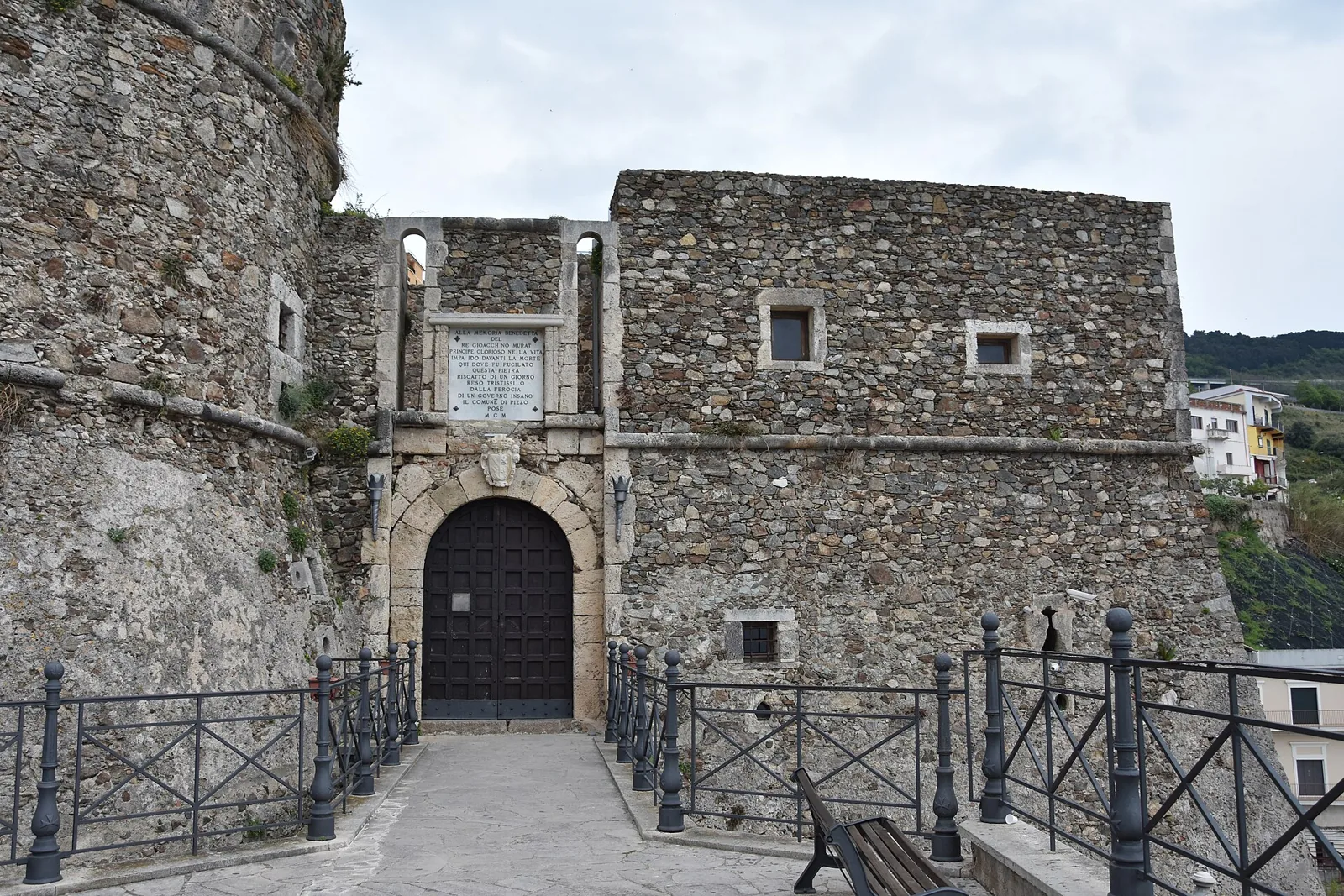
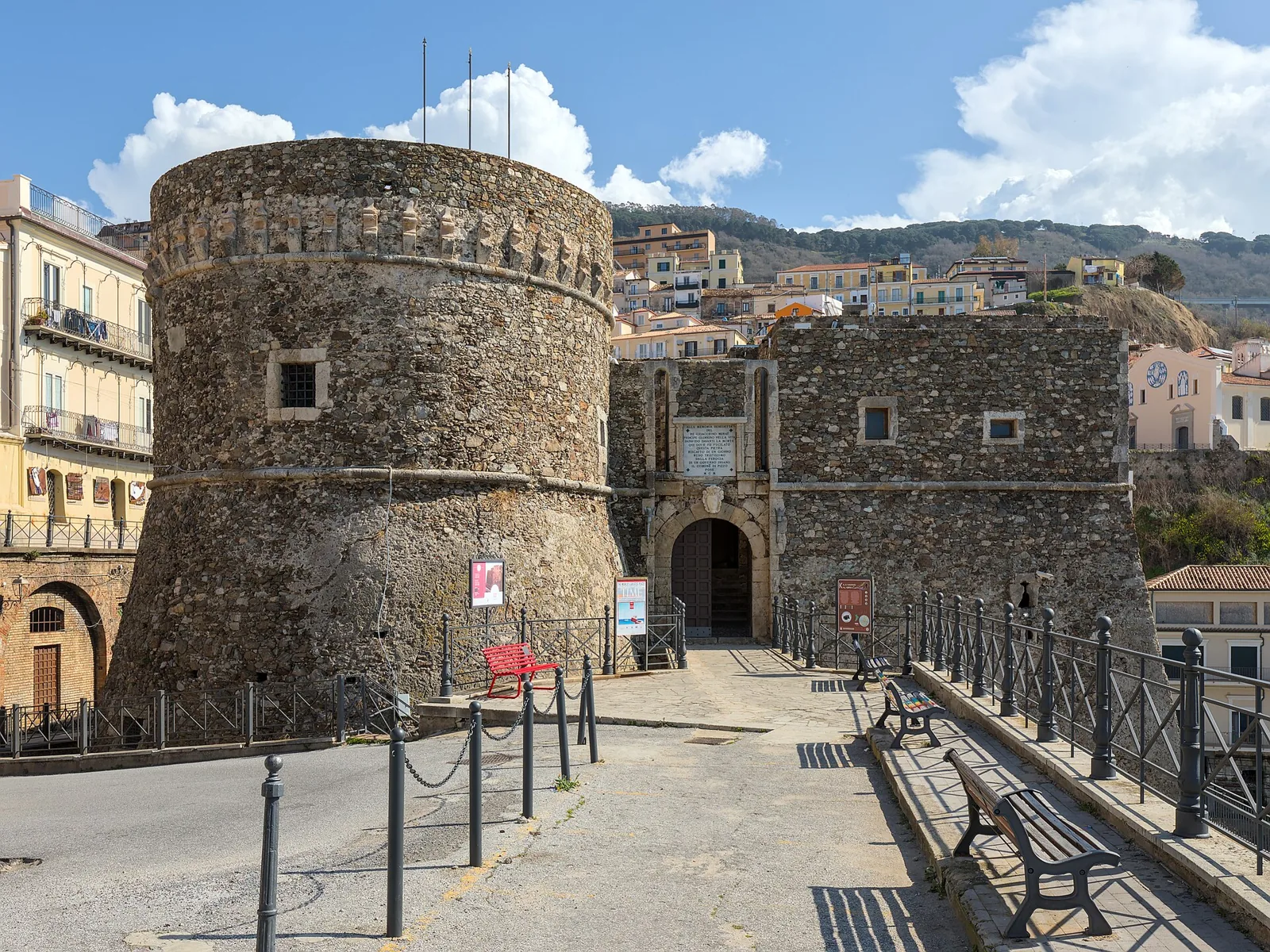
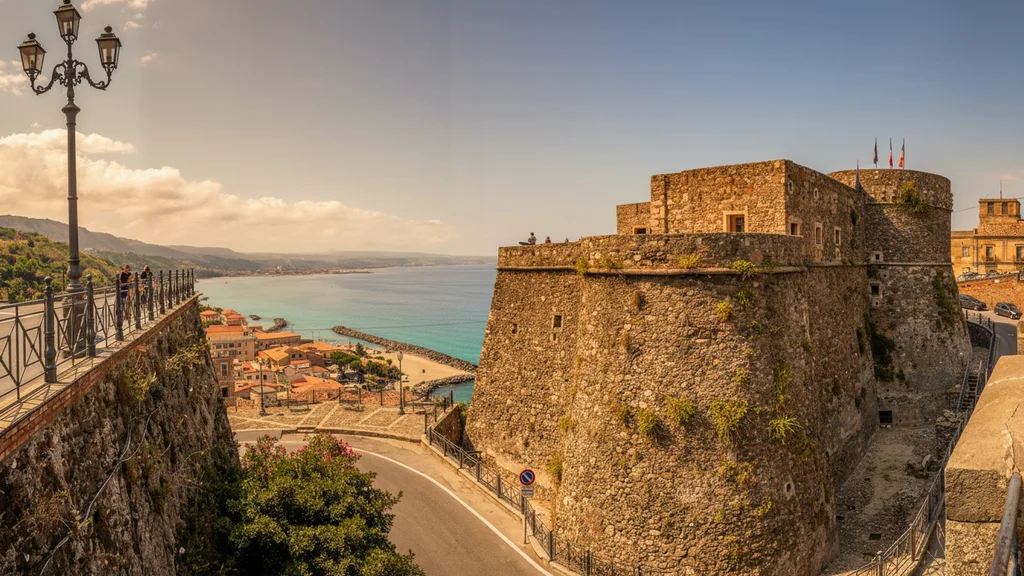
Castello Murat is a 15th-century Aragonese fortress that entered European history as the site of Joachim Murat’s imprisonment, trial and execution – Napoleon’s marshal, King of Naples, and one of the most tragic figures of the Napoleonic era. The castle overlooks the sea in the heart of Pizzo, and its walls house a museum dedicated to the king’s final days.
Table of Contents
History of the castle – from coastal fortress to a stage of royal drama
The structure has medieval origins: the oldest core of the fortification was the Torre Mastia from the late 14th century. The main Aragonese expansions began around 1480 on the initiative of Ferdinand I of Aragon. The castle was not built as a noble residence, but as a fortification and prison guarding the Tyrrhenian coast in this part of Calabria.
Joachim Murat was King of Naples from 1808 to 1815. After Napoleon’s fall he tried to hold on to power, and in March 1815 issued the so-called Proclamation of Rimini, calling on Italians to fight against Austria. After his Neapolitan forces were defeated at Tolentino on 2–3 May 1815, he fled and in the autumn made one more, already desperate, attempt to reclaim his throne.
For centuries the castle served military and prison functions, but the events of October 1815 etched it permanently into European history. Murat with a handful of supporters reached Pizzo on 8 October 1815, hoping for popular support and a swift return to power. Instead, he was arrested by the Bourbon gendarmerie led by Captain Trentacapilli and imprisoned in the fortress.
A military tribunal convened almost immediately. The trial was summary in nature, and the death sentence was passed very quickly. On 13 October 1815, Murat faced the firing squad in the castle courtyard. According to witnesses, he refused a blindfold and issued the command to fire himself, uttering his famous last words: “Aim at my chest, not my face” (Mirate al petto, non al viso). He was 48 years old.
Today’s name Castello Murat came into use long after the fortress itself was built. Murat did not build the castle – the structure had already been a coastal defensive fortress for centuries. It was his imprisonment, trial and execution that gave the place its modern museum and tourist identity.
Watch on YouTube
The Murat Museum – what to see inside
The castle houses the Museo Murattiano, a small, clearly themed museum. The exhibition focuses on Murat’s stay in Pizzo in October 1815, his trial, the final letter to Caroline Bonaparte and the execution. This is not a large military museum – rather a historical point that fits best into a walk through the old town.
Former fortress rooms – the stone interiors and thick walls convey the austere, defensive character of the building. The visit makes it clear that this is first and foremost a coastal stronghold, and only then a memorial site associated with Murat.
The room attributed to Murat – it is with this interior that the story of his final hours and his farewell letter to his wife Caroline Bonaparte and their children is associated. Display cases contain materials relating to those events, and the arrangement helps visitors piece together the final chapter of the story.
Execution courtyard – where the shots were fired. A memorial plaque quotes Murat’s last words, and the view over the sea and the Gulf of Sant’Eufemia only intensifies the contrast between the calm landscape and the drama that unfolded here in October 1815.
Exhibition hall – this is where the museum purpose of the visit comes through most fully: trial documents, copies of correspondence and memorabilia help visitors understand how quickly the last days of the former King of Naples unfolded. The exhibition also includes a notable fragment of a sculpture attributed to Antonio Canova – the surviving part depicting a helmet. The original sculpture was lost or destroyed during Garibaldi’s passage. A visit usually takes less than an hour but complements a stroll around Pizzo well.
Practical information
Detail |
Information |
|---|---|
Address |
Via P. Marincola, Pizzo (VV) |
Access |
Historic centre of Pizzo, a few minutes' walk from Piazza della Repubblica |
From Pizzo station |
Approx. 1.5–2 km on foot, partly uphill; from Vibo Valentia–Pizzo station, allow for a longer journey by local transport or taxi |
From Lamezia Terme Airport |
Approx. 30 km, by car usually 25–35 minutes |
By car |
A2 motorway, Pizzo exit, then follow signs to the historic centre |
Visit duration |
Usually 30–60 minutes |
Before visiting, it is best to check current opening hours and prices directly with the site operator, as these are details that can change. In October, the castle is sometimes also the setting for a rievocazione storica, a historical re-enactment of the Murat events connected with the anniversary of Murat’s landing and execution. According to ENIT, the event is organised every 4 years, so if you are planning an autumn stay in Pizzo, check whether an edition falls during your visit.
The fortress itself is a historic building with thick walls and stairs, so full barrier-free access may be limited. If travelling with a pushchair or requiring accessibility, it is best to confirm conditions with the site operator before arrival. The castle stands in the old part of town – expect slopes, stairs and uneven surfaces typical of Pizzo’s historic centre.
It is worth combining the visit with the Church of San Giorgio Martire in central Pizzo, with which local tradition associates the burial and commemoration of Murat after his execution on 13 October 1815. It is precisely the pairing of two sites – the fortress of the execution and the church associated with Murat’s memory – that forms the most important Murat trail in the town. After your visit, the perfect ending is a tartufo di Pizzo on Piazza della Repubblica.
Castello Murat – frequently asked questions
Who was Joachim Murat and why was he executed in Pizzo?
Joachim Murat was a Marshal of France, Napoleon Bonaparte’s brother-in-law and King of Naples from 1808 to 1815. After Napoleon’s fall he tried to hold on to power, issued the Proclamation of Rimini, and after his defeat at Tolentino made one more attempt to reclaim his throne. He reached Pizzo on 8 October 1815, was captured, tried by a military court and executed by firing squad on 13 October 1815.
How much does it cost to visit Castello Murat?
Ticket prices may change, so before visiting it is best to check the current pricing directly with the site operator. A visit usually takes 30 to 60 minutes.
Is the castle open year-round?
Opening hours may change by season, so before arriving it is worth checking the latest information directly with the site operator. This is the safest approach, especially if planning a visit outside peak season.
Where is Murat’s burial site?
In Pizzo, Murat is associated above all with the Church of San Giorgio Martire, linked to his burial and local memory after the execution. The fullest picture is gained by visiting both sites – Castello Murat and San Giorgio.
Last updated: