Pizzo Calabro, picturesquely perched on a steep tuff cliff above the Tyrrhenian Sea, is a place that combines culinary tradition with views over the Gulf of Sant'Eufemia. This famous city of tartufo, known for its exceptional tartufo, also has a history linked to the Aragonese period and the dramatic final chapter of Joachim Murat. Pizzo lies in the province of Vibo Valentia, about 30 km from Lamezia Terme airport, so it works well as a first or last stop on a route along the Costa degli Dei.
Table of Contents
- Pizzo Calabro – A Culinary Paradise: the Flavours of Calabria
- Attractions in Pizzo Calabro – Discovering Historical and Natural Treasures
- Traditions and History of Pizzo Calabro – Pearl of Calabria
- Nature and Beaches of Costa degli Dei – Natural Treasures near Pizzo
- The Festival Heart of Pizzo Calabro – Colourful Events on the Calabrian Coast
- Logistics and Practical Information for Travellers
Pizzo Calabro – A Culinary Paradise: the Flavours of Calabria
Pizzo Calabro, widely known as the "city of tartufo", is a culinary gem on the map of Calabria. Although the town gained international fame thanks to its frozen desserts, the local food scene is also based on simple products from the coast and the agricultural hinterland. The foundation of the local cuisine is fresh seafood and aromatic citrus fruits, which give the dishes their southern character.
In nearby Porto Salvo di Vibo Valentia, Don Giovannino is a family bakery whose roots go back to an activity started in 1982. In the wider region, Oleificio Torchia from Tiriolo near Catanzaro is worth knowing as a producer of Olio di Calabria IGP. A particularly prized speciality is bergamot-infused olive oil, which works well with grilled swordfish (pesce spada) and fresh salads with the famous red onion from Tropea.
In local trattorias, simple dishes usually win: grilled fish, seafood, pasta with spicy 'nduja and vegetables dressed with olive oil. Pizzo is a good place to try coastal cooking without separating it from the products of inland Calabria. The best way to discover the local food is at a table on Piazza della Repubblica or in small places by the marina, where the frozen dessert is only the finale of the meal.
Tartufo di Pizzo – the History and Craft of the Frozen Truffle
Tartufo di Pizzo is a traditional frozen dessert from Pizzo; its name has been the subject of local and national protection efforts, but it does not have EU PGI status. Its story began in 1952 at Gelateria Dante, when master confectioner Giuseppe De Maria, known as Don Pippo, had to improvise during the service at a lavish wedding. Lacking metal moulds for ice cream, he shaped a ball of hazelnut and chocolate ice cream in his hands, filled its centre with liquid chocolate, and rolled the whole thing in bitter cocoa.
In 2007, a draft disciplinare for PGI status was published, and in 2008 the name was granted temporary protection at national level. The application for EU PGI registration was rejected, however, so in practice it is important to distinguish the tradition and local protection of the name from the EU PGI label. For travellers, what matters most is whether the dessert is made on site and shaped by hand, not whether a shop uses certification language.
Authentic tartufo differs from mass-produced versions through its artisan method of production and hand shaping. The key to success is the "liquid heart" (cuore morbido), which, when the dessert is cut open, should flow onto the plate, creating a composition with the dense ice cream mass. While the classic version is based on chocolate and hazelnuts, pistachio, white chocolate, and fruit variants can now be found, served at well-known ice cream parlours.
Where to eat the best tartufo in Pizzo? The choice is wide, but several places are considered the historic custodians of the original recipe:
- Gelateria Dante – the birthplace of the dessert, where Don Pippo's tradition is still upheld today on Piazza della Repubblica.
- Bar Gelateria Ercole – run by the master's pupils, often cited by locals as the place with well-balanced cocoa bitterness.
- Bar Belvedere – offers ice cream and a sea view from its terrace.
Attractions in Pizzo Calabro – Discovering Historical and Natural Treasures
Pizzo Calabro is a town of two faces: a bustling resort and a guardian of austere Roman and medieval history. One of the most unusual sacred sites in Calabria is the Church of Piedigrotta, located about 1.5 km from the centre. This extraordinary temple originated in the 17th century, when sailors saved from a shipwreck placed a painting of the Madonna in a cave cut into the soft arenite/tuff rock above the beach. The stone sculptures of saints emerging from the rock walls were carved later, from around 1880 onwards, by local artists Angelo Barone and his son Alfonso Barone.
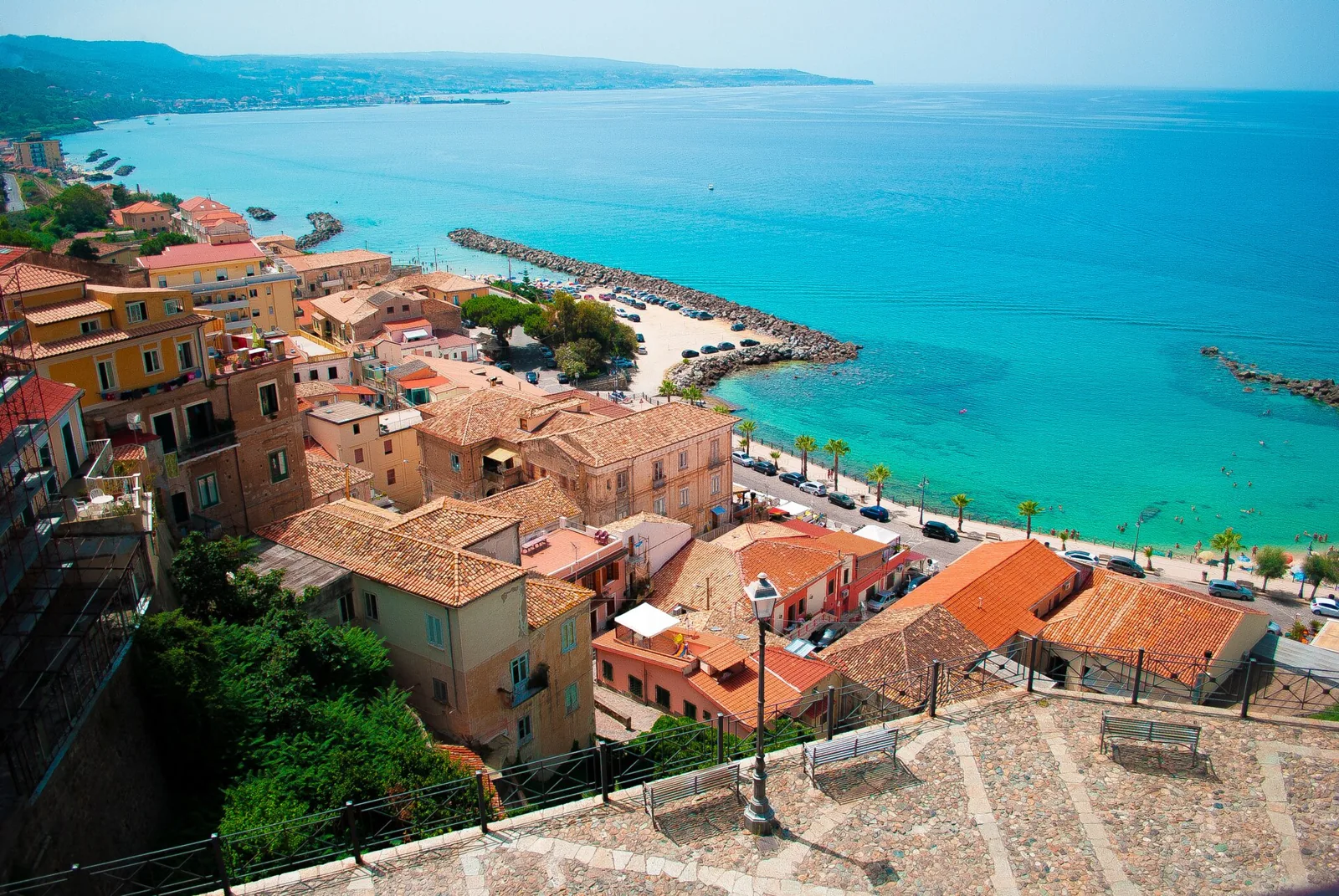
Another pillar of the town's identity is Castello Murat, a 15th-century Aragonese fortress that dominates the panorama of Marina di Pizzo. This castle became the scene of the tragic finale of the Napoleonic era, when Joachim Murat, Napoleon's brother-in-law and King of Naples, was imprisoned and shot here in 1815. Today visitors can tour Murat's cell, the Napoleonic museum, and the bastions, from which there are views over the entire Coast of the Gods.
| Attraction | Location | Visiting time | Ticket price (approximate) |
|---|---|---|---|
| Church of Piedigrotta | Via Riviera Prangi | 45 min | €3.50 |
| Castello Murat | Central Pizzo, Via P. Marincola/Piazza Musolino | 1 hour | Standard ticket around €5, reduced around €3.50; check current opening times before visiting |
| Piazza della Repubblica | Town centre | any | Free |
| Roman Baths of Acconia di Curinga | Acconia, about 18 km by car from Pizzo | 45–60 min | Usually free/open area, check locally |
Lovers of antiquity can drive to Acconia di Curinga, about 18 km by car from Pizzo, where the Terme Romane di Acconia are located. The Museo del Territorio di Curinga dates them to the 1st–2nd century AD; the complex covered about 1,000 m², and after further research about 2,000 m². It is a concrete trace of the Roman presence in the area and a good short stop while touring the inland side of the coast. In Pizzo itself, it is also worth seeking out the Mezza Praia Tower, which once served defensive functions and today serves as a landmark for walkers exploring the Tyrrhenian coastline.
Traditions and History of Pizzo Calabro – Pearl of Calabria
Pizzo Calabro is a centre with a deep cultural heritage, whose origins date back to the Roman period. The name Pizzo is linked to a local term for a rocky outcrop or the "beak" of the promontory on which the town stands. Its strategic location meant that Pizzo was for centuries an important trading point, but also a target of numerous pirate raids, which necessitated the construction of defensive fortifications.
In the 16th century, the Aragonese Castle, known today as Castello Murat, became the main element of the warning system against invaders. It was here that the dramatic events of 1815 unfolded, events that forever inscribed the town into the history books. The execution of Joachim Murat, who maintained his dignity to the last, asking the firing squad to "spare his face and aim for the heart", is still commemorated today during re-enactments and historical events.
Alongside the military history, sacred architecture flourished, symbolised by the Baroque Church of St George (Duomo di San Giorgio). The narrow, labyrinthine streets of the centro storico conceal numerous chapels and artisan workshops that have withstood the test of time. Contemporary Pizzo is not merely a resort, but a living town where the memory of the castle, churches and old coastal trades remains part of the everyday landscape.
Nature and Beaches of Costa degli Dei – Natural Treasures near Pizzo
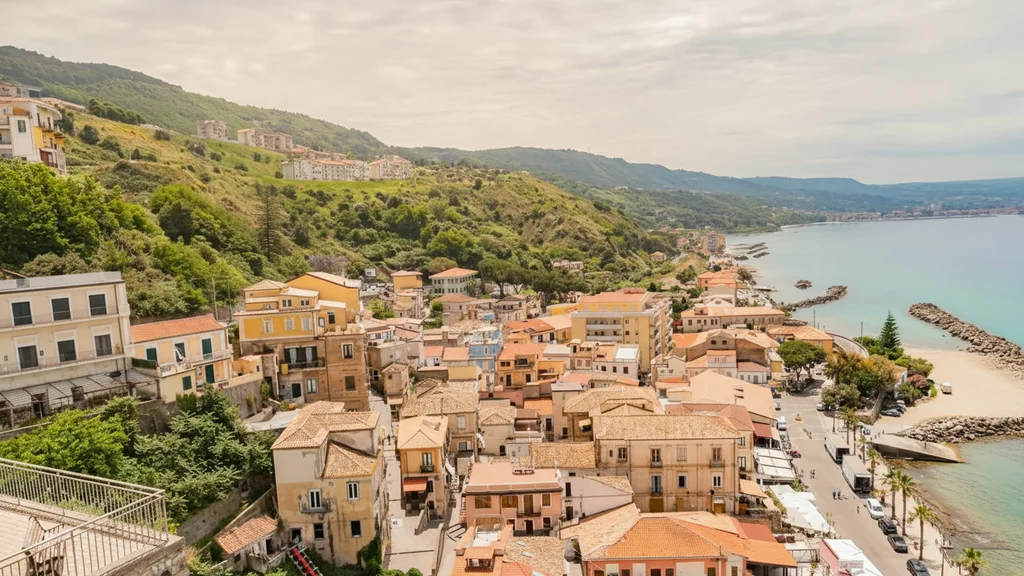
The Costa degli Dei, or Coast of the Gods, stretches for 55 kilometres, offering some of the most beautiful landscapes in all of Italy. Pizzo Calabro is the northern gateway to this stretch of coast, characterised by pale sand and turquoise water. Within the town itself, the most popular is Marina Beach, buzzing with life and surrounded by numerous cafés, making it a good choice for those who value comfort and proximity to urban amenities.
For those seeking peace and quiet, Marinella Beach or Piedigrotta Beach are good options, where rocky formations create intimate coves suitable for snorkelling. The coastal nature here works above all through contrasts of scale – the cliffside town, small beaches below the rocks and the open surface of the Tyrrhenian Sea are all within one walk. On clear days, the outline of the Stromboli volcano can be seen from the cliffs of Pizzo.
Travelling just 20 km southwards brings you to the famous Tropea, known for its Norman cathedral and spectacular cliffs. Another unmissable destination is Capo Vaticano, about 30 minutes' drive away, which offers some of the best diving conditions in the region. Costa degli Dei is a stretch of coast where it is easy to combine short swims, viewpoints and visits to historic towns.
Watch on YouTube
The Festival Heart of Pizzo Calabro – Colourful Events on the Calabrian Coast
Pizzo Calabro has a calendar based mainly on religious feasts, local history and summer food events. In summer, Pizzo hosts local food events and tastings, whose dates should be checked in the current municipal calendar or at the tourist information office. The most reliable points of the year are the celebrations of San Giorgio Martire, Madonna di Piedigrotta and the Muratian events, linked to the history of the castle and the execution of Joachim Murat.
The patron saint of Pizzo is San Giorgio Martire, whose feast falls on 23 April. Madonna di Piedigrotta has its feast on 2 July, and its most characteristic element is the sea procession led by the boat "Perla Nera". In October, the town returns to the events of 1815: the anniversary of Gioacchino Murat's landing and execution is linked to Muratian events around 8–13 October.
Year-round Culinary and Craft Traditions
Pizzo's culinary life is best seen in its gelaterias, bars and seasonal events, rather than in one fixed, year-round market. The easiest places to try local products are around Piazza della Repubblica and the marina, where tartufo appears alongside fish dishes, olive oil, spicy 'nduja and simple coastal snacks. In the summer season, the events programme can change, so check the municipality's current announcements before arriving.
Spring Processions and Religious Mysteries
On 19 March, Pizzo observes the San Giuseppe tradition, linked among other things to the distribution of pasta e ceci and blessed panini. Holy Week is a time of processions and services, which in the small centro storico have an intimate, local character. For visitors, it is a good moment to see Pizzo outside the summer peak, when the rhythm of the town is set by residents rather than the beach season.
The Summer Peak Season and Maritime Traditions
July and August are the time of the liveliest celebrations and evening events in the centre. On 2 July, the Festa della Madonna di Piedigrotta takes place: the effigy of the Madonna joins a sea procession led by the boat "Perla Nera". The patron saint of Pizzo is San Giorgio Martire, whose feast falls on 23 April; on 16 August, celebrations are held in honour of San Rocco.
Logistics and Practical Information for Travellers
When planning a visit to Pizzo Calabro, pay attention to the town's specific transport layout. The nearest airport is Lamezia Terme (SUF), about 25 minutes' drive away, which makes Pizzo a convenient first or last stop on a journey through Calabria. The town is also connected by rail, although it is important to remember that there are two stations: the local Pizzo station, closer to the marina, and the main Vibo Valentia-Pizzo station, used by some long-distance trains.
Trenitalia describes a practical rail-and-bus connection: take a regional train to Vibo Valentia-Pizzo station, then change to a Ferrovie della Calabria bus towards Pizzo/Istituto Nautico. This matters because Vibo Valentia-Pizzo station lies outside the strict centre of Pizzo, and if you arrive with luggage you need to plan the final part of the route. If your accommodation is by the marina or in the upper centro storico, check the final bus stop and timetable in advance.
For those travelling by car, an important piece of information is the presence of Limited Traffic Zones (ZTL) in the historic centre. The best option is to leave the vehicle in the free car park on Via M. Salomone and walk to Piazza della Repubblica (about 10 minutes). Bear in mind that Pizzo is built on a cliff – moving between the upper part of the town and the beaches requires climbing numerous steps, which may be challenging for people with limited mobility.
Pizzo Calabro – Frequently Asked Questions
What is tartufo from Pizzo and how does it differ from ordinary ice cream?
Tartufo di Pizzo is a traditional frozen dessert from Pizzo, usually made with chocolate and hazelnut ice cream, with a soft chocolate centre and a cocoa coating. What sets it apart from ordinary ice cream is its hand shaping into a ball and the liquid filling, which should flow onto the plate when the dessert is cut open.
How do you get to Pizzo Calabro – by train or by car?
A car offers the greatest freedom for exploring the Costa degli Dei, but Pizzo is well connected by rail. Regional trains stop at Pizzo station, close to the centre, while some long-distance services stop at Vibo Valentia-Pizzo station outside the centre; from there you can take a Ferrovie della Calabria bus to Pizzo/Istituto Nautico or a taxi.
Is the castle in Pizzo (Castello Murat) open to visitors?
Yes, Castello Murat is open to visitors. A standard ticket usually costs around €5, reduced around €3.50; check current opening times and prices before visiting. Inside you can see the museum dedicated to Joachim Murat, his cell, and the panorama of the coastline from the ramparts.
What beaches are near Pizzo Calabro?
Within the town itself there is the sandy Marina Beach. Nearby, it is worth visiting Piedigrotta Beach (by the rock-hewn church), the wild Marinella Beach, and the famous beaches at Tropea and Capo Vaticano, around 20–30 minutes' drive away.
How long does it take to visit Pizzo Calabro?
For a quick visit (castle, square, and tartufo) 3–4 hours are sufficient. However, to fully soak up the atmosphere of the town, visit the Piedigrotta church, and relax on the beach, it is worth dedicating a full day to Pizzo.
Where to buy the best tartufo in Pizzo – which gelaterias are authentic?
The best-known historic addresses are Gelateria Dante, Bar Ercole and Bar Belvedere on Piazza della Repubblica; ask for tartufo made on site using artisan methods.
Main attractions
Church of Piedigrotta
A cave cut into soft arenite/tuff rock above the beach, where sailors placed a painting of the Madonna in the 17th century. Stone sculptures carved from c. 1880 by Angelo and Alfonso Barone. Admission ~€3.50.
Castello Murat
15th-century Aragonese fortress – the prison and execution site of Joachim Murat in 1815. Napoleonic museum and panorama of the Coast of the Gods. Standard ticket ~€5, reduced ~€3.50.
Tartufo di Pizzo
Traditional frozen dessert with a soft chocolate centre, rolled in cocoa. Try an artisan version at Gelateria Dante or Bar Ercole on Piazza della Repubblica.
Roman Baths of Acconia di Curinga
Roman baths dated to the 1st–2nd century AD, located in Acconia di Curinga, about 18 km by car from Pizzo. Usually free/open area, check locally.
Costa degli Dei Beaches
Marina Beach in the centre, the secluded Marinella and Piedigrotta Beach for snorkelling. On clear days the Stromboli volcano is visible from the cliffs.
Getting there
Lamezia Terme airport (SUF) is about 30 km from Pizzo (around 25 min by car). Seasonal international routes vary by year; outside the summer season, many travellers connect via Rome, Milan or other Italian cities.
Car hire at Lamezia airport – to Pizzo about 25 min via the A2 motorway (Pizzo exit). ZTL in the centre – free parking on Via M. Salomone, about 10 min on foot to the square.
From Lamezia Terme station, take a regional train to Pizzo station (close to the centre and marina). If arriving at Vibo Valentia-Pizzo, you can change to a Ferrovie della Calabria bus to Pizzo/Istituto Nautico or take a taxi.
Regional connections with Lamezia Terme, Vibo Valentia and Tropea. At Vibo Valentia-Pizzo station, check Ferrovie della Calabria services to Pizzo/Istituto Nautico, as the station lies outside the town centre.
Near Pizzo Calabro
Last updated: