Costa Viola, known as the Violet Coast of Calabria, is one of the most distinctive stretches of coastline in southern Italy, extending for about 35 kilometres in the province of Reggio Calabria. It is defined by the violet-navy hue of the Tyrrhenian Sea, steep cliffs and the proximity of the Strait of Messina. The region forms the south-western tip of the Italian Peninsula, where the slopes of Aspromonte drop sharply towards the sea, creating one of Calabria's most striking landscapes.
From Reggio Calabria to Scilla is about 25 km, typically a 25–35 minute drive, while from Reggio airport to Scilla is around 30 km. From Lamezia Terme to Palmi is roughly 85–95 km and usually 1 hour 10 minutes to 1 hour 30 minutes by car. A good base is also Villa San Giovanni – the main ferry hub to Sicily, about 15 km from Scilla.
Table of Contents
- Top Attractions of Costa Viola – From Beaches to Historic Villages
- Living Traditions and Culture of the Violet Coast
- Ecosystems and Nature of the Violet Coast – Costa Viola's Treasures
- Beaches of Costa Viola – Hidden Gems of Calabria
- Costa Viola as a Driver of the Local Economy
- Historical and Mythical Heritage of the Violet Coast
Top Attractions of Costa Viola – From Beaches to Historic Villages
Costa Viola offers a strong combination of landscape, beaches and history. The northern end of the coastline is marked by Palmi, while the southern end is Villa San Giovanni. The Costa Viola area includes Palmi, Seminara, Bagnara Calabra, Scilla and Villa San Giovanni.
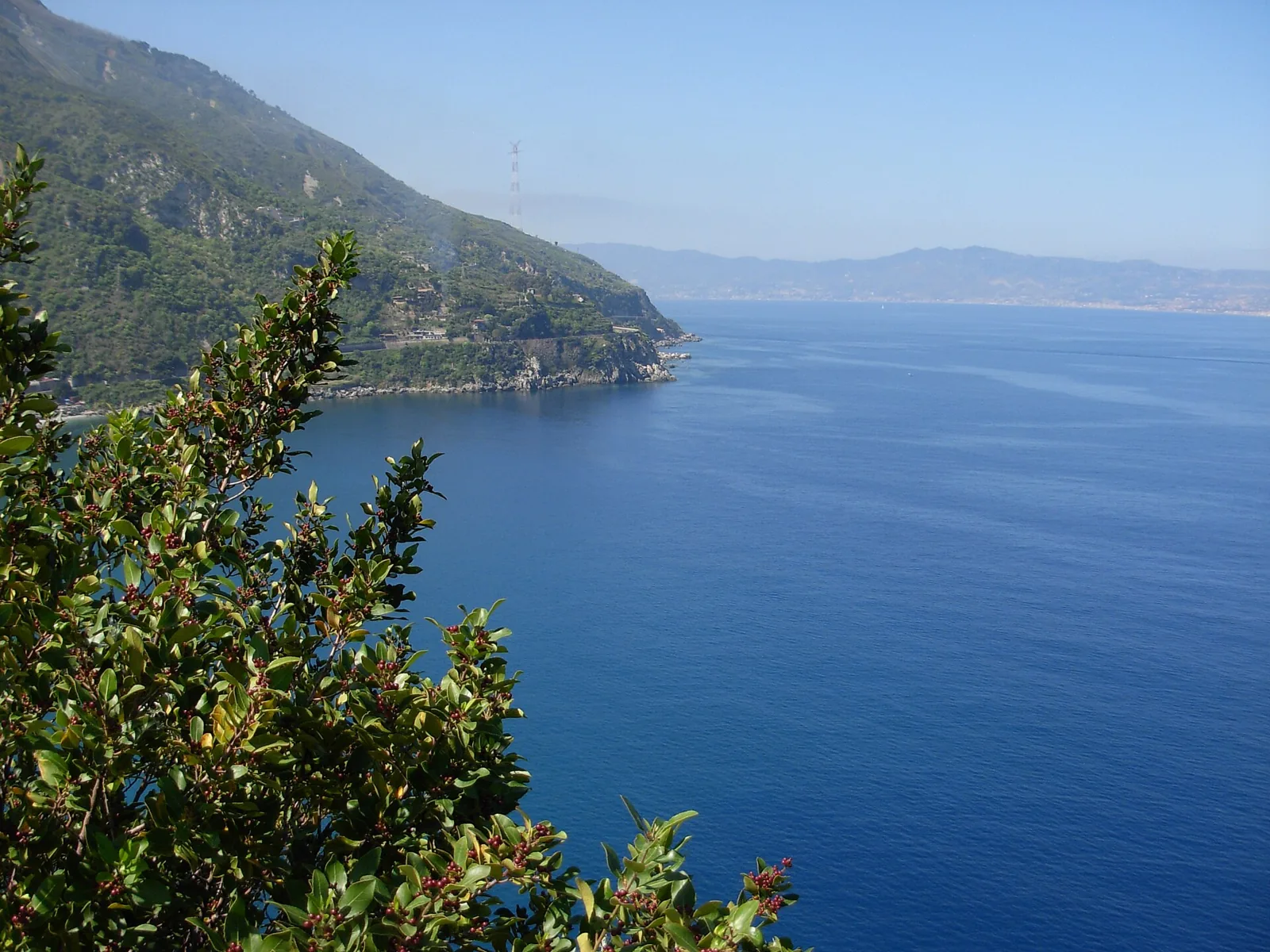
The present-day appearance of many Costa Viola towns is largely the result of natural disasters. Calabria was repeatedly struck by powerful earthquakes, particularly the series of tremors in 1783, which devastated local settlements. Further destruction came from the earthquake and tsunami of 1908, which is why many centres have not preserved compact medieval architecture to the same extent as other towns in southern Italy.
Beaches and Coves – Crystal-Clear Water and a Chromatic Phenomenon
The beaches of Costa Viola are among the most distinctive in Calabria, with clear water that attracts swimmers, snorkellers and those seeking peaceful boat trips along the cliffs. Marinella di Palmi beach is a good destination for families, while Cala Janculla, located on the coast between Palmi and Bagnara Calabra, is an option for those who prefer wilder surroundings. It is a cove that is harder to reach, often accessed by boat or kayak in calm seas.
The uniqueness of the local waters is tied to the region's name. According to local tradition, the violet tones of the sea and sky have been associated with this stretch of coast since antiquity, but the story linking the name to Plato should be treated as legend rather than confirmed historical fact. The effect is primarily an optical phenomenon – at dusk, the light, water clarity and reflections on the sea surface produce the characteristic violet-navy hues.
| Contributing Factor | Description of the Violet Colour Phenomenon |
|---|---|
| Sunset light | The low position of the sun changes the perceived colours of the sea and coast |
| Water clarity | Clear water intensifies the interplay of blue, navy and violet tones |
| Reflections and angle of light | Evening reflections on the sea surface amplify the optical effect of violet hues |
Charming Villages and Landmarks on Costa Viola
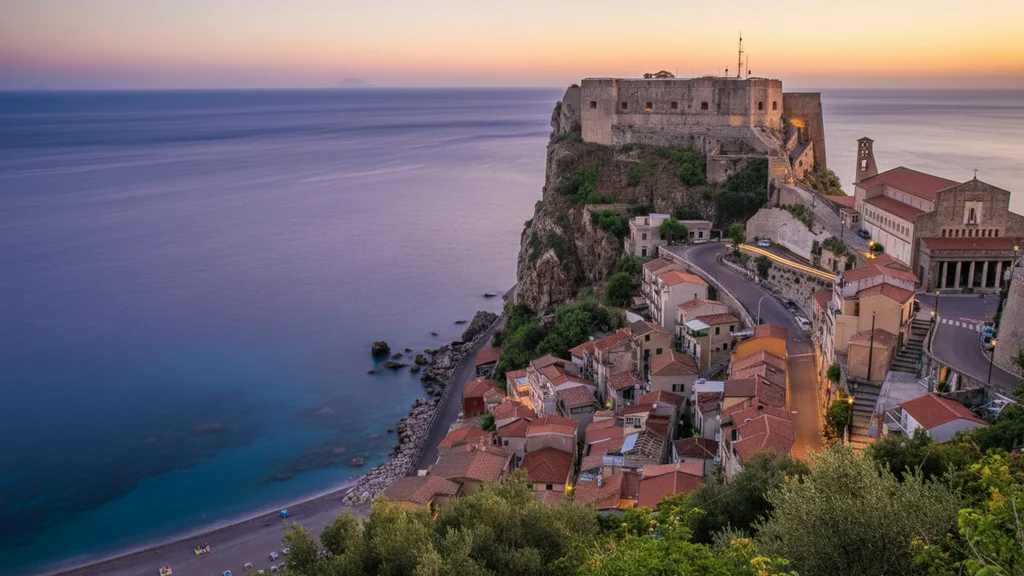
Palmi, regarded as a cultural hub of this stretch of coast, has much to offer in terms of historical attractions and viewpoints. Walking its streets helps you understand how influences from different eras have accumulated here, and a visit to the Casa della Cultura introduces the work of figures such as Leonida Repaci. Equally important is Scilla, where the fishing quarter of Chianalea and the castle on its rock form one of the most recognisable views in all of Calabria.
Casa della Cultura in Palmi is located on Via Felice Battaglia and brings several institutions together in one complex. These include the Museo di Etnografia e Folklore, Pinacoteca, Gipsoteca, Museo Musicale, Antiquarium and library. According to official information, it is open on Mondays, Tuesdays, Wednesdays and Fridays from 8:30 to 12:30, on Thursdays from 8:30 to 12:30 and 15:30 to 17:30, and closed on Saturdays and Sundays.
For active travellers, an excellent goal is Monte Sant'Elia, rising to approximately 579 metres above sea level and offering a wide panorama of the Tyrrhenian Sea. It is one of those viewpoints from which you can best see how the steep slopes drop straight down to the water. From Monte Sant’Elia you can see the Tyrrhenian Sea, the Strait of Messina, Sicily and, in good visibility, the Aeolian Islands.
Living Traditions and Culture of the Violet Coast
Costa Viola is a place rich in traditions connected with religion, the sea and craftsmanship. The region's inhabitants preserve religious festivals and traditional crafts, including the ceramics of Seminara, deeply rooted in local history. On Costa Viola, patron saint processions, pesca del pesce spada and Seminara ceramics remain important.
Festivals and Religion
Religious festivals still strongly shape the calendar of Costa Viola's towns, and the most important symbol of Palmi remains the Varia di Palmi. The feast is associated with the last Sunday of August, but the Varia itself does not take place every year in its full form. It is a processional spectacle symbolising the Assumption of the Blessed Virgin Mary, with the central structure carrying figures and roles of symbolic significance.
The current Varia Meccanica is 16 m high and weighs about 20 tonnes. It is carried by 200 ‘mbuttaturi on five wooden beams, which symbolise the old town corporations: Artigiani, Bovari, Carrettieri, Contadini and Marinai. The scale of the structure clearly shows why the event requires precise organisation and the involvement of the entire town community.
The Varia di Palmi was inscribed on the UNESCO Intangible Cultural Heritage list in 2013 as part of the serial entry "Celebrations of big shoulder-borne processional structures", together with other Italian processional festivals. For the town it is one of the most important religious events and a moment when tradition takes to the streets in a very concrete, physical form. Equally significant is the pilgrimage to the Sanctuary of Our Lady of Polsi, important for the entire Aspromonte area.
Mediterranean Cuisine and the Swordfish Tradition
The culinary tradition of the Violet Coast is built primarily on the sea and local recipes. The true king of local tables is swordfish, caught off Scilla and Bagnara using distinctive boats called feluca, also known as passarella, with a tall mast and long observation platform. The fishing season runs mainly from late spring to summer, which is when you are most likely to find the best fish.
Pesce spada alla Bagnarota is one of the most recognisable local preparations of swordfish. It typically features tomatoes, olive oil, capers, olives and aromatic additions, though there is no single obligatory recipe. Alongside fish dishes, remember Bagnara Calabra's sweet speciality – Torrone di Bagnara IGP, an EU-protected geographical indication, available in varieties including "Martiniana" and "Torrefatto glassato".
Local Crafts and Ceramics
Craftsmanship has always defined the identity of the local people, and the town of Seminara is renowned for its artistic ceramics production. Seminara is one of the most important centres of folk ceramics in Calabria, particularly associated with objects of protective and symbolic function. Characteristic forms include apotropaic masks, "bumbuli" or "bummuli", zoomorphic vessels and decorative heads.
The tradition has medieval and early modern roots, and many handmade objects remain something more than mere souvenirs to this day. In Seminara, ceramics are not just decoration – they are part of the local language of symbols, present in homes and workshops for generations.
Music and Dance
The most characteristic rhythm of Calabria remains the tarantella calabrese, performed to the accompaniment of the tambourine, organetto and Calabrian lyre. In the province of Reggio Calabria, this musical tradition is still very much alive, particularly during patron saint festivals and summer festivities.
On Costa Viola you feel this most strongly during processions and local celebrations in Palmi, Scilla and Bagnara. This is not just a performance for visitors, but part of communal celebration, where dance, religion and everyday life still intertwine.
Ecosystems and Nature of the Violet Coast – Costa Viola's Treasures
The natural uniqueness of the Violet Coast stems from its specific microclimate and the meeting of mountains and sea. Although the landscape is dominated by rugged cliffs, they conceal habitats for plant and animal species typical of southern Calabria. The best way to see this area is from the viewpoints above the Strait of Messina, where roads and paths reveal successive sections of the coast.
The most practical walking route for seeing Costa Viola from above is the Sentiero del Tracciolino on Monte Sant’Elia. Official Parco Aspromonte guides describe it as an escursionistico trail of about 8 km, with an elevation gain/loss of roughly +660/-660 m. Before setting out, check road access and the current condition of the path, as conditions on the steep coastal sections can change.
Vegetation and Landscapes of Costa Viola
Cliffs dropping straight into the sea create favourable conditions for Mediterranean scrub, which in spring fills the air with the intense scent of herbs. The region is also known for its terraced cultivation, where steep slopes support demanding harvests. The violet-navy hues of the sea, particularly visible at sunset, form a backdrop for rugged rocks and coastal formations such as the Ulivarella in the Tonnara di Palmi area.
Fauna and Optical Phenomena
In the waters of Costa Viola you can find swordfish, while the sky above the cliffs is often crossed by birds soaring over the slopes that drop towards the sea. One of the most extraordinary phenomena is the Fata Morgana in the Strait of Messina, but it should be stated straight away that this is a rare effect dependent on particular atmospheric conditions. When it does appear, it allows you to see distorted images of Sicily hovering above the horizon.
Beaches of Costa Viola – Hidden Gems of Calabria
Costa Viola offers a completely different type of beach from the better-known wide stretches of the Calabrian coast. Gravel, pebbles and stony coves predominate, which means the water stays very clear for a long time, though in practice water shoes are useful. Every cove has a different character – from easily accessible town beaches to places best reached from the sea.
Marina Grande in Scilla is the main and most easily accessible town beach. Chianalea is more of a port-fishing quarter and a place for strolling than a classic large beach. Tonnara di Palmi and Lido di Palmi are accessible by road from Palmi, while Cala Janculla remains a harder-to-reach beach, with a footpath descent that can be limited or demanding.
- Scilla and Chianalea – known as the Little Venice of the South, where fishermen's houses rise directly from the water and Castello Ruffo towers above the beach.
- Cala Janculla – considered one of the most beautiful wild beaches in Italy, located on the coast between Palmi and Bagnara Calabra, often most conveniently reached from the sea.
- Tonnara di Palmi – a more easily accessible beach, famous for the Ulivarella rock formation and good bathing conditions.
- Bagnara Calabra – a long sand-and-pebble beach with a promenade, suitable for families and for those who want to combine a swim with a seaside dinner.
Watch on YouTube
Costa Viola as a Driver of the Local Economy
This picturesque stretch of coastline has long had a clear impact on the local economy, primarily through tourism, services and fishing. In summer, activity around beaches, restaurants, accommodation and small marinas drives the life of towns such as Scilla, Bagnara Calabra and Palmi. This is an economy based more on local scale and seasonal rhythm than on large resorts.
An important role is also played by the region's traditional specialisations, especially swordfish fishing and the craftsmanship associated with Seminara. Improved road and rail connections make it easier to reach the coast, and the proximity of Villa San Giovanni further strengthens the significance of this area as a transit point between Calabria and Sicily. It is precisely this mix of everyday life, services and tradition that best explains Costa Viola's importance to the surrounding area.
Historical and Mythical Heritage of the Violet Coast
Costa Viola is a region where history intertwines with mythology and local memory. Over the centuries, this place has witnessed Byzantine, medieval and early modern influences, still visible today in the landscape and in stories connected with the strait. This is felt most strongly in Scilla, where mythical narrative meets the real geography of the strait.
Scilla is Costa Viola's most important mythological point: in Homer's Odyssey, Scylla and Charybdis symbolise the dangers of navigation in the Strait of Messina. Historically, the town controlled the strategic passage between Calabria and Sicily, and Castello Ruffo di Scilla stands on a promontory dominating the entrance to the strait. The current form of the castle is largely early modern after numerous rebuildings, but the defensive site itself is much older.
Byzantine and Medieval Heritage
In and around the municipality of Seminara, historical heritage connected to the Byzantine presence in this part of Calabria has been preserved. When speaking of Saints Elias and Filarete, it is better to think of a historical abbey and its tradition than of an active monastery in the heart of the town. This is an important trace of the former Byzantine rite influences that left a strong mark on the region's history.
Archaeology and Mythical Roots
The strongest myth of Costa Viola remains the tale of Scylla and Charybdis, which since Homer's time has given this coastline an aura of uncertainty and adventure. It is here that literature, geography and the history of seafaring merge into a single story about a strait that for centuries had to be not only admired but above all safely navigated. It is this combination of dramatic rock formations with the power of imagination that makes the Violet Coast linger long in the memory.
Frequently Asked Questions About Costa Viola
Where exactly is Costa Viola located?
Costa Viola stretches along the Tyrrhenian Sea in the province of Reggio Calabria, at the south-western tip of the Italian Peninsula, covering a stretch of approximately 35 km from Palmi to Villa San Giovanni.
Where does the name Violet Coast come from?
The name comes from the violet and navy tones visible over the sea at sunset. The story linking the name to Plato functions more as local tradition, and the phenomenon is best explained by the interplay of light, water clarity and evening reflections.
What are the most important towns in the region?
Key towns include Scilla with Chianalea, Bagnara Calabra, Palmi, and Seminara, known for its folk ceramics.
Which beaches on Costa Viola are worth visiting?
The most notable are Marina Grande in Scilla, Cala Janculla located on the coast between Palmi and Bagnara Calabra, Marinella di Palmi and Tonnara di Palmi with its famous Ulivarella rock. Bear in mind that gravel, pebbles and stony coves predominate on Costa Viola.
What is the best way to reach the Violet Coast?
The most convenient option is the A2 motorway, using the exits for Palmi, Bagnara Calabra or Scilla, or Trenitalia regional trains on the Tyrrhenian line, which serve stations including Villa San Giovanni, Scilla, Bagnara Calabra and Palmi. The nearest airports are Reggio Calabria and Lamezia Terme.
Top Attractions of Costa Viola
Scilla and Chianalea
The Little Venice of the South – fishermen's houses rising from the water and the majestic Castello Ruffo towering above the beach.
Monte Sant'Elia
Viewpoint at approximately 579 m above sea level with a panorama of the Tyrrhenian Sea, the Strait of Messina, Sicily and, in good visibility, the Aeolian Islands.
Palmi – Cultural Centre
Rocky terraces with views, the Casa della Cultura and a town shaped by the turbulent history of this coastline.
Cala Janculla
One of Italy's most beautiful wild beaches, harder to reach, often accessible from the sea, surrounded by high cliffs.
Varia di Palmi
The most important religious spectacle of Palmi, inscribed on the UNESCO list as part of the tradition of big shoulder-borne processional structures.
Seminara – Ceramics and Abbey
Famous apotropaic masks and folk ceramics, together with the historical tradition of the abbey of Saints Elias and Filarete.
How to Get to Costa Viola
From Poland to Lamezia Terme (SUF) – seasonal direct Ryanair flights; outside the season via Rome or Milan. Reggio Calabria airport is closer to Costa Viola (REG, about 30 km from Scilla) – direct flights from Katowice (Ryanair) and from Rome and Milan. From both airports, it is convenient to rent a car or continue by train.
Take the A2 Salerno–Reggio Calabria motorway – exits for Palmi, Bagnara Calabra or Scilla. From Reggio Calabria to Scilla is typically 25–35 minutes, and the SS18 runs along the coast with sea views.
Trenitalia regional trains run along the Tyrrhenian line with stops including Villa San Giovanni, Scilla, Bagnara Calabra and Palmi. A convenient option for travelling between coastal towns without a car.
Regional connections run between the larger towns, but their frequency and convenience usually fall short of the trains. From Reggio Calabria airport, Linea R1 "Aeroporto dello Stretto - Villa - Scilla - Bagnara - Palmi" can be useful. The published timetable lists stops including Aeroporto Reggio Calabria, Scilla Castello Ruffo / the Chianalea area, Bagnara Calabra and Palmi. Before travelling, check the current timetable, especially outside the season.
Near Costa Viola
Last updated: