Piedigrotta Church is a cave chapel carved into soft sedimentary rock directly above the sea – one of the most extraordinary sacred sites in all of Italy. Created out of gratitude by shipwrecked sailors, then expanded over decades by local sculptors who coaxed dozens of biblical figures from the living rock. It is a place where nature, faith, and folk art intertwine in a way you will not find anywhere else in Pizzo or the whole of Calabria.
Table of Contents
The shipwreck legend – how the church was born
According to local tradition, at the end of the 17th century a ship carrying Neapolitan sailors was wrecked off the coast of Pizzo; the legend is also linked to the ship’s bell dated 1632. As waves smashed the hull, the captain and crew prayed before a painting of the Virgin Mary carried on board, vowing to build a chapel in her honour if they survived. The ship sank, but every sailor reached the shore alive.
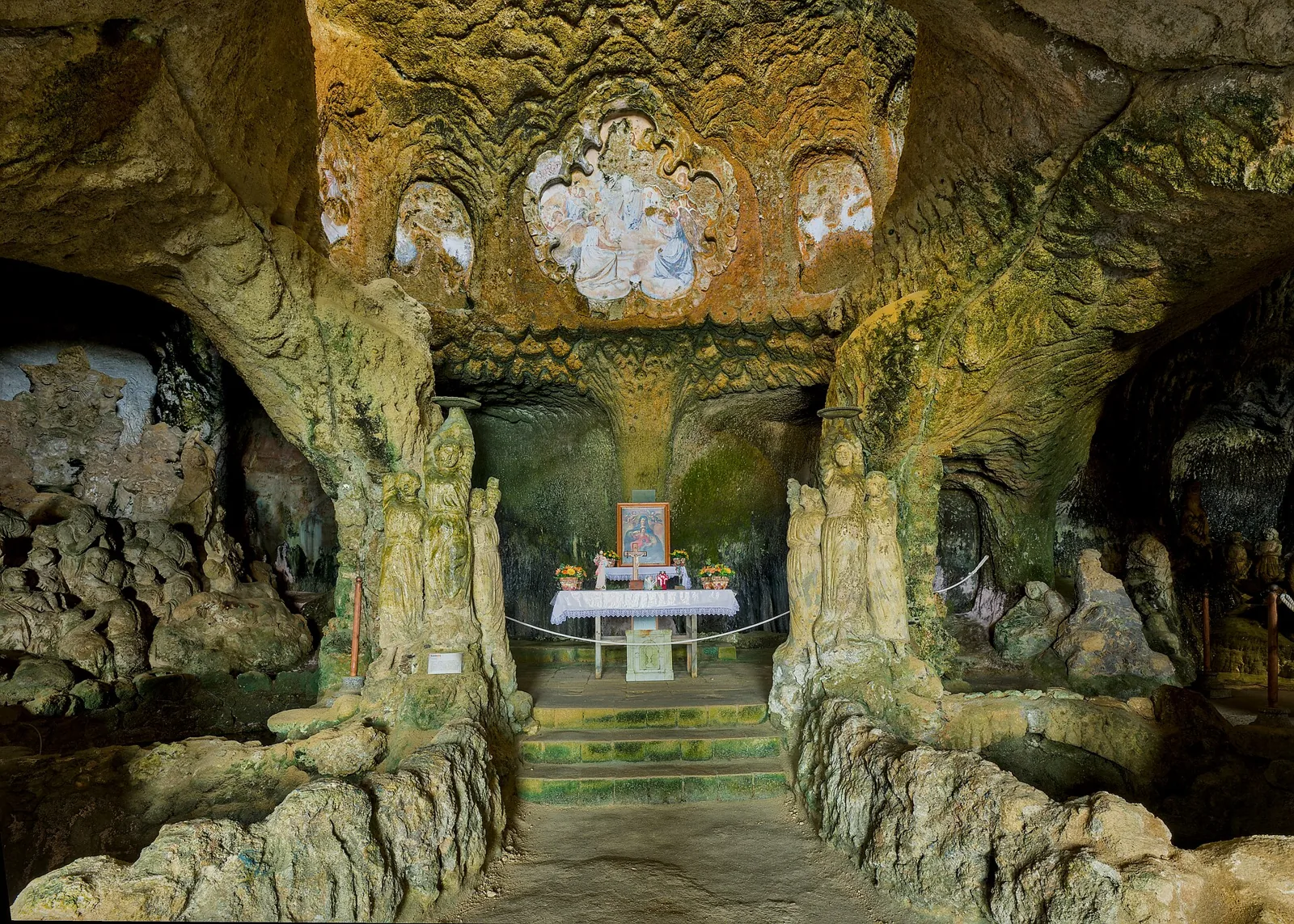
On the beach, among the wreckage, they found the surviving painting of the Madonna and the ship’s bell. They took it as a divine sign – placed the painting in a small grotto hollowed into the cliff, and so the Chiesetta di Piedigrotta was born. The image of the Madonna di Piedigrotta remains the centre of devotion; however, to be precise, after restoration the original painting was not always displayed inside the grotto itself, and the altar is described as holding a copy or image.
The local legend needs to be separated from the later, better-documented history of the site. The tradition of the shipwreck and the painting of the Virgin relates to the origins of the sanctuary, while the current appearance of the interior is the result of sculptural work carried out in the 19th and 20th centuries. Angelo Barone began the main work around 1880; after him it was continued by his son Alfonso Barone, and in the late 1960s Giorgio Barone restored some of the sculptures and added new elements.
Watch on YouTube
Sculptures from rock – the work of the Barone family
For nearly two centuries, the chapel remained a modest place of prayer. The essential sculpting and expansion of the interior began only in the second half of the 19th century, when Angelo Barone started transforming the grotto into a stone narrative of faith. Working by hand in the soft sedimentary rock, he carved saints, scenes from Scripture, and episodes from the life of Christ.
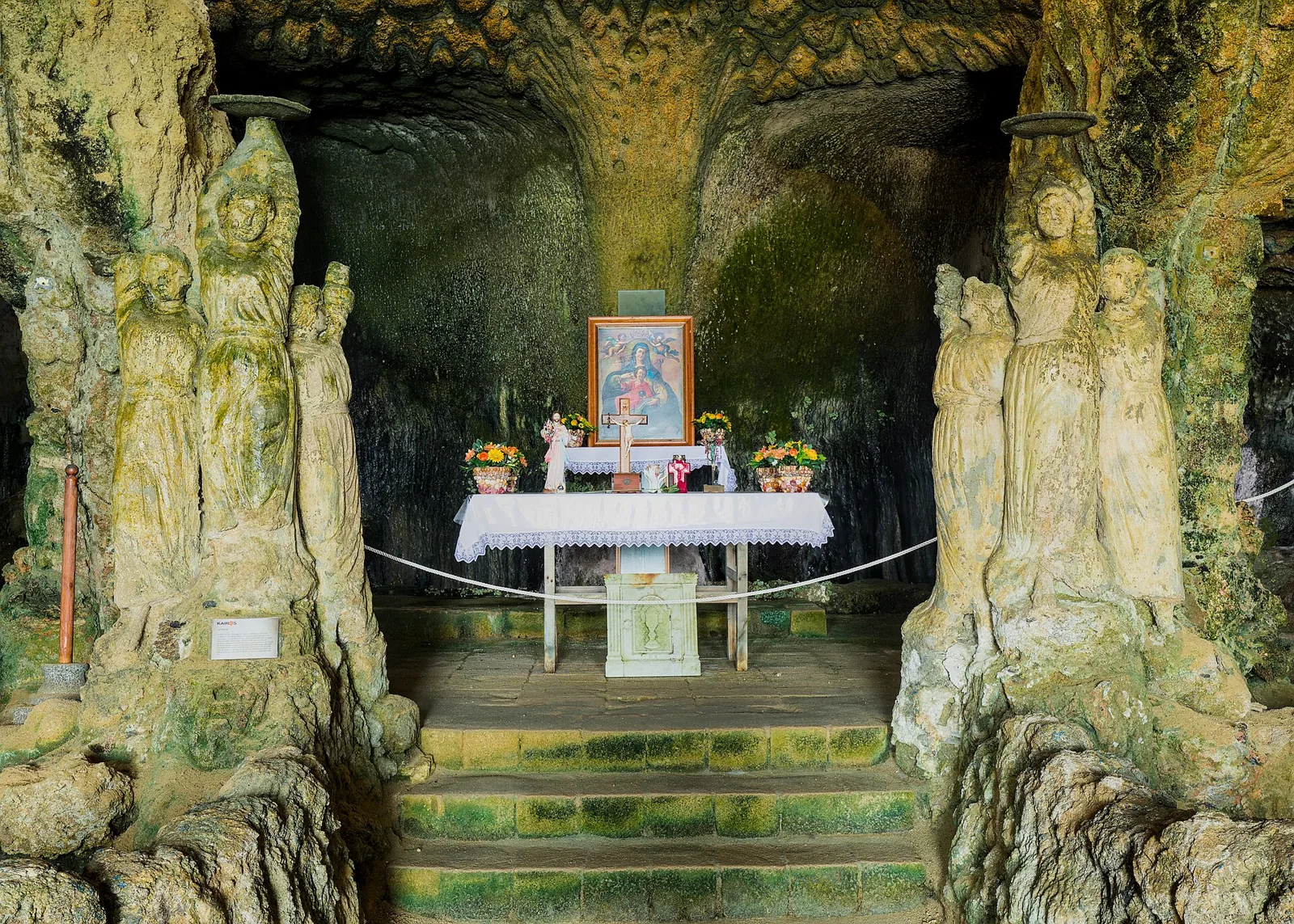
After Angelo, the work was continued by his son Alfonso Barone, and in the late 1960s Giorgio Barone, after returning from Canada, restored some of the damaged sculptures and created, among other works, medallions of John XXIII and John F. Kennedy. Thanks to successive generations, the grotto was further deepened, shaped and gradually filled with figures. The result today is not the product of a single moment but of many stages of work spanning the 19th and 20th centuries.
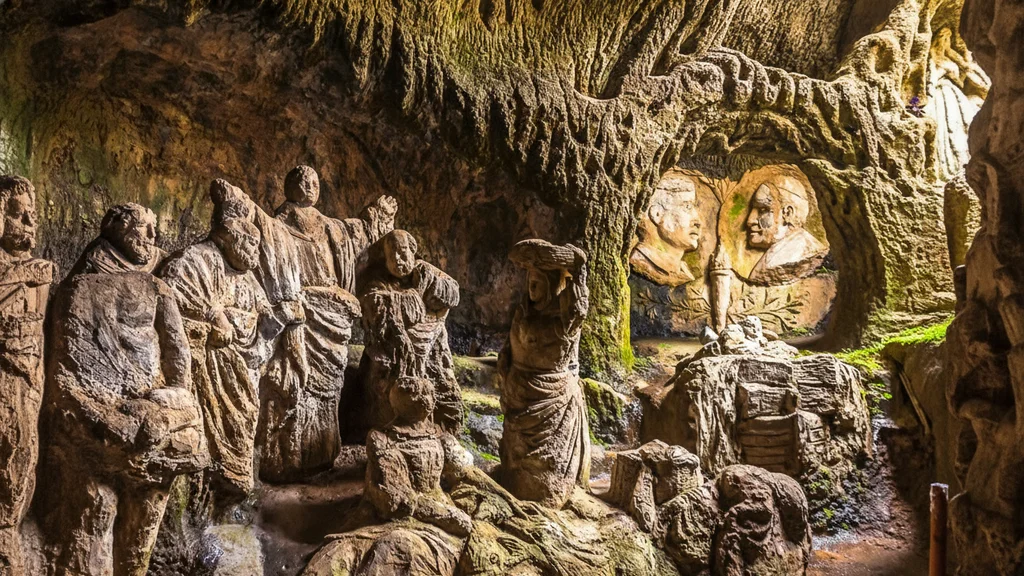
Inside, dozens of figures carved directly from the rock depict scenes from the life of Jesus, saints and devotional groups. Some sculptures are fully three-dimensional, others take the form of reliefs, and the grotto itself retains an irregular character with successive chambers and niches hollowed out in stages. Alongside the figures, frescoes attributed to Alfonso Barone have also survived, including scenes described as a pilgrimage to Lourdes, a ship in a storm, the Battle of Lepanto, the marriage of the Madonna, and a medallion with the Ascension. Many of these paintings are now in poor condition because the interior has long been exposed to damp and salt.
Among the most notable scenes:
- The Nativity – the Presepe/Natività, with Mary, Joseph and shepherds carved into a natural rock niche
- San Francesco di Paola – the saint shown during his miraculous crossing of the Strait of Messina on his cloak
- The multiplication of the loaves and fishes – one of the confirmed biblical scenes in the grotto’s rock-carved decorative programme
- Madonna di Piedigrotta – the image surrounded by local veneration, set in the central altar niche
Descriptions of the interior also mention the Madonna di Pompei, Sant’Antonio da Padova with orphans, the Sacro Cuore di Gesù and Cuore di Maria, the Madonna di Lourdes, San Giorgio slaying the dragon, and Santa Rita crowned by the Angel of Death. This selection captures the character of Piedigrotta well: it is not a museum-like decoration following a single programme, but a stone catechism built up over many years, where Gospel scenes stand alongside locally venerated saints and Marian figures.
The rock from which the cliff is made is a soft sedimentary rock – often popularly described as “tufo”, and in newer descriptions as sandstone/calcarenite – which made it possible to hollow and carve the interior by hand. It is precisely this property that allowed successive creators to gradually hollow out chambers and give the figures their characteristic softness of form.
Visiting and practical information
Piedigrotta Church lies about 1.5–2 km north of the historic centre of Pizzo, along the coastal road SS522 / Via Riviera Prangi. Access is via steps down to the beach, so comfortable shoes really are useful. From Piazza della Repubblica, the drive takes about 5 minutes, and the walk usually 20–30 minutes.
Allow 15–30 minutes for the interior itself. According to the update of 28 June 2026, a standard ticket costs €5.00, a reduced ticket €3.50, and a combined ticket with Castello Aragonese costs €8.00 standard / €6.50 reduced. For the period from 01.03.2026 to 31.10.2026, the listed opening hours are 9:00–13:00 and 15:00–18:00, while in winter closing is at 17:00. These details should be checked again before publication and before your visit, because prices and opening hours can change seasonally.
The Festa della Madonna di Piedigrotta takes place on 2 July and is preceded by a novena. The most distinctive moment is the sea procession: the image of the Madonna travels by boat on the “Perla Nera”, decorated with flowers and small flags. This is when it becomes clearest that this is not merely a tourist attraction but a living sanctuary rooted in the maritime religiosity of Pizzo. Photography is allowed without flash, and even in summer the interior stays pleasantly cool.
Chiesa di Piedigrotta is one of the most recognisable places of worship and symbols of Pizzo, combining popular religiosity, memory of the sea and the votive traditions of seafarers. For locals it is not just an extraordinary grotto above the beach but also part of the town's maritime identity.
After your visit, combine it with Castello Murat in the town centre and a stroll ending at Piazza della Repubblica, where a tartufo di Pizzo awaits.
Piedigrotta Church – frequently asked questions
Who carved the statues in Piedigrotta Church?
The main work was begun in the second half of the 19th century by Angelo Barone. After him, the work was developed by his son Alfonso Barone, and in the late 1960s Giorgio Barone restored some of the damaged sculptures and added, among other works, medallions of John XXIII and Kennedy. The figures were carved by hand in the soft sedimentary rock.
How was the cave church created?
According to local tradition, the origins of the sanctuary are linked to a shipwreck at the end of the 17th century; the legend is also connected with the ship’s bell dated 1632. The surviving sailors are said to have placed a painting of the Virgin Mary from their ship in a grotto. The simple chapel was later expanded and sculpted in the 19th and 20th centuries.
Is Piedigrotta Church open all year?
Opening hours are seasonal. According to the update of 28 June 2026, from 01.03.2026 to 31.10.2026 the listed hours are 9:00–13:00 and 15:00–18:00, with winter closing at 17:00. Admission is paid; in the same update, a standard ticket costs €5.00, a reduced ticket €3.50, and a combined ticket with Castello Aragonese €8.00 standard / €6.50 reduced.
When does the sea procession of the Madonna di Piedigrotta take place?
The Festa della Madonna di Piedigrotta takes place on 2 July and is preceded by a novena. In the sea procession, the image travels by boat on the “Perla Nera”, decorated with flowers and small flags.
Last updated: