'Nduja is a fiery, spreadable pork sausage born in the tiny village of Spilinga on Calabria's Monte Poro plateau. Made from just three ingredients – pork, chili peppers and salt – it has become a culinary symbol of Calabria recognized around the world. It is simple, fatty, very spicy and used in cooking more as an intense seasoning than as an ordinary cured meat.
Table of Contents
Origins and history – how 'nduja was born
The name 'nduja sounds mysterious, but its genealogy is not fully settled. The most commonly cited connection is to the French andouille; other etymologies are best treated as hypotheses rather than certainties. What is certain: 'nduja in its current form is a Calabrian product, closely linked to Spilinga in the province of Vibo Valentia.
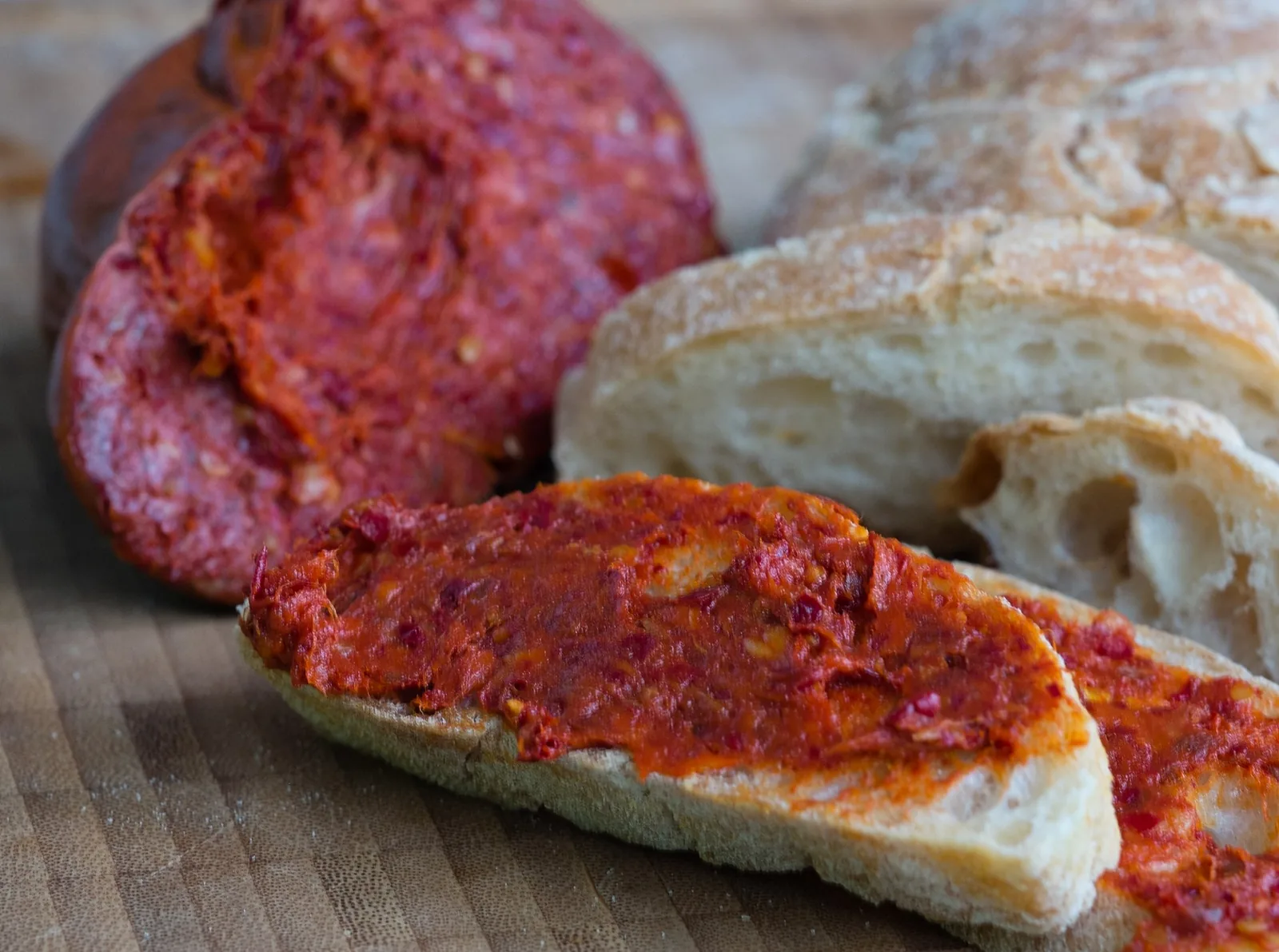
Production likely began in the 18th or 19th century, when Calabrian peasants needed to use every scrap of pork after the winter slaughter. Fatty trimmings, jowls, cheeks – the parts that wealthier families did not want – were ground together with generous amounts of local peperoncino. However, Capsicum peppers only reached Europe after Columbus's voyages, from the late 15th and into the 16th century, so any form of 'nduja in its familiar spicy version is by nature a modern-era product.
The chili pepper was not a casual addition. Peperoncino aided preservation, but salt, smoking, and aging also played crucial roles. This is a classic example of cucina povera that grew from a local product into a recognizable ingredient beyond Italy as well.
For centuries, 'nduja remained a secret of the surrounding villages. The turning point came in 1975, when Spilinga organized the first Sagra della 'Nduja – a festival customarily held in early August, though the exact date is worth checking for each edition. From around 2015–2016, 'nduja experienced a boom in the United States and the United Kingdom, appearing on menus at restaurants in New York and London.
In rural Calabria, the traditional winter pig slaughter fell between December and February. The principle non si butta via niente del maiale explains well why fattier and less noble cuts ended up in 'nduja. This product belongs to the local norcineria tradition of the Monte Poro area and Spilinga, alongside other pork specialities of the region.
Ingredients and production – what makes real 'nduja
The recipe for authentic 'nduja from Spilinga is radically simple. The base consists of fatty pork cuts, salt, and a significant amount of peperoncino, the proportion of which varies by producer. No colouring, no preservatives, no unnecessary additions – what matters is the quality of the raw materials and the feel for the right proportions.
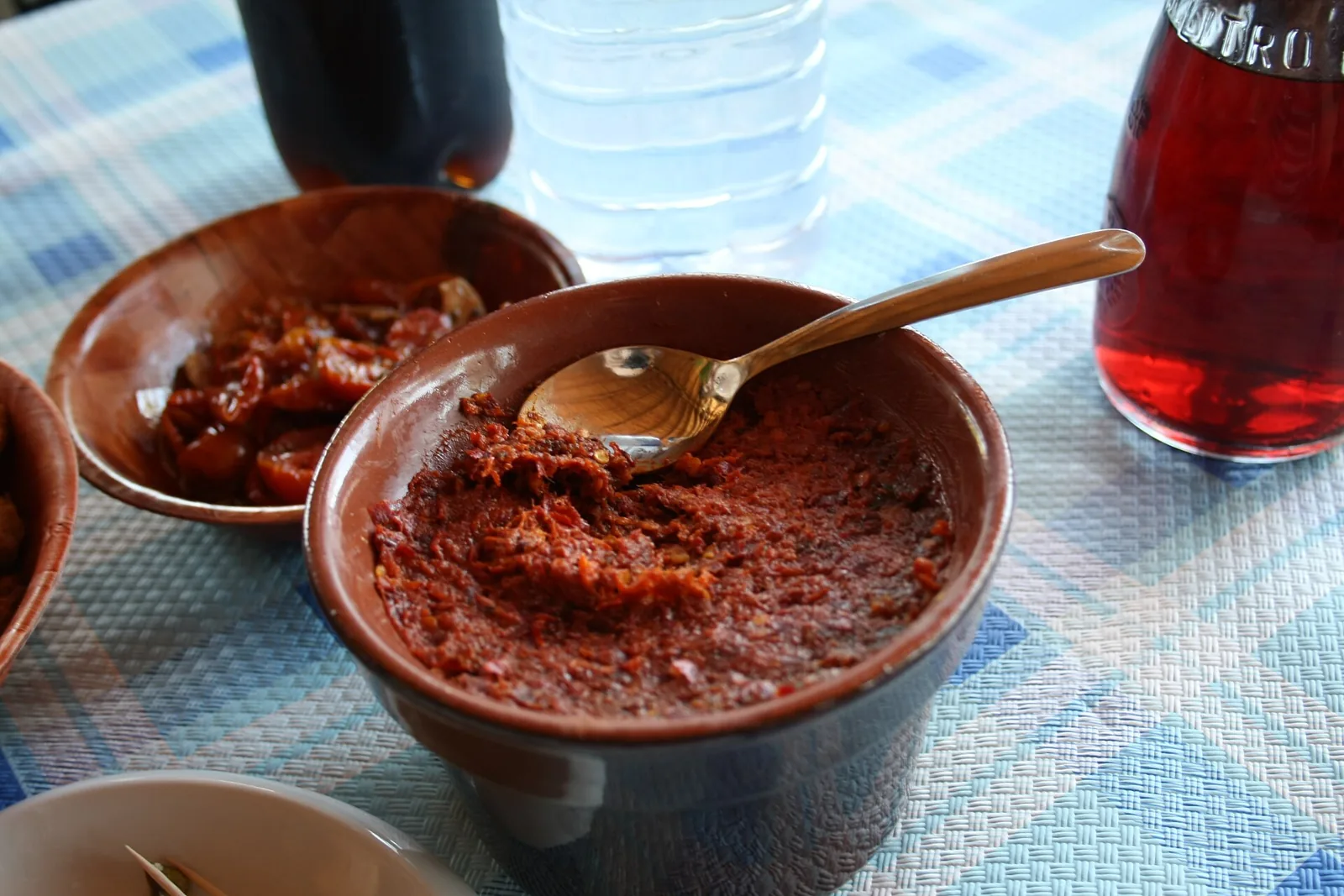
The production process follows several key stages:
- Meat selection – fatty cuts of pork are used: jowls, cheeks, trimmings from various cuts, and fatback (guanciale and lardo)
- Grinding – the meat and dried chili peppers are ground together into a fine, uniform paste
- Stuffing – the paste is packed into natural casings – traditionally the cecum (blind gut), which gives 'nduja its characteristic thick shape
- Smoking – the stuffed casings are smoked, though methods vary by producer
- Aging – the product matures for 3 to 6 months in cool, well-ventilated rooms
The result is a soft, creamy paste with an intensely red colour that spreads with a knife like butter. This texture sets 'nduja apart from most Italian salumi – it is one of the most well-known spreadable sausages.
| Feature | 'Nduja from Spilinga | Typical salami piccante |
|---|---|---|
| Texture | Creamy, spreadable | Firm, sliced into rounds |
| Chili pepper content | Significant, varies by producer | Usually lower and dependent on the recipe |
| Casing | Traditionally cecum/orba; other calibres are possible | Variable: natural, collagen or synthetic depending on the product |
| Aging | 3–6 months | 1–3 months |
| Serving method | Spreading, melting into sauces | Slicing, serving on a board |
How to eat 'nduja – traditional and modern uses
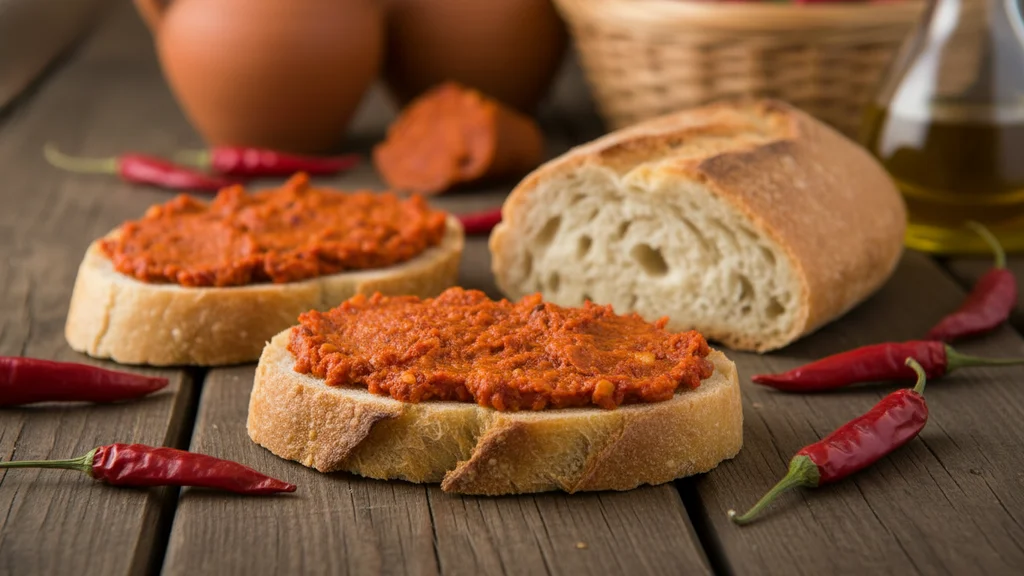
In a Calabrian household, 'nduja is like butter or olive oil – always within reach, good with many simple dishes. The simplest way is to spread it on a slice of toasted bread (bruschetta con 'nduja). The warm bread gently melts the fat and quickly releases the aroma of peperoncino.
The most popular ways to use 'nduja in Calabrian cooking:
- Pasta con 'nduja – melt a spoonful into olive oil with sliced Tropea onion, add tomato passata and simmer for 20–30 minutes; serve with maccheroni, penne or fusilli
- 'Nduja pizza – added 5–10 minutes before the end of baking so it melts without burning; excellent with buffalo mozzarella or gorgonzola
- Frittata – chunks of 'nduja mixed into beaten eggs for a simple, fiery meal
- 'Nduja arancini – a locally found and contemporary variation of fried rice balls, rather than a classic symbol of Calabrian street food
- Ragu alla 'nduja – stirred into a slow-cooked meat sauce for a fiery, deep flavor
- With cheese – paired with aged Pecorino del Monte Poro or with ricotta for a contrast to the heat
If you want to stay with products from the area closest to Spilinga, look for the name Pecorino del Monte Poro. This cheese has held DOP status since 2020, and its production area covers municipalities in the province of Vibo Valentia within the Monte Poro district, including Spilinga, Ricadi, Tropea, Drapia, Zungri and Vibo Valentia. Aged pecorino stands up well to the heat of 'nduja because it has a pronounced, salty flavour and firm texture.
In home cooking, 'nduja is most often spread on warm bread or melted in a little olive oil as a sauce base. In practice, a small amount suffices – roughly 20–30 g for 2 servings of pasta usually gives a noticeable heat. Warming quickly releases the fat and peperoncino aroma, so it is better to add it briefly than to fry it hard over high heat.
The global rise of 'nduja has opened new uses beyond Calabrian cooking. Chefs in London and New York tuck it into burgers, spread it on avocado toast, and stir it into seafood pasta. One of the most inspired combinations is 'nduja with honey – the pepper heat meets sweetness, creating a surprisingly harmonious pairing.
Watch on YouTube
Where to try 'nduja in Calabria
Spilinga is the obvious pilgrimage site for any 'nduja enthusiast. This village of fewer than 2,000 residents has long been associated with the local tradition of making this spicy sausage. Several local workshops and artisan producers operate here, and the topic of name protection regularly comes up in discussions about the product's future and efforts toward IGP (Protected Geographical Indication) certification.
The best occasion for tasting is the annual Sagra della 'Nduja, organised since 1975. The sagra takes place on 8 August; the official municipal announcement lists the 49th edition for 8 August 2025 and the 50th edition for 8 August 2026. During the festival, the entire town transforms into a giant open-air dining room. Stalls serve 'nduja in many forms – on bread, in pasta, on pizza, even in desserts.
Spilinga lies in the province of Vibo Valentia, in the Monte Poro area, about 12–15 km by road from Tropea, about 5 km from Ricadi and about 8 km from Capo Vaticano. The easiest way to get there is by car from Tropea – the drive usually takes 15–20 minutes. If travelling by train, the nearest major station is Tropea on the Tyrrhenian line, and the nearest airport is Lamezia Terme (SUF), about 60 km by road from the Tropea and Spilinga area. Public transport is also possible: Ferrovie della Calabria operates bus line 237 on a route including Spilinga, Ricadi, Tropea, Parghelia, Vibo Marina, Pizzo, Lamezia Terme Airport and Catanzaro. Timetables are seasonal, so check the current departure times before travelling.
Beyond Spilinga, you will find 'nduja across the region. In Tropea, many trattorias and Calabrian restaurants serve pasta or bruschetta with 'nduja. In Cosenza, you can try modern interpretations at new Calabrian cuisine restaurants. At markets, delicatessens and regional food shops in many Calabrian towns, you can also buy jars of 'nduja – a convenient format for gifts or stocking up before the journey home.
A few practical shopping tips:
- Look for "prodotto a Spilinga" on the label – the name "di Spilinga" is not yet legally protected, so check the producer's address
- Good 'nduja has a deep red color, an intense pepper aroma and a creamy consistency
- In retail, you will most commonly find 'nduja in natural casing and in jars; typical jar sizes are around 180 g, 200 g, and 314 g, while casings usually range from about 300 g to 500 g
- For tourists, a jar is often more practical – easier to portion after opening and more convenient to transport by plane
- Once opened, store in the refrigerator and follow the date given by the producer on the label
Protected status and the future of 'nduja
'Nduja from Spilinga holds P.A.T. (Prodotto Agroalimentare Tradizionale) status – official recognition by Italy's Ministry of Agriculture as a traditional food product. In the national P.A.T. list for Calabria, 'Nduja appears in the category "Carni (e frattaglie) fresche e loro preparazione" under number 26. This is an important but insufficient level of protection. The producers' consortium has been pursuing IGP certification for years, which would grant 'nduja from Spilinga European Union-level protection – similar to Tropea's red onion (Cipolla Rossa di Tropea IGP).
P.A.T. is Italy's national list of traditional agri-food products, based on documented production tradition of at least 25 years. IGP/PGI is an EU-level system of geographical name protection, requiring a product specification and compliance controls. Regione Calabria explains that a geographical name in the P.A.T. list serves to identify the product and does not constitute protection of origin; DOP/IGP products should not remain in the P.A.T. register. In other words, P.A.T. confirms tradition but does not provide the same strong name protection on the EU market as IGP.
The problem is that 'nduja's international success has spawned a wave of imitations. Supermarket shelves across Europe now carry products labeled "'nduja" that were manufactured far from Calabria, often with entirely different ingredient ratios. Until IGP certification is granted, consumers must verify the product's origin themselves. This is one more reason why tasting 'nduja on site, in Spilinga or nearby, allows you to better experience the local style and get to know the producers.
You can learn more about the history and production of 'nduja in the Wikipedia article dedicated to this remarkable product.
'Nduja – frequently asked questions
What exactly is 'nduja?
'Nduja is a soft, spreadable pork sausage from Calabria, originating in Spilinga in the province of Vibo Valentia. Unlike firm salami, 'nduja has a creamy texture thanks to its high fat content and a significant proportion of chili peppers, which varies by producer. It is eaten spread on bread, melted into pasta sauces or added to pizza.
How spicy is 'nduja?
'Nduja is distinctly spicy and among the hotter traditional products in Italy. Its heat is balanced by the richness of the pork fat, so the flavour is intense but not one-dimensional. If you are not accustomed to spicy food, start with a small amount on a piece of bread.
Does 'nduja have DOP or IGP certification?
'Nduja currently holds P.A.T. (Prodotto Agroalimentare Tradizionale) status – recognition from Italy's Ministry of Agriculture. The producers' consortium in Spilinga has been working toward IGP (Protected Geographical Indication) certification at the European Union level, but the process has not yet been completed.
When is the 'nduja festival in Spilinga?
The Sagra della 'Nduja takes place annually in Spilinga on 8 August. The official municipal announcement lists the 49th edition for 8 August 2025 and the 50th edition for 8 August 2026. During the celebration you can taste 'nduja in many variations, accompanied by concerts and artisan demonstrations. Arrive early, because the village fills up quickly.
How should I store 'nduja bought in Calabria?
Unopened 'nduja in its natural casing will keep for several months in a cool, dark place. Once opened, store it tightly wrapped in the refrigerator – shelf life depends on the producer and the label. The jarred version is easier to transport, but after opening you should follow the producer's label; it usually requires refrigeration and consumption within a few days to a few weeks. You can also freeze portions of 'nduja for several months.
Last updated: