Calabria, a land full of sunshine and history, holds many remarkable places. One of them is MAB Museo all'Aperto Bilotti – an open-air art gallery located in the heart of Cosenza. This museum, accessible around the clock without tickets or gates, fits so naturally into the urban fabric that art becomes part of an ordinary walk. Walking along Corso Mazzini, you can see sculptures placed along one of the city's most important pedestrian streets.
Table of Contents
Cosenza as an Open Gallery – History of MAB Museo all'Aperto Bilotti
MAB (Museo all'Aperto Bilotti) in Cosenza is an example of an urban art exhibition that goes beyond the traditional walls of a gallery. The project was born alongside the redesign and pedestrianisation of Corso Mazzini at the beginning of the 21st century, when the main promenade of the modern part of the city began to change into a representative walking axis. Corso Mazzini was transformed into a pedestrian street in 2002, creating the basis for the later museum route. From the start, the museum was conceived as an open space, freely accessible to residents and visitors alike.
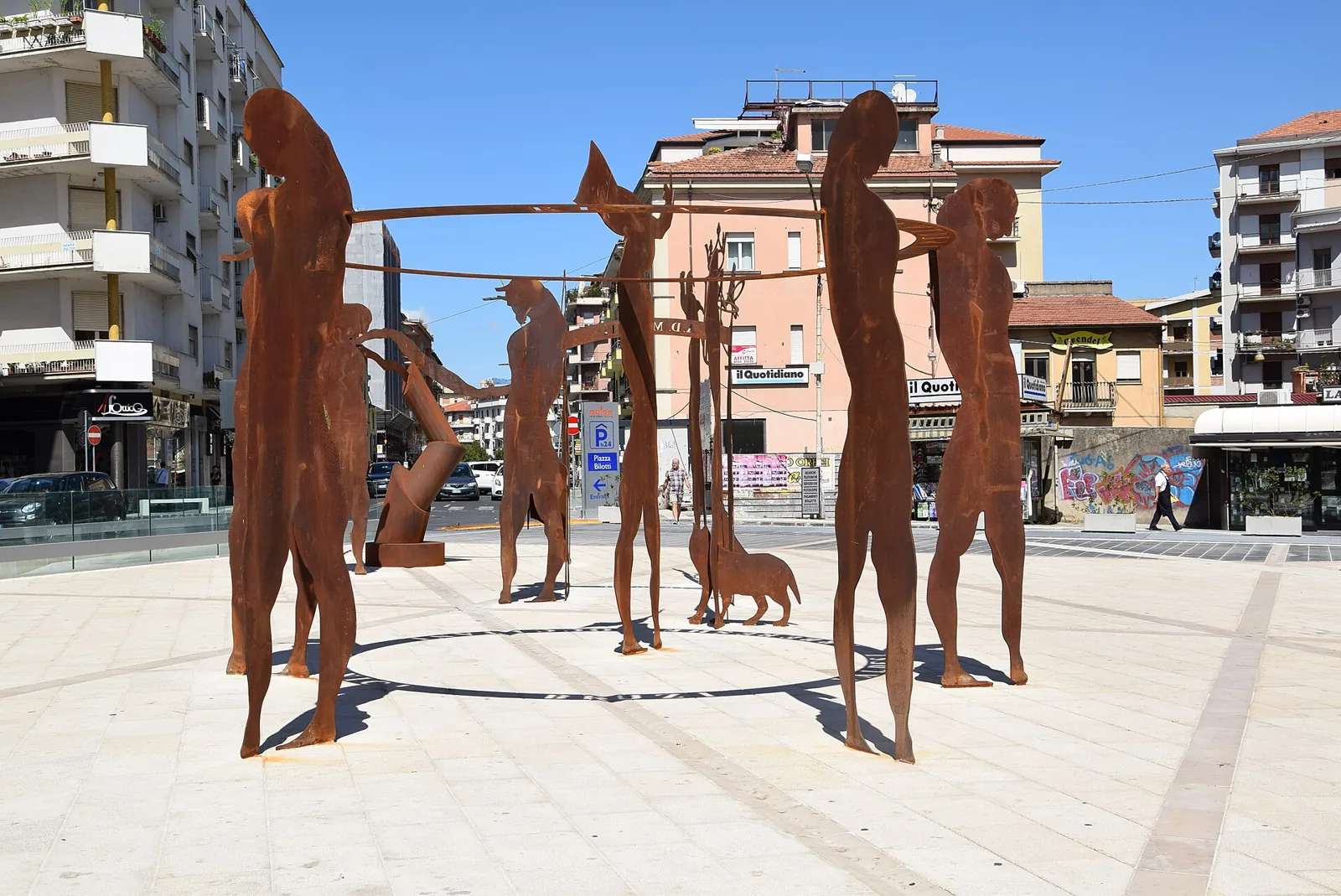
The idea for this exceptional space originated from the vision of Carlo Bilotti – an art collector and entrepreneur from Cosenza, connected to the American cosmetics industry. It was his name that gave the project its identity, and Corso Mazzini became the exhibition axis running from Piazza dei Bruzi to Piazza Carlo F. Bilotti. The project grew out of a donation of artworks made to the city in 2005 by Carlo and Enzo Bilotti; the museum was inaugurated in 2006, after Corso Mazzini had been transformed into a pedestrian street.
After Carlo Bilotti's death in 2006, his family and local institutions continued to look after the family's legacy. MAB is owned and managed by the Comune di Cosenza, the Municipality of Cosenza. Thanks to this, MAB has remained an important element of Cosenza's cultural life and one of the most recognisable symbols of the modern part of the city.
MAB changes the way art is perceived in an urban context, making Cosenza a place more open to everyday contact with culture. This is not a museum you have to make a special effort to enter – here sculptures are viewed between a café, a shop and an evening stroll. It is precisely this accessibility that is its greatest strength.
Art as an Element of Cosenza's Urban Transformation
Cosenza, situated in the heart of Calabria, has become an interesting example of the connection between art and urban space. Its approach to urban planning integrates a prestigious collection with the daily rhythm of life, where sculptures stand alongside cafés and boutiques. It is on Corso Mazzini, the city's main street, that the renowned MAB transforms this space into a living gallery. Public art plays the role of a landmark here, influencing the way residents and visitors read the modern city centre.
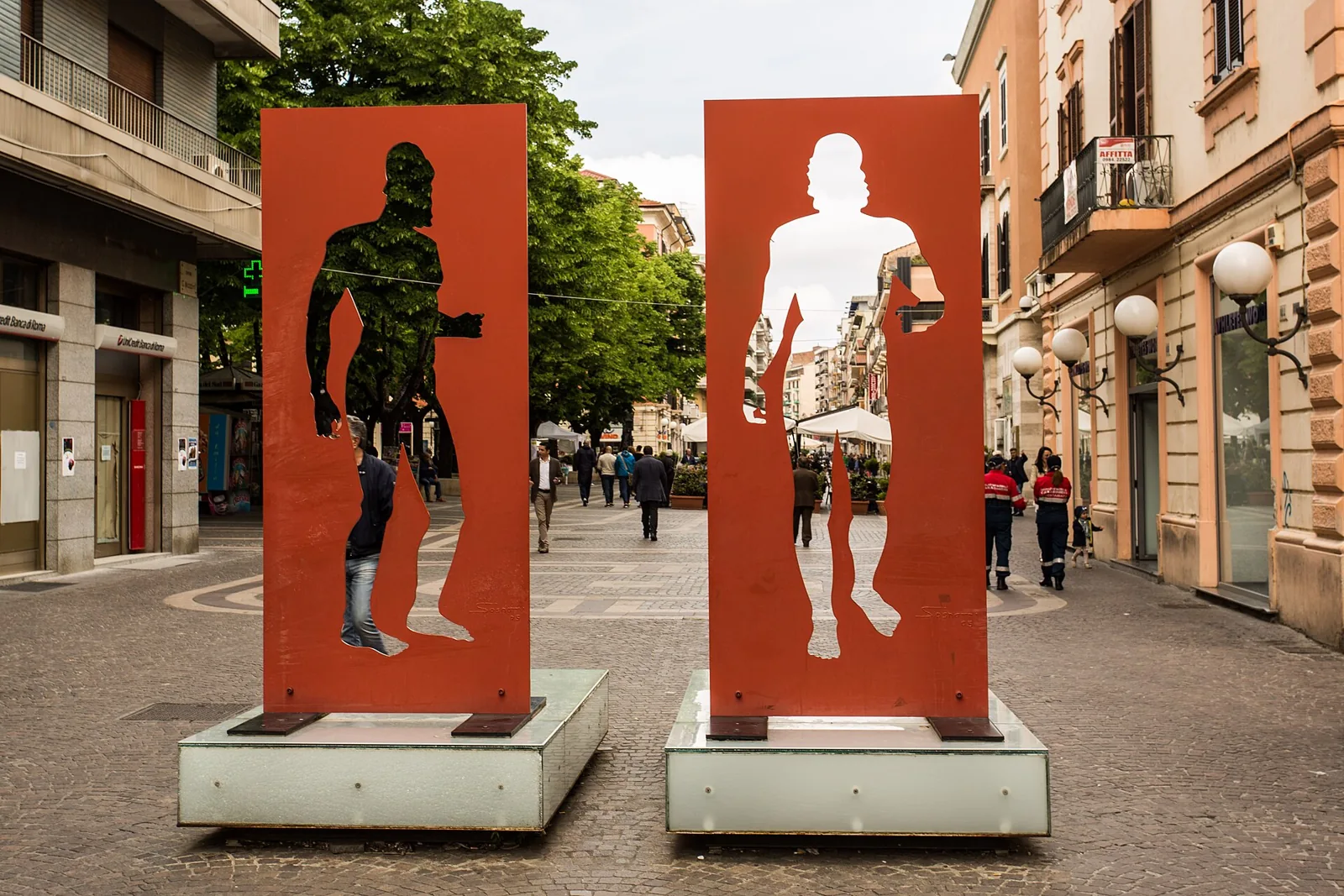
The history and heritage of Cosenza, full of old walls and palaces, give this place a special context. The city is sometimes called the “Athens of Calabria” because of its intellectual traditions, associated among others with the figure of Bernardino Telesio. MAB fits well into this narrative, connecting the contemporary axis of Corso Mazzini with the older, more historical face of Cosenza situated higher above the Crati valley.
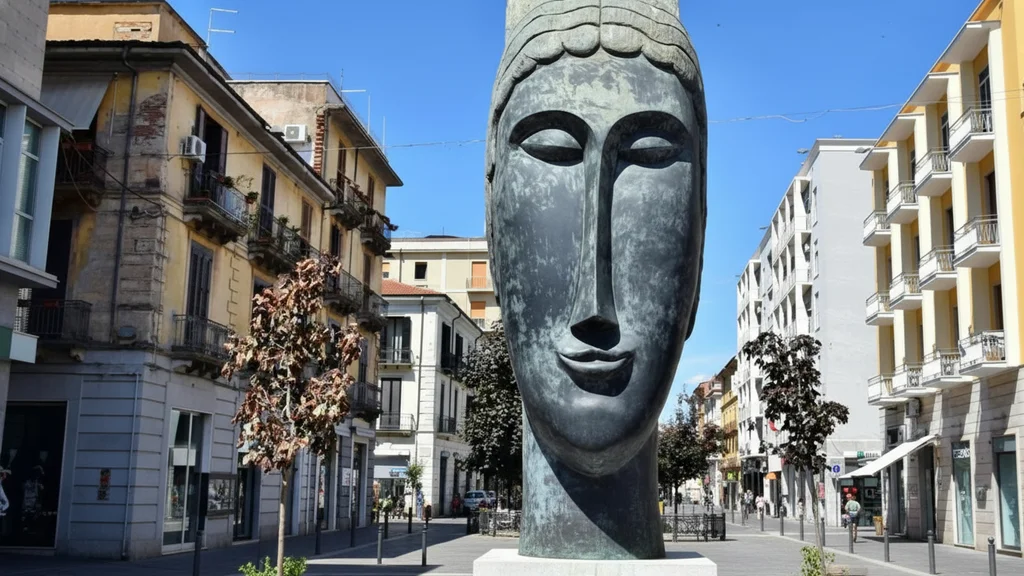
Contemporary artistic projects make Cosenza a centre for modern art in public space. Districts and places connected with culture gain in attractiveness thanks to the BoCs Art residencies, whose museum has operated since 2017 in the Complesso Monumentale di San Domenico. By assembling over 300 works by young creators, the city builds a multi-layered cultural narrative that engages the local community in the process of socio-economic revitalisation.
Such initiatives strengthen Cosenza's role as a city that treats culture not as decoration but as an element of everyday life. The increase in foot traffic and tourism around Corso Mazzini also supports gastronomy and commerce. Cosenza demonstrates that the “museum without walls” model can work not only symbolically but also very practically.
Masterpieces Open on the Street – Key Works of MAB in Cosenza
MAB Museo all'Aperto Bilotti on Corso Mazzini is a space where contemporary art enters into dialogue with the urban landscape. The open-air character of the collection means each work looks slightly different in the morning, in the harsh southern sun, and in the evening when the promenade fills with strolling residents. This is an important element of the identity of modern Cosenza – the contemporary axis of the city contrasting with the old centre situated higher above the Crati valley.
MAB also helps explain why Cosenza invests so strongly in art in public space. The city, sometimes called the “Athens of Calabria,” has long emphasised its intellectual and cultural traditions, and Corso Mazzini has become their most everyday, universally accessible expression.
Among the best documented MAB works are pieces by Salvador Dalí, Giorgio De Chirico, Amedeo Modigliani, Giacomo Manzù, Mimmo Rotella, Pietro Consagra and Sacha Sosno. Officially listed works include, among others, “San Giorgio e il drago” by Salvador Dalí, “Grande Metafisico,” “I due Archeologi” and “Ettore e Andromaca” by Giorgio De Chirico, “Cardinale in piedi” and “Testa di Medusa” by Giacomo Manzù, “Rinascita della Cultura” and “Lupo della Sila” by Mimmo Rotella, “Testa di Cariatide” by Amedeo Modigliani, and “Tre colonne doriche,” “Bronzi di Riace” and “Sette di Cuori” by Sacha Sosno.
| Artist | Work | Material | Characteristics |
|---|---|---|---|
| Giorgio de Chirico | Ettore e Andromaca | Bronze | One of the most recognisable works associated with the MAB route. |
| Salvador Dalí | San Giorgio e il Drago | Bronze | A surrealist form that stands out strongly in the promenade setting. |
| Amedeo Modigliani | Testa di Cariatide | Bronze | A work cited in descriptions of MAB as an example of classicising synthesis of form. |
The Most Important Works in the Collection
Along the MAB route you can find, among others, “San Giorgio e il drago” by Salvador Dalí, “Ettore e Andromaca,” “I due Archeologi” and “Grande Metafisico” by Giorgio De Chirico, “Testa di Medusa” by Giacomo Manzù and “Lupo della Sila” by Mimmo Rotella. In practice, the greatest impression is made by the contrast itself between the movement of the city and the sculptures placed along Corso Mazzini. This is a collection best read as a whole – as a story about how art can transform an ordinary promenade into a place with character.
The Subtle Female Figure and Classical Beauty
In this part of the walk, the most interesting thing is observing how classicising and more figurative forms work in the open space of the city. Smooth silhouettes, calm proportions and a clear rendering of the human figure contrast well with the bustle of shops, windows and cafés. This is what makes MAB not just a collection of objects but also an interplay between sculpture and the everyday rhythm of the street.
Dynamic Wandering and Existential Unease
Some works on Corso Mazzini create an entirely different tension – more austere, vertical and focused on the human silhouette. In the open space of the promenade, such forms work particularly powerfully, as they are viewed in motion, from different perspectives and against the backdrop of urban bustle. It is at such moments that one best sees how MAB transforms an ordinary walk into a more attentive experience.
The Poetics of Obliteration and Futurist Energy
The open-air collection also showcases works that play with abbreviation, emptiness and bold contour. On the wide promenade, such forms do not get lost but rather catch the eye from afar and work well with light. This is what keeps MAB alive not just as a collection of sculptures but also as part of the urban scenography.
Watch on YouTube
MAB in Cosenza – the Social Contribution of Street Art
MAB Museo all'Aperto Bilotti is not just a gallery but an essential element of the social landscape. Thanks to complete accessibility 24 hours a day, art has ceased to be the domain of elites, becoming part of everyday life for different social groups. This is a real example of the democratisation of culture, where economic barriers practically disappear.
Culture is a pillar of Cosenza's identity, and MAB influences the way residents use the city. Daily contact with art in public space naturally familiarises people with sculpture and encourages more attentive observation of their surroundings. The museum also fulfils an educational function, as even a short walk along Corso Mazzini can become a first encounter with contemporary art.
An important aspect is also the very presence of works in a living urban environment. The sculptures are exposed to light, weather and intensive foot traffic, which means their reception is always linked with responsibility for shared space. This is one of the reasons why MAB functions not just as a tourist attraction but also as a daily lesson in sharing the city.
MAB serves as an inspiration for urban planners and those involved in urban culture, demonstrating that integrating art with everyday life truly works. The collaboration between the Bilotti family and public administration has created a model of patronage that has clearly influenced Cosenza's image. Thanks to this, residents and visitors can experience art not on special occasions but simply during a stroll.
Practical Information
Location: Corso Mazzini, Cosenza – from Piazza dei Bruzi to Piazza Carlo F. Bilotti
Hours: Accessible 24 hours a day, 7 days a week
Tickets: Free admission
Getting there: Cosenza railway station is outside the pedestrian area; Corso Mazzini can be reached on foot from the modern city centre or by city bus to the area around Piazza dei Bruzi or Piazza Bilotti.
Walking through the entire MAB axis usually takes about 20–30 minutes without stops and 45–60 minutes when viewing the sculptures at a relaxed pace. The easiest approach is to start at Piazza dei Bruzi and walk towards Piazza Carlo F. Bilotti, treating the route as a simple, linear stroll through the centre. On 1 September 2026, a comprehensive riordino of MAB was announced: in the following weeks, 12 new works are to be installed, the route reorganised and the information plaques updated. Sacha Sosno's three columns are to be moved to the Hortus Conclusus of the San Domenico complex, and one of them is under reconstruction after being damaged.
From Lamezia Terme Airport to Cosenza is about 65 km. By car the journey usually takes 45–60 minutes, and when travelling by bus or train you should check the current timetable before departure. SACAL lists Cosenza–Aeroporto bus connections operated by Autolinee Romano. Trenitalia describes integrated connections from Cosenza FS to Cosenza Centro operated by Ferrovie della Calabria; the ticket price is the sum of the Trenitalia fare and the Ferrovie della Calabria fare calculated by distance.
The most pleasant time to visit MAB is late afternoon or evening, especially from spring to early autumn, when Corso Mazzini truly comes alive. In summer, daytime temperatures in Cosenza often exceed 30°C, so it is worth having water, a hat and sun protection.
Frequently Asked Questions
What is MAB and what sculptures can you see on the streets of Cosenza?
MAB is the Museo all'Aperto Bilotti, an open-air contemporary sculpture gallery stretched along Corso Mazzini. Listed works include, among others, “San Giorgio e il drago” by Salvador Dalí, “Ettore e Andromaca” by Giorgio De Chirico, “Testa di Medusa” by Giacomo Manzù, “Lupo della Sila” by Mimmo Rotella and “Testa di Cariatide” by Amedeo Modigliani.
Where exactly is the MAB Bilotti open-air gallery located?
The museum stretches along Cosenza's main promenade – Corso Mazzini. The collection starts at Piazza dei Bruzi and leads to Piazza Carlo Bilotti, creating an artistic axis in the modern city centre.
Who was Carlo Bilotti and why does the museum bear his name?
Carlo Bilotti was an art collector and entrepreneur from Cosenza, connected to the American cosmetics industry. The project grew out of a donation of artworks made to the city in 2005 by Carlo and Enzo Bilotti, and the museum was inaugurated in 2006.
Is visiting MAB Museo all'Aperto Bilotti free?
No, visiting the museum is completely free. The sculptures are placed in public space, allowing them to be admired at any time of day or night without buying a ticket.
What new works were added to the collection in 2026?
In 2026, the city announced a riordino of MAB and the installation of new works. ANSA reported on 4 March 2026 on a project involving 10 works and a budget of 64,762 euros; on 1 September 2026, the installation of 12 new works in the following weeks was announced, along with the relocation of Sacha Sosno's three columns to the San Domenico complex for better protection.
Last updated: