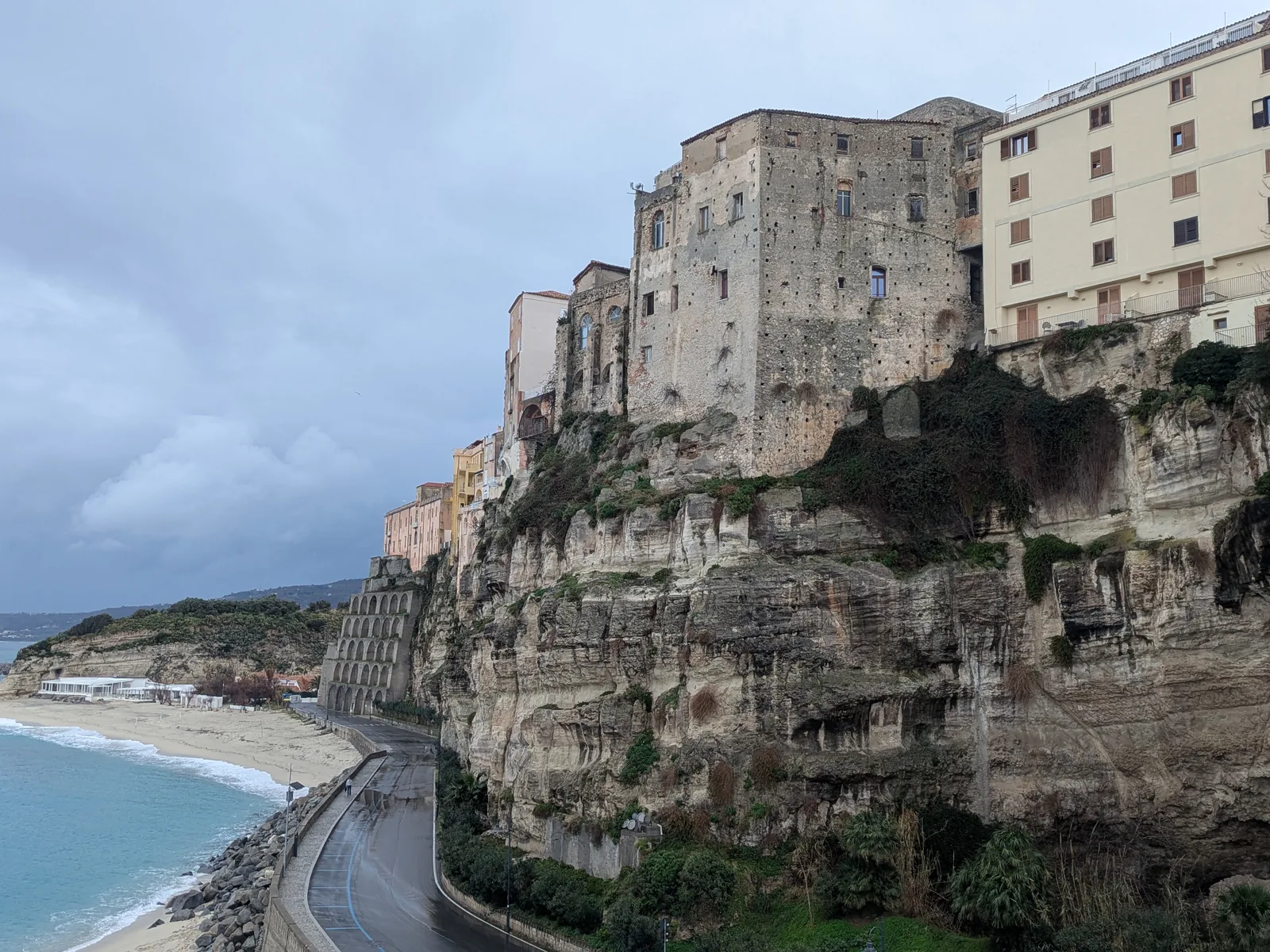
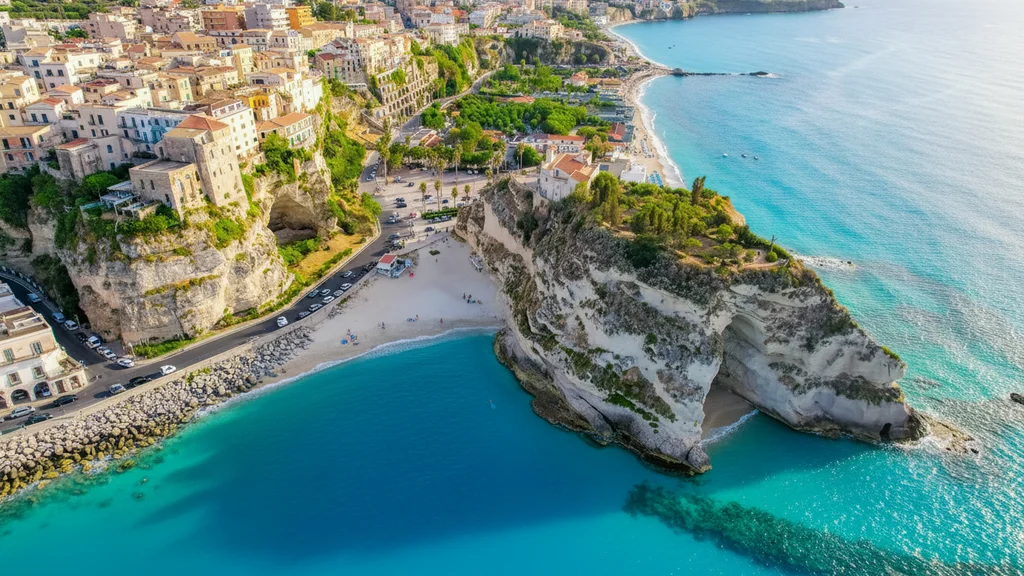
Tropea's beaches consistently rank among the finest in Italy – and for good reason. White sand, turquoise water with Caribbean-like clarity, and dramatic sandstone cliffs create scenery that is hard to match anywhere else in the Mediterranean. All of Tropea's main beaches lie at the foot of the 50-metre cliff on which the old town stands, overlooked by the silhouette of the Santa Maria dell'Isola sanctuary. The region bears the fitting name Costa degli Dei – the Coast of the Gods.
Tropea sits on a high cliff of tuff and sandstone, rising some 40–50 metres above sea level. The beaches at the foot of the town formed through marine erosion and the accumulation of pale sand in small bays separated by rocks. Santa Maria dell'Isola itself stands on an isolated rock outlier that was formerly an island or peninsula connected to the mainland by a narrow sandbar.
Table of Contents
Tropea's Main Beaches
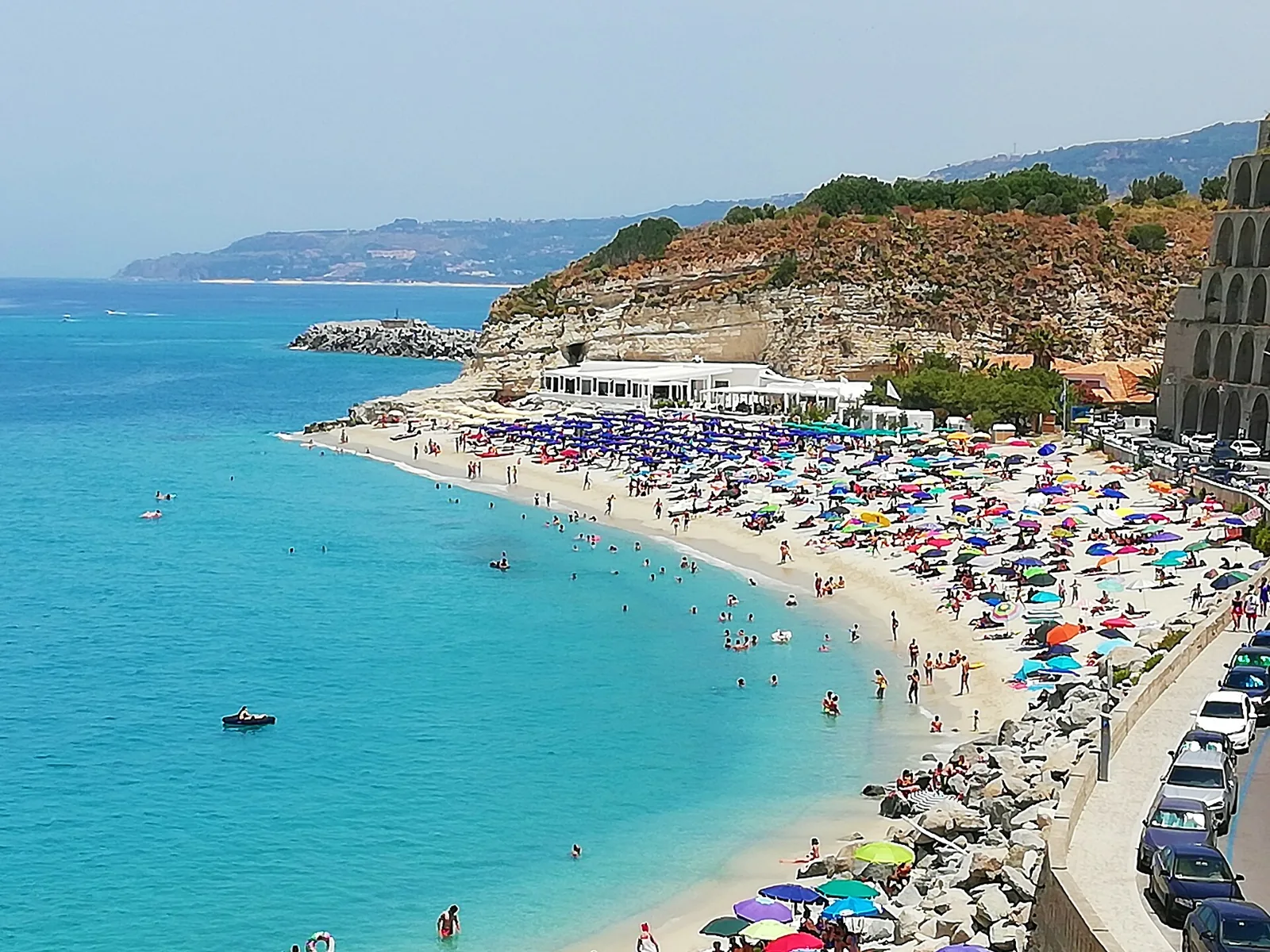
Spiaggia della Rotonda, also known as Spiaggia delle Roccette, is the most popular and one of the easiest beaches to reach in Tropea. It stretches for around 300 metres at the foot of the old town cliff, on its western side. You can reach it via the Discesa Marina del Vescovado from Porta Nuova or by the Scala dei Carabinieri steps from Affaccio di Largo Galluppi; the latter has around 100 steps cut into the rock. The descent takes a few minutes, but the climb back up in the heat can be a challenge. The sand is fine and pale, and the water shifts from light turquoise near the shore to an intense sapphire further out. Sunbeds and umbrellas are available in paid lido sections during the season, but part of the beach remains free.
Spiaggia del Cannone (U Cannuni) is the most intimate of Tropea's beaches. Hidden near the beginning of the tourist harbour pier and sheltered by Scoglio di San Leonardo, it is harder to find; the safest approach is from the harbour side and the northern pier. This is a small, quiet cove with crystal-clear water and a view of the Santa Maria dell'Isola cliff. Outside July and August, it is often nearly deserted. There are no food facilities – bring water and snacks.
Mare Piccolo (Mari Picciulu) lies on the north side of the Santa Maria dell'Isola rock. It is a calmer beach, popular with families thanks to the gentle entry into the water. A small kiosk sells drinks, coffee, and ice cream. The view is exceptional – the sanctuary rock rises directly overhead, creating one of Tropea's most recognisable views.
A Linguata is a narrow, elongated beach stretching south from the Santa Maria dell'Isola rock. The name comes from its tongue-like shape. It offers a more secluded atmosphere than Rotonda, though access can be tricky due to narrow passages. Bear in mind occasional warnings about cliff stability – when in doubt, ask locals about current conditions.
If you want the easiest access and full facilities, Rotonda is the best choice. Mare Piccolo usually works well in calmer seas and for those who want to beach right next to the Santa Maria dell'Isola rock. Del Cannone has a more intimate feel, while A Linguata offers a longer stretch for walking and a more open exposure to the sea.
Watch on YouTube
Beaches Beyond Tropea's Centre
Spiaggia Mare Grande – the longest beach in the area, extending south from the centre. Accessible by car (parking available), it offers both free stretches and numerous lidos with sunbeds, beach bars, and restaurants. Ideal for those seeking a full day of beachside comfort. The water is every bit as clean as at the cliff-foot beaches.
Spiaggia della Contura – a stretch north of the harbour, administratively linked to Parghelia; because of erosion and the beach's variable width, check current access and conditions before setting off.
Spiaggia Michelino (Parghelia) – a lesser-known gem 2–3 km to the north of Tropea's centre. The beach lies near the centre of Parghelia, between an old Roman granite quarry to the north and the Scogli della Ringa to the south. Getting down requires descending long steps, but the reward is a wild, rock-framed beach with a view of Pizzuta – a distinctive rock formation rising from the sea. The official Parghelia municipal portal describes Scoglio del Palombaro as a rock emerging from the extension of the Scogliera della Pizzuta. Getting there by car usually takes 5–10 minutes to the viewpoint and beach access, but the climb back up requires good fitness. Facilities on site are limited or seasonal, so bring water and water shoes. From here, it is a short distance to Capo Vaticano and its even more secluded coves.
Practical Beach Tips
Swimming season runs from May to October, though the warmest water (24–27°C) falls in July–September. For the 2025 season, Regione Calabria set the seasonal bathing period from 1 May to 31 October. During this period, concessions must meet minimum safety requirements and water quality is monitored by Arpacal; outside this period, bathing may take place without these guarantees after appropriate signage. June and September are the sweet spot – pleasant temperatures and far fewer crowds than peak season.
Facilities: Rotonda and Mare Grande beaches have lidos renting sunbeds and umbrellas; prices vary strongly by month and row – they can be lower outside peak season, but in July and August a set in popular Tropea lidos can cost several dozen euros, even around €45–70. Smaller beaches have no infrastructure – bring your own towel, sunscreen, and water.
Access: Most central beaches require descending steep steps from the old town cliff. The main descents lead from the Piazza Cannone / belvedere area near the historic centre and from the steps near the Santa Maria dell'Isola sanctuary. The descent usually takes 5–10 minutes, the climb back up 10–15 minutes depending on fitness and temperature. In season, it is best to head down in the morning or after 16:00 to avoid the heat and queues on the steps.
Car and parking: Traffic restrictions and ZTL zones apply in the historic centre of Tropea, so it is easiest to leave your car in car parks outside the core and walk down to the beaches. In peak season, finding a spot after 10:00 can be difficult, so arrive early in the morning or choose beaches outside the centre such as those in Parghelia.
Sea conditions: Bathing conditions in Tropea depend heavily on wind and swell. In stronger wind, one side of the Santa Maria dell'Isola rock can be noticeably calmer than the other, so after descending it is worth checking both sides of the beach – the difference in water clarity and wave height can be noticeable on the same day.
Water shoes: At Spiaggia del Cannone and A Linguata, the seabed can be rocky at the entry point. Water shoes will make things much more comfortable.
On Italian beaches, paid sections (lido) and free sections (spiaggia libera) typically coexist side by side. In Tropea the heaviest crowds fall in the second half of July and August, especially around Ferragosto on 15 August, so for free sections it is best to arrive before 9:00.
After a day on the beach, stroll through the old town lanes and sample local specialities – from lemon granita to dishes featuring the famous Tropea red onion. Nature lovers should visit nearby Capo Vaticano, where cliffs plunge straight into the sea, creating some of the most stunning panoramas along the entire Calabrian coast.
Frequently Asked Questions
Which Tropea beach is best for families with children?
Mare Piccolo – it has a gentler entry into the water, a kiosk selling drinks and ice cream, and a calmer character than the busier Rotonda. Bear in mind, however, that sea conditions change depending on wind and swell.
Do Tropea's beaches hold Blue Flag certification?
In the 2026 Bandiera Blu edition, the municipality of Tropea has the following recognised bathing areas: Marina del Convento, Marina dell'Isola, and Rocca Nettuno. Neighbouring Parghelia appears on the same list with Costa dei Monaci/Bordila, La Grazia/Vardano, Michelino, and La Tonnara.
Do you have to pay to use the beach?
Access to the beaches themselves is free. Charges apply only to lido zones with sunbeds and umbrellas. Spiaggia libera free sections are usually available too, but in July and August it is best to arrive early, as spaces fill up quickly.
Last updated: