The Sanctuary of Santa Maria dell'Isola is the undisputed symbol of Tropea and one of Calabria's most recognisable landmarks. The church crowns a 33-metre sandstone rock that was once a separate island – over the centuries, marine sediment joined it to the mainland, but the name endured. The sight of its white silhouette against the turquoise Tyrrhenian Sea has become the calling card of not just Tropea, but of Calabria as a whole.
Table of Contents
A Thousand Years of Monastic History
The sanctuary's origins probably reach back to the early Middle Ages, when ascetic monks of the Byzantine tradition settled on the rock; later, the Isola also hosted a community of Basilian monks. They arrived in Calabria in broader waves during the 8th–9th centuries, partly in connection with iconoclasm and instability in the Byzantine world. For several centuries, the cliff served as a hermitage, and a local religious tradition took shape around it. In the 11th century, during the Norman period, the hermitage was placed under the care of the Benedictines.
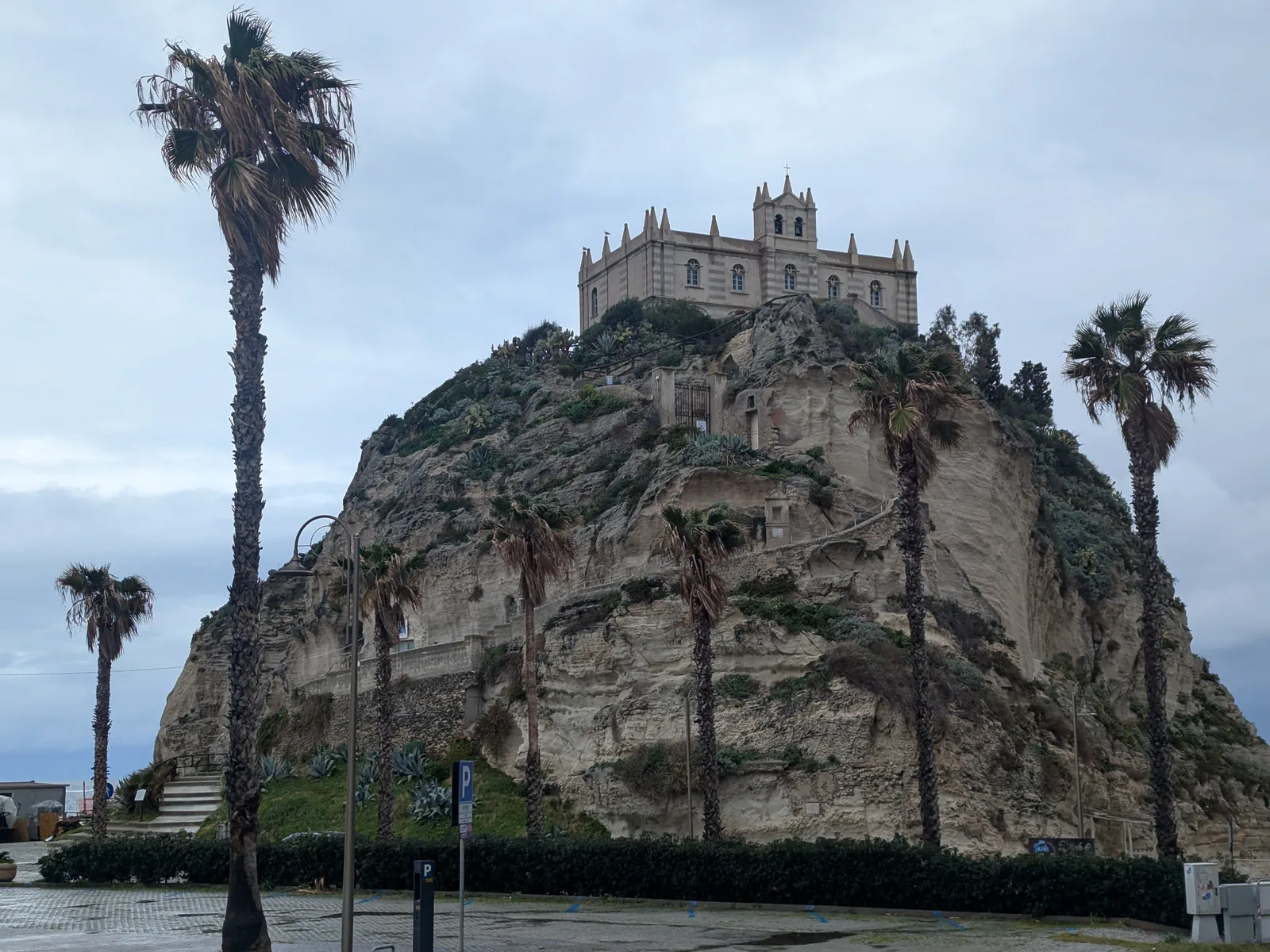
The earliest mentions of Santa Maria dell'Isola appear in medieval sources, and the site was already an important religious landmark of Tropea in the Norman era. The sanctuary's official history states that in the 11th century the Isola passed to the Benedictines of Montecassino; the donation is attributed to Princess Sichelgaita and was officially confirmed in 1090 by an act of Roger Borsa. The connection with the Abbey of Montecassino remains an important part of the site's history. It is also important to remember that today's structure is not an entirely preserved building from the early Middle Ages, but the result of many reconstructions after seismic damage.
Basilian monks were religious of the Byzantine tradition, living according to the Rule of St Basil. Their presence in Calabria was particularly strong between the 8th and 11th centuries and left behind a legacy of Greek liturgy, eremitic tradition and a network of monasteries linked to the Byzantine heritage of southern Italy. This is an important thread for understanding a region where Greek, Byzantine and Latin influences intermingled for centuries.
The site's history was far from peaceful, however. Major earthquakes in 1783 and in 1905 severely affected Santa Maria dell'Isola, and the sanctuary's present appearance is largely the result of later reconstructions. Despite these changes, the place has retained its austere, contemplative character – the interior is dominated by simplicity and an atmosphere of seclusion that suits its position on a rock above the sea.
Around the feast of 15 August, the Assumption of the Blessed Virgin Mary, religious celebrations take place in connection with the sanctuary and Tropea's seaside character. The sanctuary houses an 18th-century sculptural group of the Holy Family, which during the feast is carried in procession and placed on a decorated fishing boat. The programme of events may change, so it is best to check current information locally before your visit.
Watch on YouTube
Rock-Carved Steps, Gardens and Panoramas
The path to the summit leads up stone steps carved directly into the rock. The climb is moderately demanding – rest spots appear along the way, and with each level the view becomes ever wider. Comfortable shoes and a bottle of water are recommended, especially in summer, when the sandstone absorbs the heat of the sun.
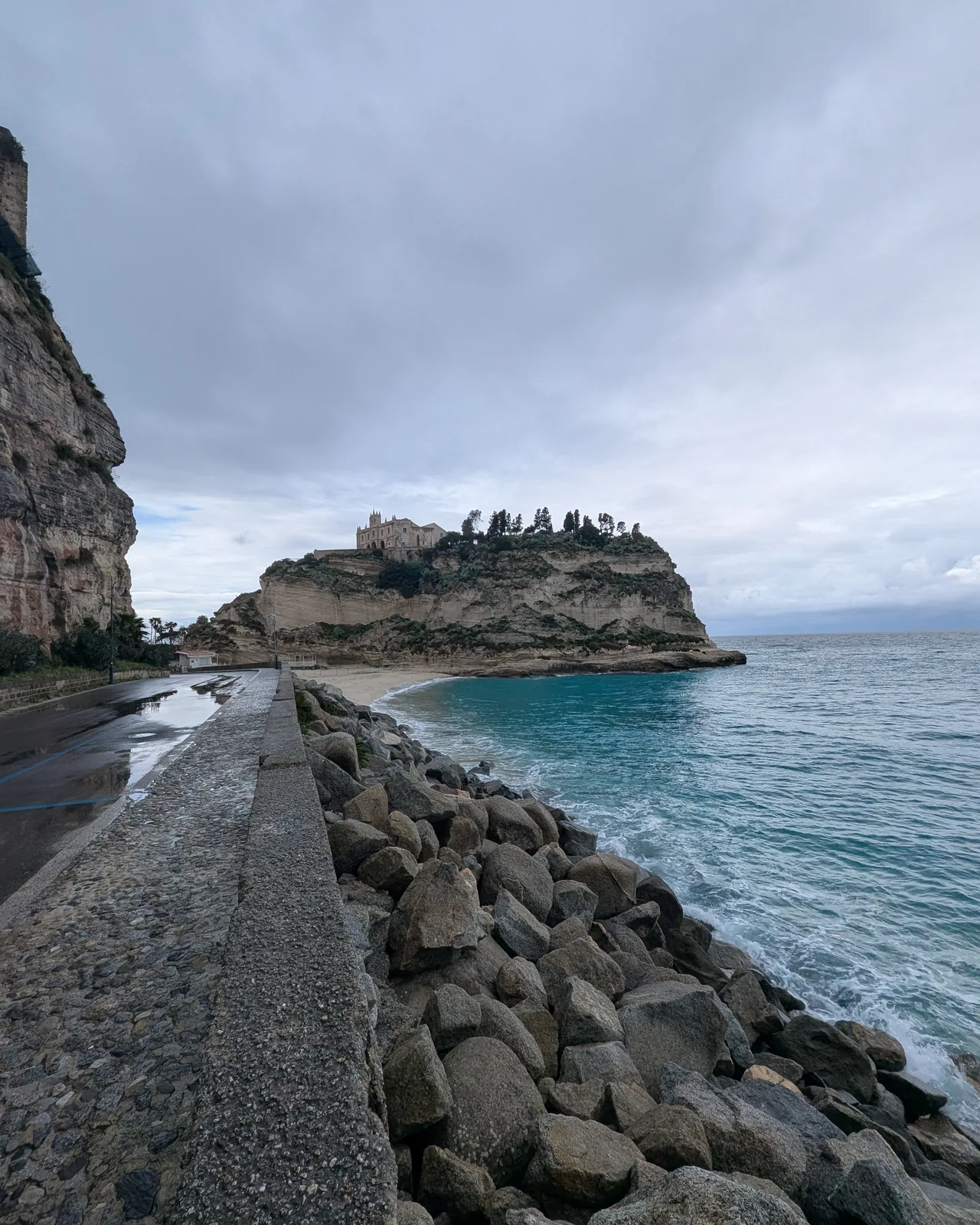
Behind the church stretch gardens filled with Mediterranean vegetation – surprisingly expansive for a cliff-top setting. Pathways wind among oleanders, agaves, prickly pear cactuses, and olive trees. It is a peaceful spot with a wide view of the Tyrrhenian Sea and, in good atmospheric clarity, of Stromboli and the silhouettes of the Aeolian Islands. Within the sanctuary complex there is also a small museum with artefacts found on the site, including medieval tombs and valuable statues.
The most classic view of Santa Maria dell'Isola is from the belvedere at Corso Vittorio Emanuele / Piazza del Cannone, where you can see the rock, the beach and the Tyrrhenian Sea in one frame. An alternative view comes from the beach at the foot of the rock – especially in the morning and at golden hour. In the rock there is a passage known as Grotta del Palombaro, connecting Rotonda beach with Linguata beach. If you want photos without crowds, it is best to come early, as in high season the area fills up quickly.
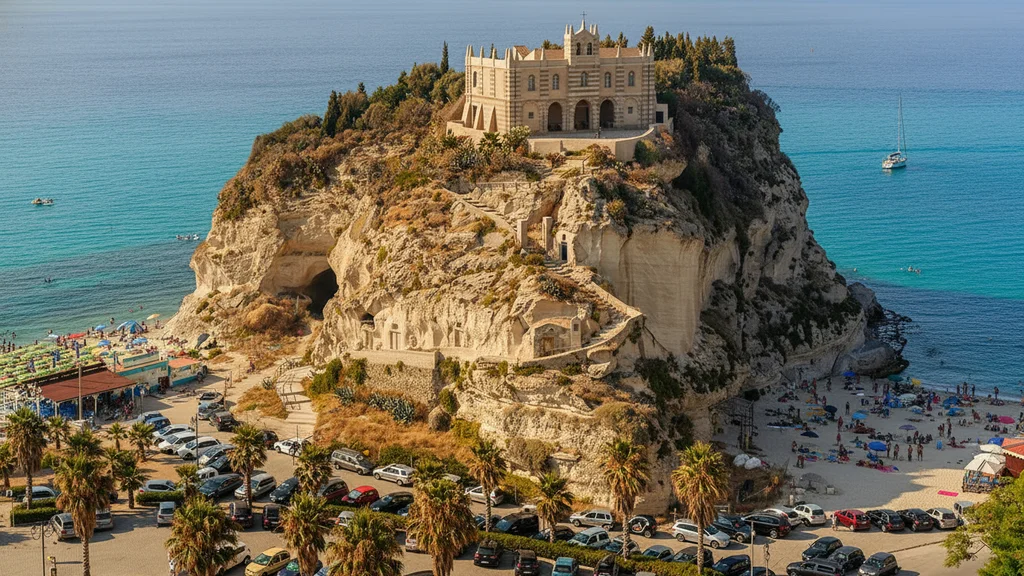
From Tropea's beaches below, you can admire the sanctuary from below – a perspective that best reveals the sheer scale of the rock and the drama of its position. The descent to the beach leads down steep steps from the town, so factor that into your walk.
Practical Tips
Opening hours: According to the sanctuary's official website, it is open in April, May and October from 9:30–19:30 and from June to September from 9:30–20:00; in January, February, March, November and December it is closed. Check for updates before visiting. Entry times may also depend on religious services and the current organisation of visitor access.
How to get there: From Tropea's old town, you can reach the vicinity of the sanctuary in about 10–15 minutes, and then there is the climb up the rock steps. The route is not adapted for pushchairs or persons with limited mobility. Allow about 30–60 minutes for the visit. In summer, the approach is often in full sun, so it is best to go in the morning or late afternoon and bring water and a hat.
Tickets: According to current information from the local portal Tropea.biz, entry to the garden, the historical-liturgical route and the panoramic terrace costs €3.00 for visitors over 18, €2.00 for children and teenagers aged 7–18, and is free for children up to 6 years old. Treat prices as practical information to verify before entering, as visiting rules may change seasonally.
Public transport: Tropea has a railway station on the Tyrrhenian line, served by regional trains and some long-distance services on the Reggio Calabria–Lamezia Terme–Naples route. From the station to the historic centre is about 10–15 minutes on foot, and from there another 10–15 minutes to the sanctuary area. The nearest airport is Lamezia Terme (SUF), about 55–60 km from Tropea.
Best time to visit: Early morning or late afternoon. In July and August, midday can be very tiring, as the rock offers little shade. If you hope to see Stromboli, remember it is only visible in good atmospheric clarity – best in the morning, after rain or in low humidity. The volcano lies roughly 55–65 km in a straight line from the Tropea area, depending on the vantage point.
The sanctuary makes an ideal starting point for exploring Capo Vaticano, about 20–30 minutes' drive away depending on traffic and starting point, and the wider Tropea region.
Frequently Asked Questions
Is there an entrance fee for Santa Maria dell'Isola?
The church itself is sometimes accessible without an additional fee, while according to current information from the local portal Tropea.biz, entry to the garden, the historical-liturgical route and the panoramic terrace costs €3.00 for visitors over 18, €2.00 for children and teenagers aged 7–18, and is free for children up to 6 years old. Check the current rules before entering.
How long does a visit take?
Usually about 30–60 minutes is enough for the ascent, a short walk through the gardens and a stop at the viewpoints.
Are the steps difficult for elderly visitors?
The steps are steep and can be demanding, especially in the heat. There is no access adapted for pushchairs or a comfortable alternative without steps, so it is best to take it at a leisurely pace.
When does the maritime procession take place?
The maritime procession is connected with the celebrations of the Assumption of the Blessed Virgin Mary in mid-August. In 2026, the celebrations began on 14 August with a concert by the Città di Tropea Wind Orchestra and a polyphonic choir, and on 15 August the maritime procession and an evening fireworks display took place. The sanctuary houses an 18th-century sculptural group of the Holy Family, which during the feast is carried in procession and placed on a decorated fishing boat.
Last updated: