Hidden in the picturesque hills of Calabria, the Cattolica di Stilo is one of the most precious examples of Byzantine architecture to have survived to our times. This church combines Eastern and Western influences, and its compact form makes a strong impression both externally and inside, where remnants of wall paintings have been preserved. Since 2006, the monument has been on Italy's UNESCO Tentative List as part of the candidacy "Cattolica Monastery in Stilo and Basilian-Byzantine complexes".
The building rises on the slopes of Monte Consolino, dominating the Stilaro river valley. Between the 9th and 11th centuries, Calabria was an important area of the Byzantine world, and Stilo was one of the most significant centres in this part of the region. The Cattolica probably served as a church linked to the local monastic milieu, acting as a point of reference for the Greek religious tradition present in the valley.
The Cattolica di Stilo is most commonly dated to the 10th century, often narrowed to the late 10th or early 11th century. The building was erected at a time when southern Calabria belonged to the Byzantine political and ecclesiastical sphere, and Greek monasticism associated with the Basilian tradition was developing in the area. After the Norman conquest in the 11th century, many Greek religious institutions continued to function, even as Latin influence gradually grew.
Table of Contents
Architectural Mastery and the Style of Cattolica di Stilo
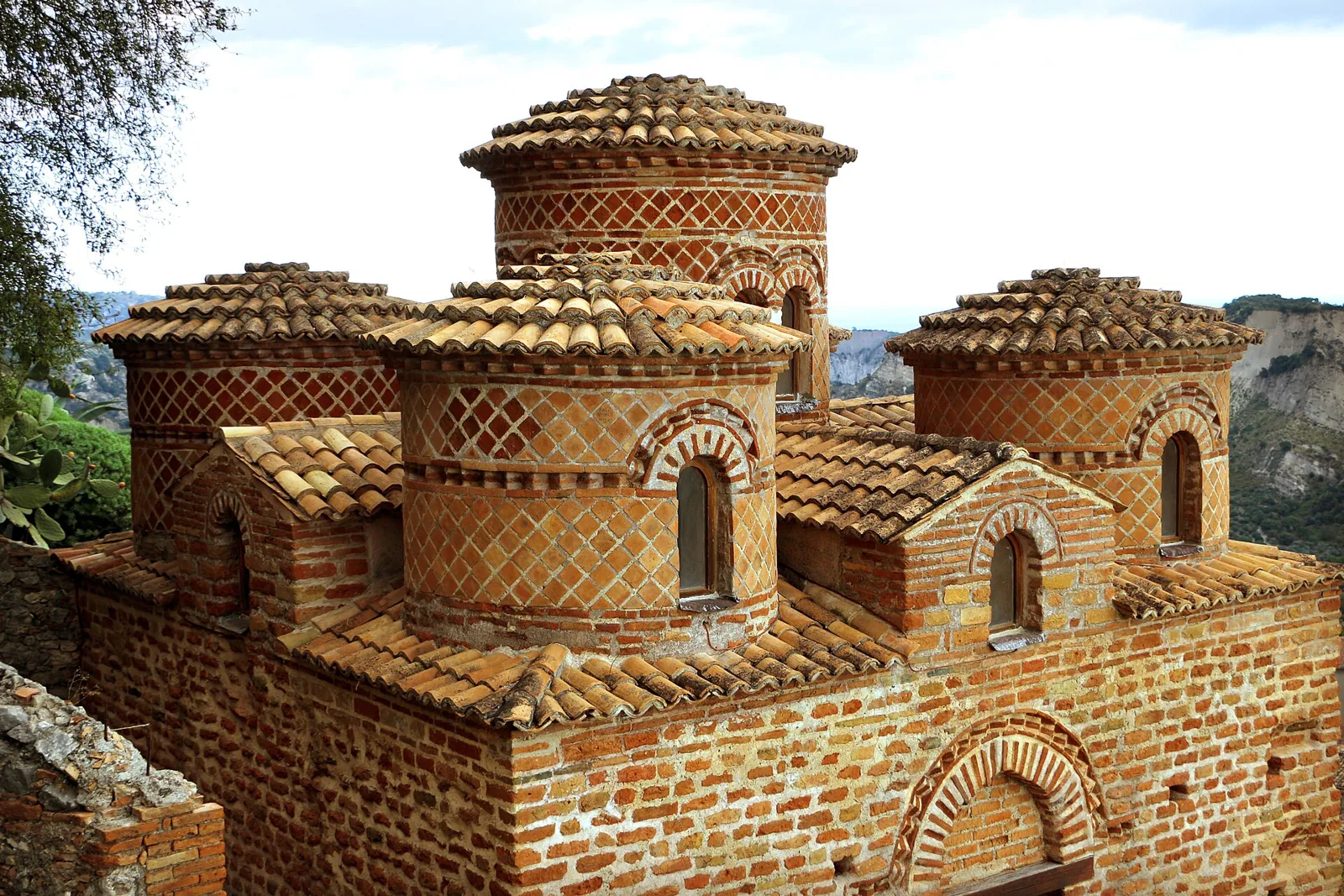
The Cattolica di Stilo is an outstanding example of Byzantine architecture in the Calabria region, built on a Greek cross plan inscribed within a square. This precise layout, measuring approximately 7.80 by 7.30 metres, symbolises in Byzantine theology the union of the earthly square with the heavenly sphere of the domes. The central dome is supported by four pillars, and the entire structure is crowned with five domes in a quincunx arrangement, resembling the pattern of dots on a die.
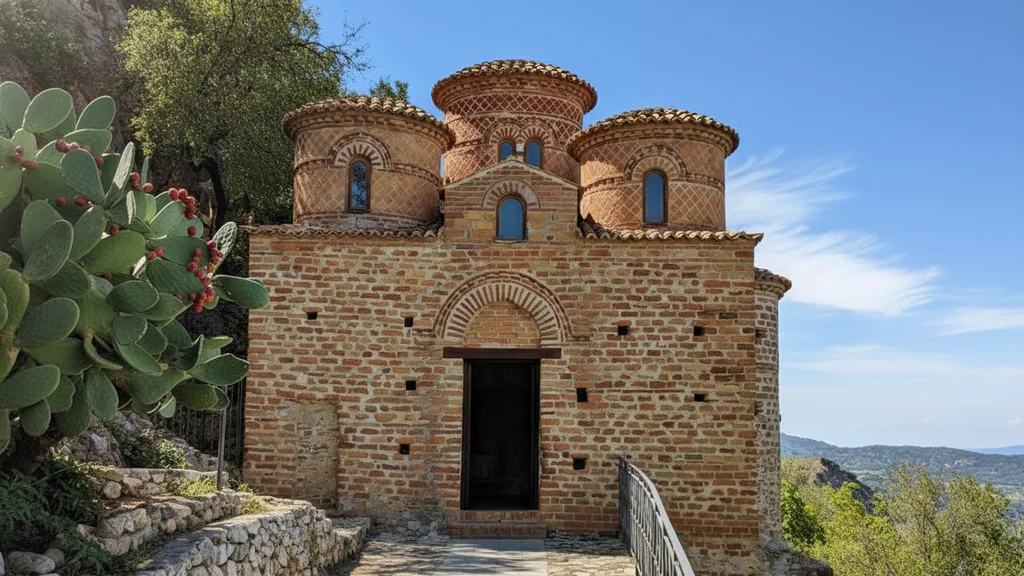
The exterior elevation draws attention with its austere form and masterful use of brick, laid in places in the characteristic spina di pesce pattern. The building also incorporates reused ancient elements, a common practice in the Middle Ages. Through the system of pendentives, architects managed to transition smoothly from square forms to the round drums of the domes, which illuminate the interior through narrow bifora and monofora windows.
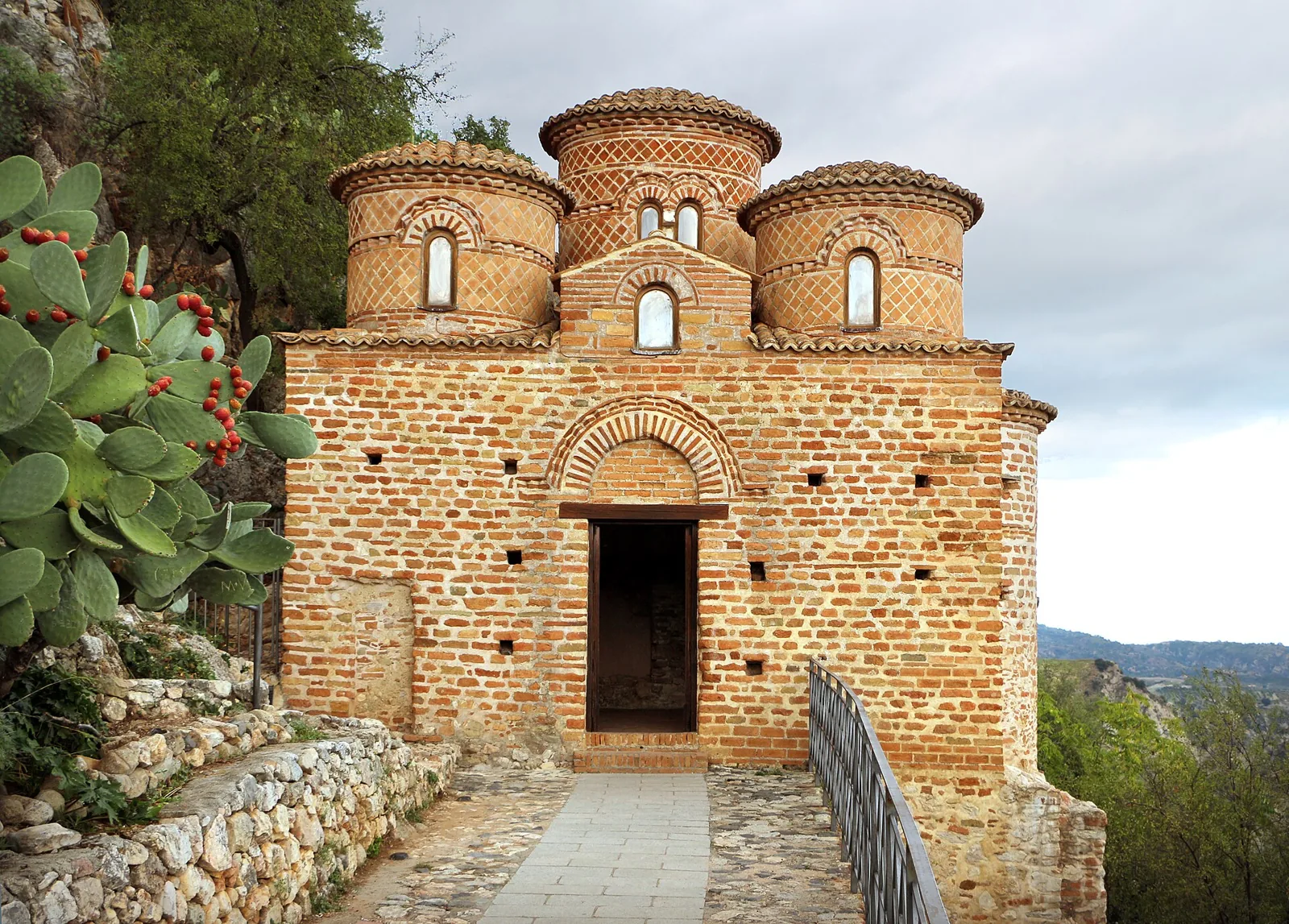
The name "Cattolica" most likely derives from the Greek katholikí. It may denote the main church of a monastic community or a temple of particular liturgical rank, although the precise local meaning of the term is not entirely unambiguous.
| Structural Element | Technical Characteristics |
|---|---|
| Temple plan | Greek cross inscribed in a square (Macedonian model). |
| Domes | Five domes with tiles arranged in diamond patterns. |
| Interior columns | Four ancient columns/spolia supporting the central dome. |
| Building material | Brick and mortar, spolia from ancient ruins. |
The church interior is divided into nine square spaces by four ancient columns. One of the columns is placed unusually – upside down, with a Corinthian capital at floor level, revealing the pragmatism of old master builders. Three apses facing east serve liturgical functions: the central one and the two lateral ones, typical of the Eastern rite.
The Legacy of Cattolica di Stilo – from Byzantine Temple to Modern Monument
The temple's name most likely derives from the Greek word Katholikì, associated with a main or privileged church. The building itself belongs to the world of Byzantine Calabria, and its history is part of the story of Stilo as an important centre of the Stilaro valley. After the Norman conquest, Latin influence grew gradually, but the Greek rite persisted here for a long time.
Modern knowledge of the monument is largely thanks to the outstanding archaeologist Paolo Orsi. He made an important contribution to the study and popularisation of the Cattolica di Stilo, drawing attention to the significance of this small church in the landscape of medieval Calabria. Several phases of painted decoration have been identified in the interior, showing that the temple was used and modified over a long period.
Over the centuries, the role of the Cattolica di Stilo in the social life of the region was significant. In the 19th and 20th centuries, the building was recognised as an exceptional monument of medieval Calabria and brought under the conservation protection of the Italian state. Today's appearance of the temple and the way it is opened to visitors are the result of conservation works carried out in stages in the 20th and 21st centuries, including the latest interventions preceding the reopening of the building in July 2026.
Byzantine Decorations in the Cattolica di Stilo – a Dialogue between East and West
The interiors of this Byzantine church are an interesting testimony to the long use of the temple. Fragments of wall paintings from different phases survive in the interior, but the decoration is incomplete and heavily damaged. The Catalogo Generale dei Beni Culturali states that all the walls preserve traces of frescoes executed in different phases between the late 10th and the 15th century.
It is precisely the fragmentary state of the interior that says most about its past today. Rather than a complete iconographic programme, what one sees here are traces of successive eras, each of which left behind new painted interventions. The Ministero della Cultura lists among the surviving representations, among others, the Dormitio Virginis, the Ascension of Christ, and the holy bishops Saint Nicholas, Saint Basil and Saint John Chrysostom. Thanks to this, the Cattolica di Stilo remains an important point of reference for the study of the interpenetration of Eastern and Western traditions in Calabria.
Watch on YouTube
Cattolica di Stilo – Spiritual Centre of Calabria
The Cattolica di Stilo is an important trace of the spiritual history of the region and one of the clearest signs of Byzantine Calabria. Stilo and the entire Stilaro valley are strongly connected to the Byzantine-Greek tradition, which developed here over centuries. The temple is therefore not an isolated monument but part of a broader religious landscape shaped by monasticism and the liturgy of the Greek rite.
Closely linked to this landscape is also the figure of John Theristus, one of the best-known saints of the region. San Giovanni Theristis was a monk venerated in both Greek and Latin traditions, and the most important sanctuary associated with his cult is the Monastero di San Giovanni Theristis in Bivongi, a few kilometres from Stilo. According to information from the Comune di Bivongi, the Monastero Greco-Ortodosso di San Giovanni Theristis is generally open daily from 09:00–13:00 and 14:00–18:00, and admission is free. In practice, the Cattolica is best seen in this wider context of the Stilaro valley, combining it with Bivongi on the same trip.
Practical Information
Location: Slopes of Monte Consolino, Stilo (RC)
By car: From the Ionian coast, take the SS106 Jonica, usually via the Monasterace/Stilo exit, then the SP9 road to Stilo
By train: The nearest station on the Ionian line is Monasterace-Stilo; from the station to the historic centre of Stilo is about 10–12 km uphill
On site: From the centre of Stilo to the Cattolica is a short drive or walk; visiting the building itself usually takes 20–30 minutes, and with the approach and viewpoints about 45–60 minutes
From 29 July 2026, the Cattolica di Stilo is open to visitors again. The current hours given by the Comune di Stilo are: Monday closed; Tuesday and Sunday 14:00–19:30; Wednesday–Saturday 8:30–19:30; the first Sunday of the month and 15 August 8:30–19:30. The ticket office closes 15 minutes before the monument closes.
The Direzione regionale Musei nazionali Calabria lists tickets at: full 4.00 euros, reduced 2.00 euros. The site can be contacted by email at drm-cal.cattolica@cultura.gov.it or by phone on 320 6130878. Before setting off, check the prices again, especially after the 2026 reopening.
The approach is short but steep in places, so in summer it is worth bringing water, a hat and shoes with good grip. The best light for photographs is usually in the morning and late afternoon. It is a good idea to combine the visit with the centre of Stilo, the Norman castle on Monte Consolino, and a trip to Bivongi and the Cascata del Marmarico.
Frequently Asked Questions
What period does the Cattolica di Stilo date from and why is it unique?
It is most commonly dated to the 10th century, often narrowed to the late 10th or early 11th century. Its uniqueness lies above all in its compact Byzantine form with five domes and the fact that it is one of the most recognisable examples of this type of architecture in Calabria.
Is Cattolica di Stilo inscribed on the UNESCO list?
The monument has been on Italy's UNESCO Tentative List since 2006, as part of the candidacy "Cattolica Monastery in Stilo and Basilian-Byzantine complexes". This is not yet a full World Heritage inscription but an important step in the candidacy process.
What are the opening hours of Cattolica di Stilo and how much does a ticket cost?
From 29 July 2026, the monument is open to visitors again. The stated hours are: Monday closed; Tuesday and Sunday 14:00–19:30; Wednesday–Saturday 8:30–19:30; the first Sunday of the month and 15 August 8:30–19:30, with the ticket office closing 15 minutes earlier. The Direzione regionale Musei nazionali Calabria lists a full ticket at 4.00 euros and a reduced ticket at 2.00 euros.
Where do the Arabic inscriptions inside the church come from?
Arabic inscriptions on one of the columns are confirmed; one corresponds to the profession of faith, while the other is translated as "Glory to God". There is no certainty, however, as to why they are in the church: explanations include the temporary use of the building as a Muslim oratory, the involvement of Arab craftsmen, or the reuse of a column that already bore the inscriptions.
What is the best way to get to Cattolica di Stilo?
The most convenient way is by car from the SS106 Jonica, usually via the Monasterace/Stilo exit and then the SP9 road to Stilo. The nearest railway station is Monasterace-Stilo on the coast, but from there to the town it is still about 10–12 km uphill.
Last updated: