The castle on Monte Consolino, set amid the mountainous scenery of Calabria, is an important testament to the Norman presence in the region. This fortress, rising to 701 metres above sea level, is a relic of its former defensive role and a trace of the long history of this place. The ruins on the summit, associated with the 11th century, attract tourists and scholars as a legible sign of the multicultural past of Stilo and the Stilaro valley.
The castle did not arise in a vacuum. Stilo developed as an important centre already in the Byzantine era, and the surrounding area was settled earlier, joining Greek, Byzantine, and later Norman traditions. The best reminder of this continuity is the nearby Cattolica di Stilo, usually dated to the 10th century and regarded as the most important surviving Byzantine monument of the town.
Table of Contents
- Strategic Significance of the Castle on Monte Consolino in Medieval Political Realities
- Norman Essence in the Ruins of Stilo Castle – A Testament to Medieval Might
- The Normans and Their Legacy in Calabria – An Analysis Through Stilo Castle
- Earthquakes as Catalysts of Destruction at the Castle on Monte Consolino
Strategic Significance of the Castle on Monte Consolino in Medieval Political Realities
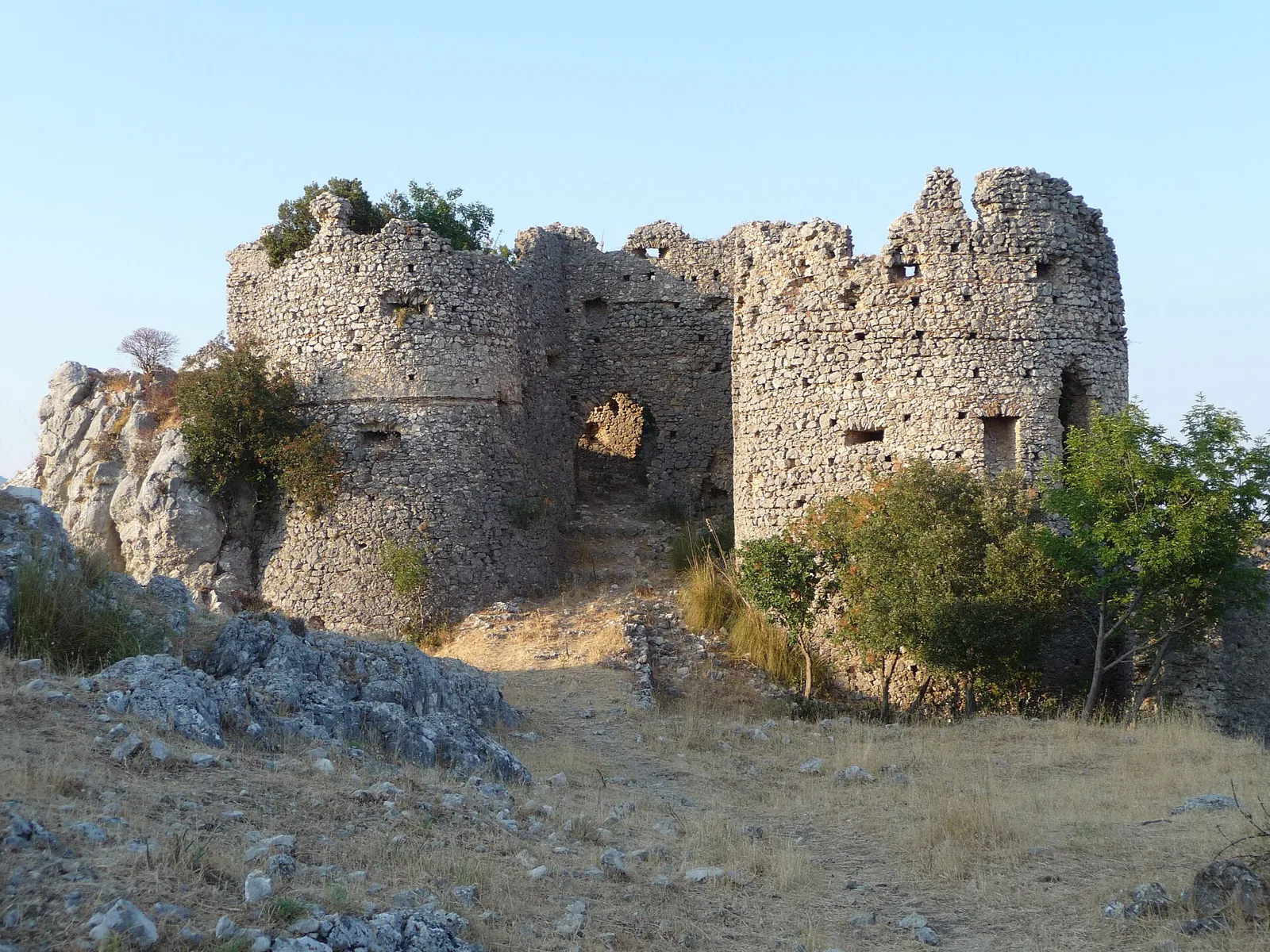
The castle on Monte Consolino, also known as Castello Normanno di Stilo, played an important strategic role in the Middle Ages. Perched on a mountain summit, it offered wide views of the Ionian Sea and surrounding hills, and above all allowed control of important routes inland. Its location at the very peak enabled observation of a broad stretch of the Ionian coastline, making the fortress difficult to surprise.
| Geographical-Technical Parameter | Specification |
|---|---|
| Summit elevation | 701 m a.s.l. |
| Location | Summit of Monte Consolino, Stilo (RC) |
| Rock formation | Limestone (roccia calcarea) |
| Elevation gain from town | Approximately 301 metres |
Control of Communication Routes
Monte Consolino, with its view over the Calabrian coast, was well positioned for controlling the Stilaro valley and a stretch of the Ionian coastline. Its location favoured oversight of the movement of people and goods between the coast and the mountain hinterland. The fortress served as an important control point over the Stilaro valley, protecting the town of Stilo and an area of considerable economic importance for the region.
Defence Against Threats
The Norman fortress also served a defensive role against external attacks, protecting inhabitants from threats arriving from the coast. The strengthening of settlement on elevated terrain intensified in the Middle Ages partly for defensive reasons, although the history of Stilo is older and strongly linked to the Byzantine period as well. Together with other fortifications, the castle formed part of the system securing this stretch of southern Calabria.
Political and Administrative Significance
On the political plane, Monte Consolino was a place of symbolic dominion over the area, serving as an important centre of governance and feudal authority. In the 13th century, under the Angevins, the castle functioned within the administration of the Kingdom of Sicily. Documents from 1281 describe conservation works to which local barons were obligated, showing that the stronghold remained important to the Crown.
Role in the Defence System
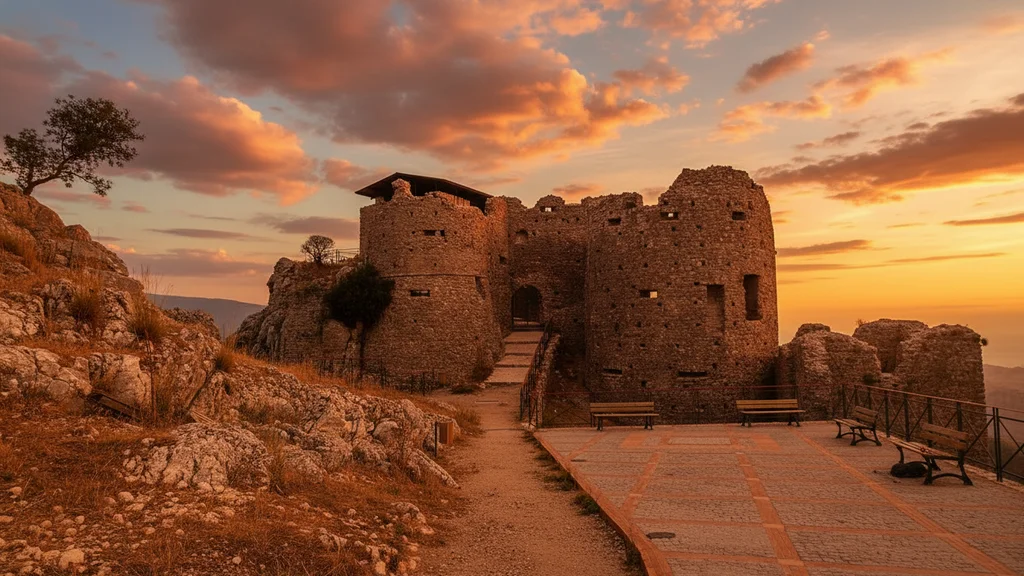
The castle on Monte Consolino was part of a network of medieval fortifications, providing excellent visibility and an early warning system. The builders exploited the irregular orography of the terrain, running walls along the line of rock and steep slopes. To this day, the ruins clearly show how strongly the architecture here was subordinated to the topography of the place.
Watch on YouTube
Norman Essence in the Ruins of Stilo Castle – A Testament to Medieval Might
The castle on Monte Consolino is a legible example of medieval defensive architecture adapted to rugged terrain. Today, what is most visible here are the surviving fragments of curtain walls, tower remnants, and the irregular outline of the entire complex, subordinated to the rock and steep edges of the hill. These are ruins that must be read as a multi-phase structure, transformed over the centuries, rather than a homogeneous building from a single moment in history.
Architectural Characteristics of the Castle
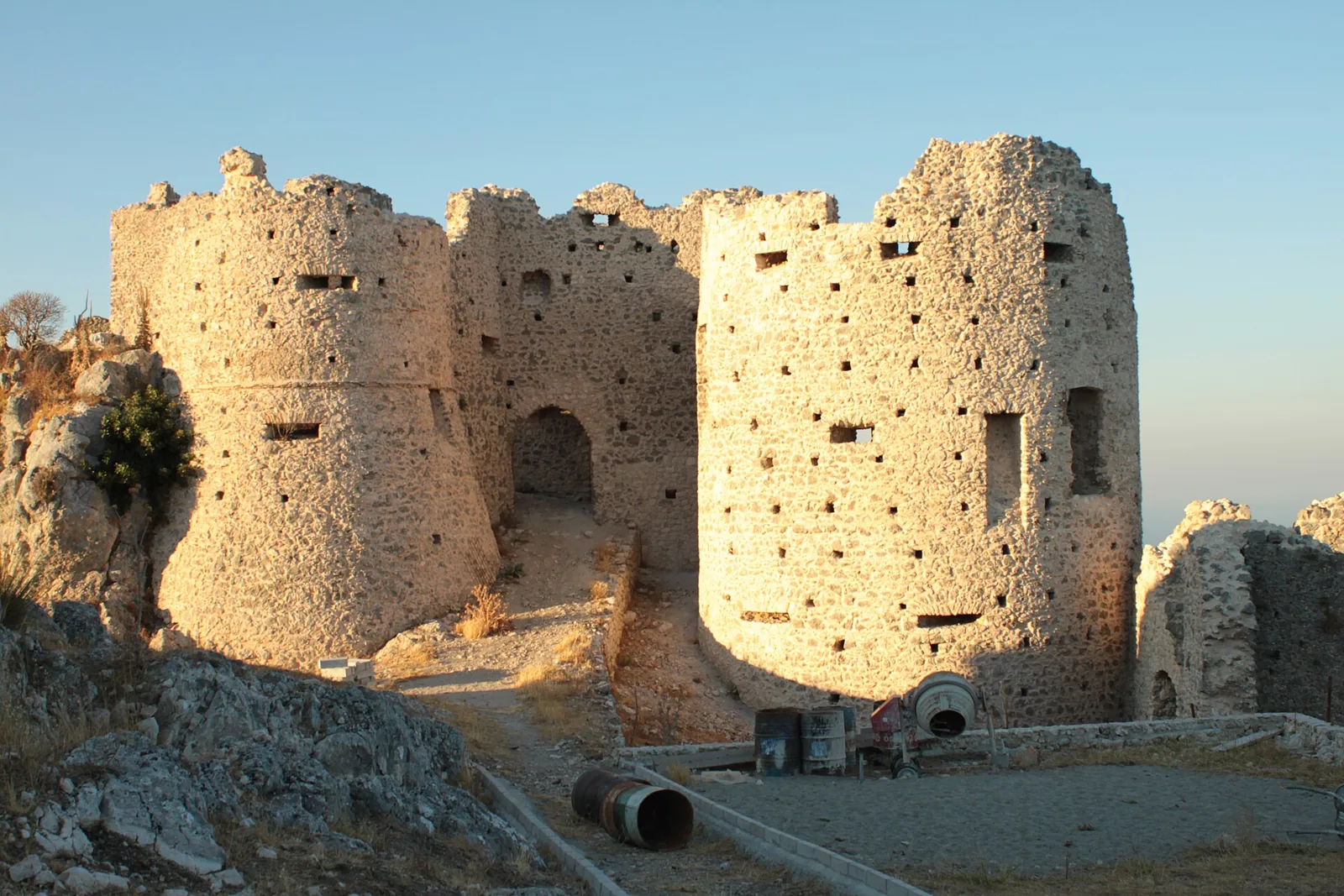
The castle in Stilo is distinguished by its simplicity of form, underscored by austere stone structures devoid of elaborate detail. According to the Catalogo Generale dei Beni Culturali record, it was a Norman structure built of stone and mortar, laid out on an irregular plan. Historically it had three storeys, while today its state of preservation is described as a rudere, or ruin.
The ruins preserve above all fragments of walls and tower remnants, and the whole is adapted to the irregular topography of Monte Consolino. The visible walls reach a maximum height of around 8 metres, and an underground cistern also survives. On the ground floor there were 9 rooms, including 2 in the tower blocks by the entrance, which helps to imagine the scale of the former fortress. Later rebuilds and repairs mean that today's image of the castle is the result of many phases, not solely the original Norman concept.
| Architectural Element | Characteristics and Functions |
|---|---|
| Curtain walls | Surviving fragments of the defensive perimeter adapted to the rock edge. |
| Tower remnants | Remains of flanking and observation elements visible in the ruins. |
| Complex layout | Irregular outline subordinated to the topography of Monte Consolino. |
| Multi-phase character | Structure transformed over the centuries, legible today as a ruin complex. |
Comparison with Other Norman Constructions
Compared to the richly decorated cathedrals of Sicily, the castle in Stilo shows a more functional face of the Norman era. Here it is not about decoration, but about position, control of terrain, and the subordination of architecture to defensive function. It is precisely this austerity that means the ruins on Monte Consolino are read today above all through their relationship with the landscape.
The Normans and Their Legacy in Calabria – An Analysis Through Stilo Castle
The Normans in Calabria: Historical Context
The Normans played a key role in shaping the culture and architecture of Calabria, particularly in the 11th century. These warriors, led by figures such as Robert Guiscard, extended their influence across southern Italy, creating a dynamic state. Calabria, situated between the Tyrrhenian and Ionian Seas, was an arena of action for many powers, and the Normans introduced a new feudal and urban system.
In Stilo, their presence overlaid much older layers of history. The town was an important centre already in the Byzantine era, and the Stilaro valley preserved traces of Greek, religious, and administrative traditions predating the Norman conquest. Thanks to this, the castle on Monte Consolino is best understood as another link in a long chain of settlement and strategic continuity, rather than the beginning of this place's story.
Construction of the Castle on Monte Consolino
The castle's construction dates to the 11th century, the period of strengthening Norman presence in Calabria, and is sometimes associated with the times of Roger I. The year 1093 is an important reference point for the region's history on account of a document of Roger I connected with the Charterhouse of St Bruno. In subsequent centuries, the fortress remained part of the power structures of the Kingdom of Sicily, and its importance waned only with later destruction and progressive abandonment.
Architectural and Cultural Heritage
The castle in Stilo is part of a broader cultural landscape in which Byzantine, Norman, and modern layers meet. The relationship between the austere ruins on Monte Consolino and the Byzantine Cattolica at its foot well illustrates that the town cannot be contained within a single era. Tommaso Campanella, born in Stilo in 1568 and died in 1639, is another important element of this heritage, although he wrote his "City of the Sun" around 1602 during imprisonment in Naples, not in his home town.
A Dark Chapter of History – The Angevin Prison
In the 13th century, the castle functioned within the Angevin administration of the Kingdom of Sicily, and its role was not limited solely to military function. The Comune di Stilo states that political prisoners were held in the castle in the time of Charles of Anjou. This is a concrete detail that shows the administrative and repressive dimension of the fortress.
The municipal description also mentions prisons cut beneath the castle into the limestone wall of Monte Consolino. Access to them was said to be possible only by lowering or pulling someone up from above with a block and tackle. In the case of Monte Consolino, such information is more useful than later sensational stories, because it relates directly to the topography of the rock and the castle's function.
Earthquakes as Catalysts of Destruction at the Castle on Monte Consolino
The castle on Monte Consolino is a witness to history and long degradation in one of the most seismically active regions of Italy. Its position on rocky terrain means the ruins have for centuries been exposed not only to tremors but also to erosion and gradual degradation. The condition of the surviving walls has been affected by wars, abandonment, and the lack of continuous conservation, rather than a single event.
The present state of the ruins should be linked to many factors: long abandonment, degradation, armed conflicts, and damage which, according to the Comune di Stilo, intensified during the Franco-Spanish war and was deepened in 1806 by Napoleonic troops. The earthquakes of 1783 widely affected southern Calabria, but without an additional source they should not be presented as the main cause of the castle's ruin. In the 21st century, stabilisation work has been carried out, but it is safer to treat these generally as protective measures at the ruins.
Frequently Asked Questions
How long does it take to climb Monte Consolino to the castle in Stilo?
The ascent from the historic centre of Stilo usually takes about 45–60 minutes one way, depending on the pace and chosen path. The approach is steep and stony in places, so it is best to have full-soled shoes with good grip, water, and a sun hat.
What can you see from the castle ruins on Monte Consolino?
The ruins offer a wide panorama of the Stilaro valley, the Ionian Sea, and the rooftops of Stilo. In good visibility, the surrounding hills and nearby towns including Pazzano and Bivongi are also clearly visible.
What is the history of the Norman castle in Stilo?
The castle is associated with the Norman period and the 11th century, and the year 1093 is an important reference point for the region's history. In the 13th century, the fortress functioned within the administration of the Kingdom of Sicily, and its later ruin is linked to abandonment, degradation, and wartime destruction, including damage intensified during the Franco-Spanish war and deepened in 1806 by Napoleonic troops.
Is the castle in Stilo accessible to climbers?
The castle should be treated primarily as a destination for a hiking excursion and a ruin site, rather than a typical sports venue. On site, caution is advised as the approach is steep and the surface can be uneven and stony.
What is the Palio di Ribusa held in the shadow of the castle?
The Palio di Ribusa takes place in Stilo every year on the first Sunday of August, and its tradition was revived in 1997. It is a historical re-enactment connected with the realities of the 15th–17th centuries, the Fera de Ribusa, and the figure of the Mastrogiurato. The programme refers to old rivalries and tournaments such as tiro al cerchio, tiro all’anello, tiro con l’arco, tiro con la balestra, and tiro al montone.
The ruins are located above Stilo on Monte Consolino, and the starting point for the walk is within the town. The official Comune di Stilo website gives the site address as Castello Normanno, 89049 Stilo RC, the access mode as Accesso libero, and the municipal contact telephone number as 0964 776006. This is not a typical museum site with a ticket office and fixed visiting rhythm, but an open-air approach to ruins, so you should expect a lack of standard infrastructure on site. Driving is the most practical option, especially as public transport connections in this part of the Stilaro valley are limited and often require travel via larger centres of Ionian Calabria. It is best to set off in the morning or late afternoon, outside the worst of the heat.
Last updated: