Swordfish fishing in the Strait of Messina is one of the oldest living fishing traditions in the Mediterranean basin, practised to this day on the waters between Calabria and Sicily. Fishermen from Scilla and nearby Bagnara Calabra head out to sea on specialised boats with tall sighting platforms, spotting and harpooning swordfish as they pass through the strait. This craft remains an important element of local identity and a memory of the old fishing world.
It is safer to speak here of ancient origins than of a single specific date. The most reliable ancient reference point is Polybius, the 2nd-century BC historian, whose description of swordfish fishing in the sea off Scilla became a key source for later authors, including Strabo. Swordfish fishing in the area of Scyllaeum and Messana was known already in antiquity, and the realities of fishing in the Strait appear in descriptions by Graeco-Roman authors writing about Scylla, Charybdis and the richness of these waters. This is not a local curiosity but a tradition deeply rooted in the history of the place.
Table of Contents
Boats and technique – feluca, luntro, and passarella
Traditional swordfish fishing in the Strait of Messina involves specialised vessels and a small crew in which each member has a clearly defined role. Historically various types of boat and local naming conventions existed, but today the most characteristic remains the feluca used in the Scilla and Bagnara Calabra area. According to the ICCD record, the traditional luntro was about 6 m long and just over 1.5 m wide, a small working boat suited to manoeuvring close to the fish.
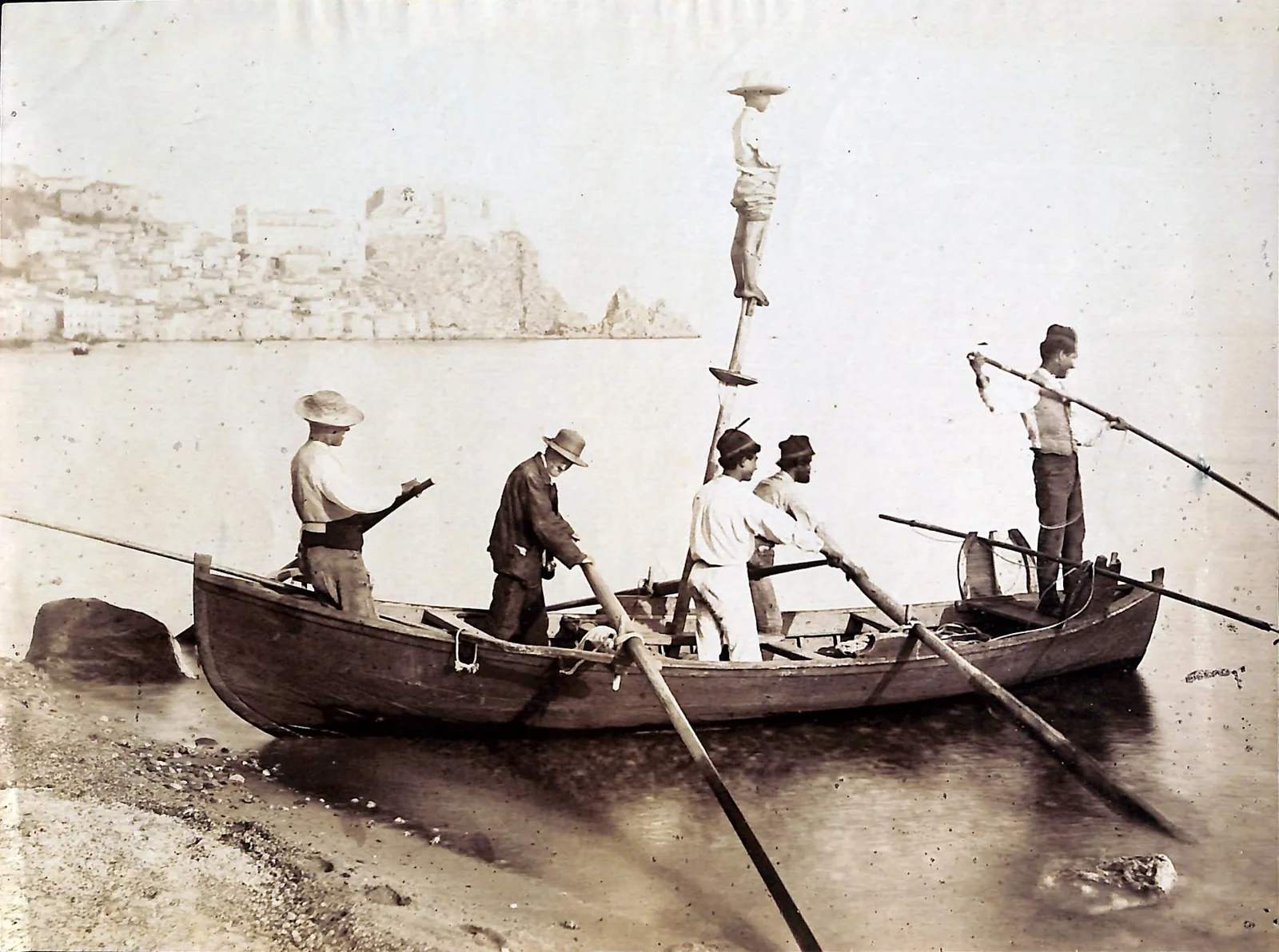
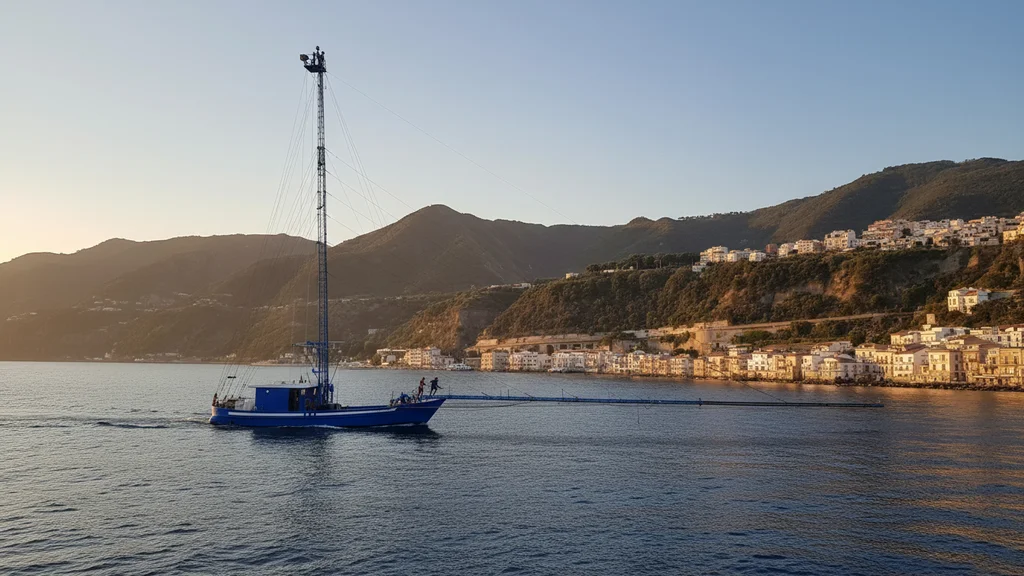
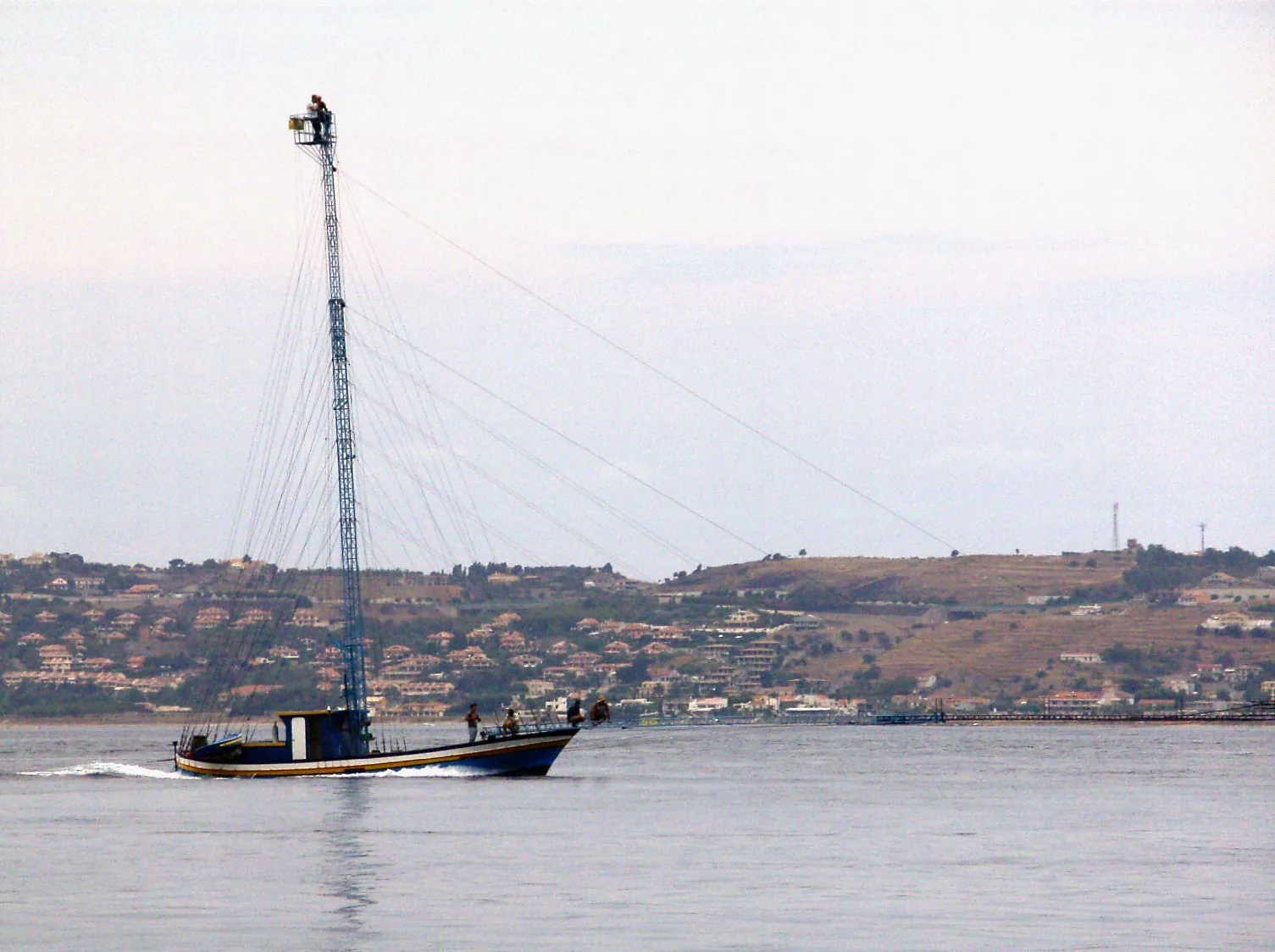
The feluca (feluca, sometimes also spelled felucca) is a boat fitted with a very tall lattice mast or sighting tower and a long front walkway. Older feluche had a sighting mast of about 20 m, giving the spotter a wide field of view over the surface of the water. The spotter stands high above the deck and from this position watches for fish near the surface, signalling the crew to manoeuvre. It is precisely this silhouette – a slender hull, a tall tower and a long boom over the water – that has become one of the symbols of the Strait.
To clarify the terminology: the passerella or passarella is the walkway projecting beyond the bow for the harpooner; in local usage, the same name is also used for a modern motorised fishing vessel with a tall lattice sighting tower and a long bow passerella. From 1963, the motorised passerella was introduced with a tall lattice tower and a bow passerella at least twice as long as the hull. It does not replace the sighting mast but works alongside it – the spotter stands high up while the harpooner works on the front walkway.
| Element of the tradition | Details |
|---|---|
| Fishing season | April–September; for visitors, the best chances of observation usually fall in late spring and summer. |
| Feluca | Tall sighting mast or tower and a long front walkway |
| Passerella / passarella | Long walkway at the bow from which the harpooner operates |
| Spotter | Watches for fish from a high position above the deck and directs manoeuvres |
| Harpooner | Operates from the front walkway at the decisive moment of approaching the fish |
| Heritage protection | Local fishing tradition and an important element of Scilla and Bagnara Calabra identity |
On 15 May 2024, the traditional pesca dello Stretto di Messina was included among the Slow Food Presidia. The initiative covers the fishing community on both shores of the Strait, highlights the seasonal and selective nature of the catch, and treats the feluca not only as a working tool but also as cultural heritage.
Hunting strategy – knowledge passed down through generations
The fishermen of Scilla draw on a profound understanding of the sea and fish behaviour, handed down through families and fishing crews for generations. In local practice and stories, the motif of observing pairs of swordfish in season and choosing the moment to strike so as to increase the chances of success recurs. It is better to treat this as part of traditional fishing knowledge than a rigid biological rule. Polybius's ancient description shows that already in the 2nd century BC swordfish fishing off Scilla was distinctive enough to become a reference point for the later written tradition.
The choice of fishing ground is no accident. The Strait of Messina, just 3.2 km wide at its narrowest point, forms a natural “funnel” through which migrating fish must pass. The Strait is a corridor for the seasonal migration of swordfish; in spring and summer, during the breeding period, the fish move along a route from Bagnara and Scilla towards Messina and Punta Faro, which makes it possible to spot them from high lookout positions. It is precisely this geography that has made Scilla and neighbouring Bagnara Calabra among the best-known centres of traditional harpoon swordfish fishing in the Strait of Messina.
The tradition also has a communal dimension. Documented practices connected with the catch include rituals relating to the fish itself, such as the cardata da cruci, the sign of the cross made on the swordfish's gills after it has been hauled onto the boat. Sources also record the invocation “San Marcu è binirittu”. These gestures show that for fishermen the swordfish was not only a commodity, but part of an order of work, faith and the local language of the sea.
Watch on YouTube
Swordfish in cuisine and culture – Sagra del Pesce Spada
Swordfish (pesce spada) is not just an object of the catch – it is a pillar of Calabrian cuisine and a cultural symbol of Scilla. Swordfish meat is delicate, slightly pink in colour, and suited to a wide range of culinary techniques:
- Grilled swordfish – steaks marinated in olive oil, lemon, and oregano, grilled over charcoal
- Involtini di pesce spada – thin rolls stuffed with breadcrumbs, capers and olives
- Carpaccio di pesce spada – raw, thinly sliced with olive oil and lemon
- Pasta con pesce spada – pasta with swordfish sauce, tomatoes, capers, and olives
In the cuisine of the Strait area, swordfish most commonly appears alla griglia, alla ghiotta – with tomatoes, olives and capers – and in involtini. Bagnara Calabra is famous not only for pesce spada but also for torrone di Bagnara IGP, and related traditions of preparing this fish exist on both sides of the Strait. In Scilla and Bagnara the local narrative is very specific: swordfish is not just a dish but part of the fishing identity of the place.
The climax of the season can be the Sagra del Pesce Spada (Swordfish Festival), usually held in summer, often in July or August, depending on the municipality's calendar and organisers. It is a good opportunity to sample various swordfish dishes and hear stories from people connected with the sea. Check the current programme before travelling, as dates of local sagre can change.
Practical information
Fishing season: April–September; for visitors, the best chances of observation usually fall in late spring and summer
Sagra del Pesce Spada: usually in summer, often in July or August, in Bagnara Calabra, about 9–10 km north of Scilla.
Where to see the boats: The best chances are at dawn, when vessels depart from the ports of Scilla and Bagnara Calabra; from land, good vantage points include the waterfront in Scilla, the Chianalea area and viewpoints near Castello Ruffo
Where to try swordfish: Restaurants in Chianalea serve fresh swordfish in the fishing season
The easiest way to reach Scilla is by train on the Tirrenica Meridionale line. From Reggio Calabria Centrale station a regional train usually takes about 20–30 minutes, and from Villa San Giovanni about 10–15 minutes; Bagnara Calabra lies further north on the same line. By car, Scilla is on the A2 del Mediterraneo motorway, exit Scilla.
Remember that observing the boats is not a guaranteed daily attraction. Visibility depends on the weather, sea conditions and the fleet's current activity, so it is best to treat it as a bonus to a morning walk along the waterfront rather than a fixed item on the itinerary. In the MASAF register for 2026, 17 vessels are listed as authorised for swordfish fishing as “feluche”, alongside a separate extensive list of longliners. This shows that traditional fishing still exists today on a limited, regulated scale.
Frequently Asked Questions
How old is the swordfish fishing tradition in Scilla?
It has very ancient origins and was known already in antiquity in the Strait of Messina area. The most reliable ancient reference point is Polybius, the 2nd-century BC historian, whose description of swordfish fishing off Scilla became a key source for later authors. It is safer to speak of ancient sources and centuries-long continuity than of a single precise date for the beginning of this tradition.
What is a feluca and why does it have such a tall mast?
A feluca is a traditional swordfish fishing boat fitted with a very tall sighting platform and a long front walkway. The spotter watches for fish from above while the harpooner operates from the passerella extending beyond the bow. It is precisely the combination of these two elements that gives the boat its characteristic silhouette.
When is the Sagra del Pesce Spada held?
Usually in summer, often in July or August, but the date can change from year to year. Before travelling it is best to check the current calendar of the municipality and organisers.
Can you watch traditional swordfish fishing live?
The best chances are at dawn from late spring to summer, when boats depart from the ports of Scilla and Bagnara Calabra. The fishing season runs from April to September, but observation from land depends on the weather, sea conditions and the fleet's activity. From the waterfront, Chianalea and viewpoints near Castello Ruffo you can observe the vessels at sea.
Last updated: