Castello Ruffo di Scilla is a mighty fortress built on a rocky promontory above the Strait of Messina – on the rock traditionally identified as the place where the mythical Scylla from the Odyssey was located. This defensive site has a history stretching back over 2,500 years, though the present form of the castle is the result of much later rebuilds. It is an essential stop on any visit to Scilla – both for the views and the fascinating history; in exceptionally clear weather you can make out the Sicilian coast and sometimes part of the archipelago, especially Stromboli.
Table of Contents
History of the fortress – from Anaxilas to the Ruffo dynasty
The first fortification on Scilla's rock was erected in the 5th century BC by order of Anaxilas, tyrant of Rhegion (today's Reggio Calabria), as a defence against pirates raiding the Strait of Messina. In 390 BC the fortress was seized by Dionysius of Syracuse, and during the Roman period the site retained its importance as a key control point for the crossing between Calabria and Sicily.
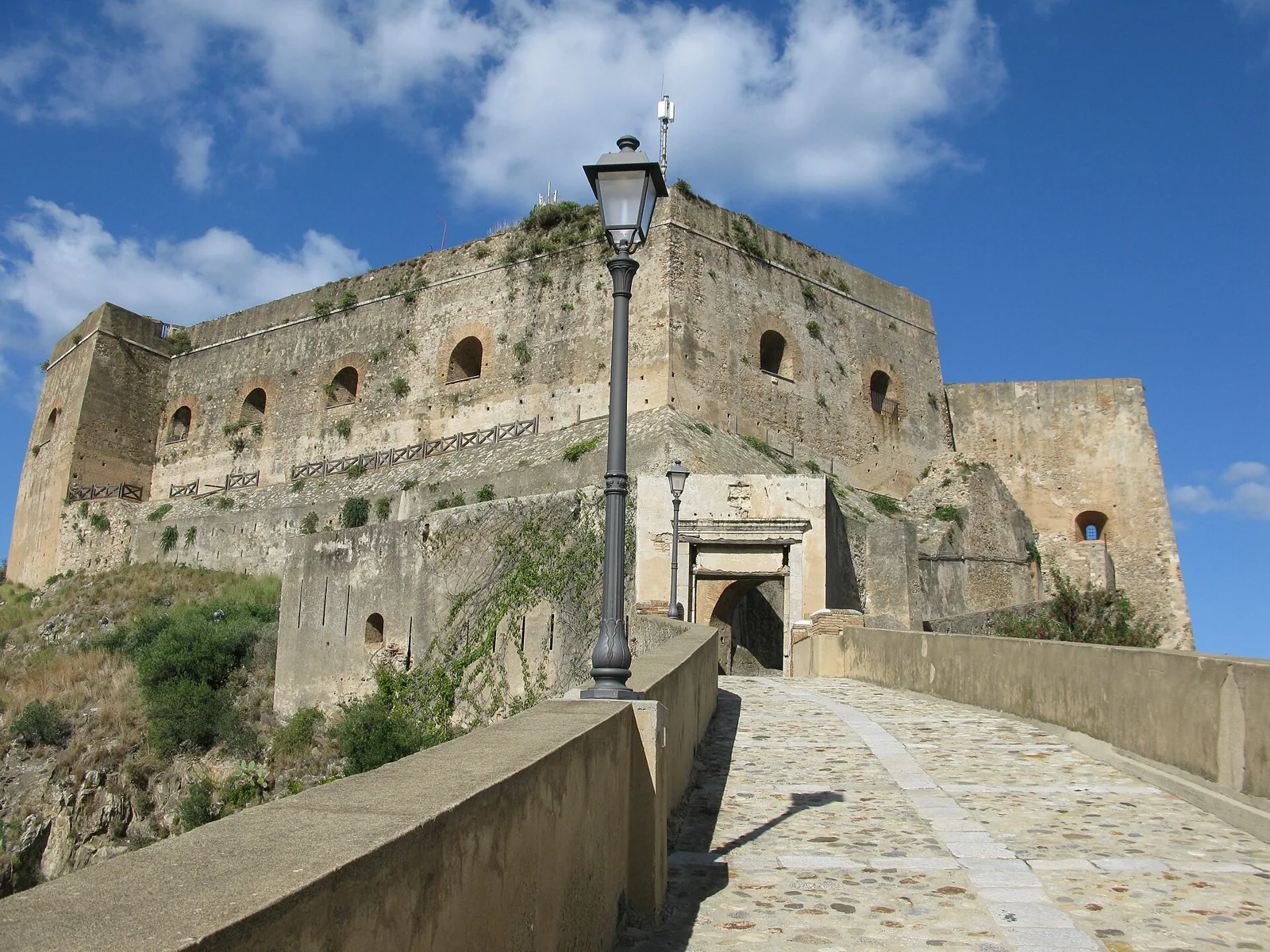
In 1060 the castle surrendered to Robert Guiscard, the Norman conqueror, who turned it into a military garrison. Over the following centuries the fortress changed hands repeatedly, until in 1412 the De Nava family became lords of Scilla. In 1533 Gutierrez De Nava sold the fief to his brother-in-law Paolo Ruffo, and the Ruffo di Sinopoli held Scilla until the abolition of feudalism in 1806. It is this family that gave the castle its present name and is associated with an important phase of residential and defensive rebuilding: during this period the site was enlarged and adapted to serve as a feudal residence.
Two catastrophic earthquakes – in 1783 and 1908 – severely damaged the castle. The site was subsequently rebuilt and transformed, and a lighthouse from the early 20th century operates at its summit, continuing the age-old watchful role of this location.
Crucial to the fortress's present appearance, however, was the early 19th century. In 1808, during Joachim Murat's reign in the Kingdom of Naples, the castle was heavily rebuilt and fortified as part of the defence system of the Strait of Messina against the British and Bourbons in Sicily. In the Napoleonic era the castle retained its military importance; in 1808 it became state property, and around 1810 it was being restored and adapted to the defensive needs of the strait.
Mythology – Scylla and Charybdis from Homer's Odyssey
The rock on which Castello Ruffo stands is, according to the ancient Greeks, the lair of the sea monster Scylla – a six-headed beast that snatched sailors from passing ships. On the opposite side of the strait, off the coast of Sicily, lurked Charybdis – a whirlpool that swallowed entire vessels. In Book XII of the Odyssey, Homer describes how Odysseus, following the sorceress Circe's advice, chose the route closer to Scylla – losing six companions but saving the ship from Charybdis.
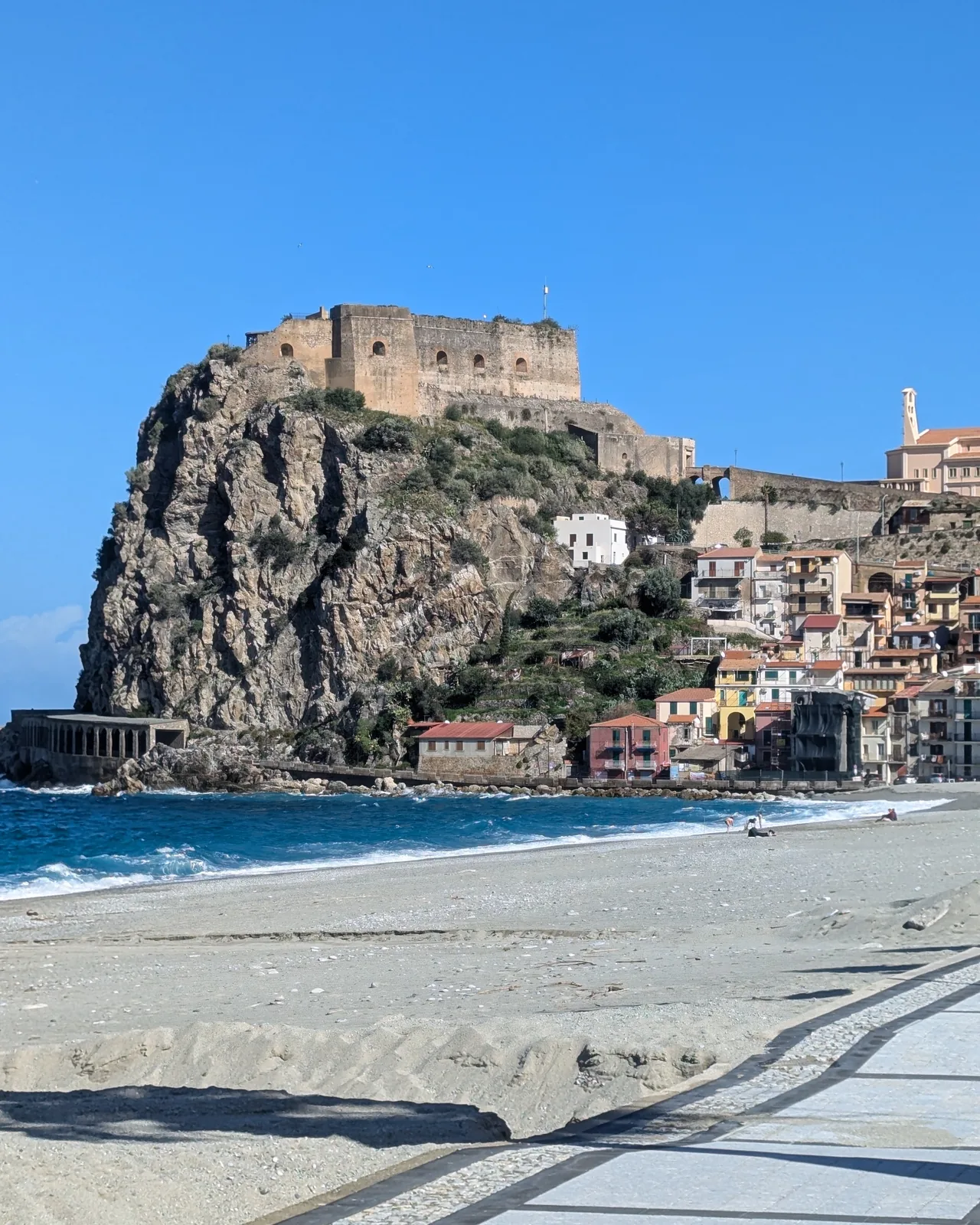
The phrase "between Scylla and Charybdis" has become a universal metaphor for choosing between two evils. Standing on the castle walls, it is easy to see where the legend came from – powerful currents, swirling waters, and a sheer cliff dropping straight into the sea create a landscape tailor-made for mythology. In the classical tradition, Scylla and Charybdis are placed on opposite sides of the Strait of Messina, and Scylla herself has over time become strongly identified with present-day Scilla. This is an important element of local cultural and tourist narrative, but the mythological identification of the rock should be separated from the history of the castle itself, whose present form is much later.
Watch on YouTube
What to see – architecture, museum, and panoramas
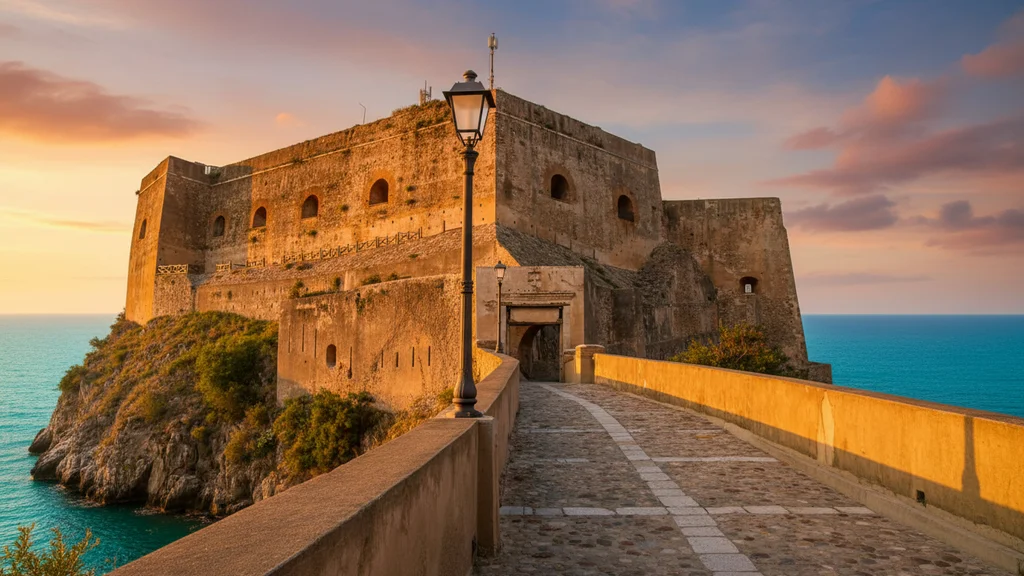
The castle has an irregular layout adapted to the terrain, standing on a monolithic rock that dominates the entrance to Chianalea and Marina Grande. The present plan is dictated by the shape of the promontory, and the visible elements are mainly the perimeter walls, viewing terraces and sections rebuilt in the early modern and Napoleonic eras. At the entrance, look for the bridge leading to the building, the stone portal with a pointed arch, the Ruffo family coat of arms and a plaque commemorating a 16th-century restoration. From there you pass through an androne with a lowered vault into the courtyard, where a grand staircase leads to the residential section.
The interior now serves cultural and exhibition functions, and the halls are used for temporary exhibitions and events. The most notable elements connected with local tradition include:
- Luntre – an original fishing boat used in the traditional swordfish hunt in the Strait of Messina
- Naturalistic exhibits – models and artefacts related to the swordfish fishing tradition
- Lighthouse – operating on the castle grounds, highlighting its historic role in controlling this stretch of coastline
Traditional swordfish fishing in Scilla relies on specialised boats: a feluca or passarella with a tall sighting mast and a long walkway, plus smaller support vessels. The season falls mainly from late spring to summer, when swordfish migrate through the Strait of Messina. It is one of the most recognisable elements of the identity of Scilla and the entire Costa Viola coast.
The real attraction, however, is the panorama from the defensive walls. To the north stretches the Costa Viola – a cliff-lined coast with violet hues. To the south lies the Strait of Messina with Sicily beyond, and on clear days Mount Etna's silhouette rises on the horizon. In exceptionally clear conditions, you can also make out part of the Aeolian Islands on the horizon, especially the distinctive cone of Stromboli.
Practical information
Location: The castle stands on a rocky headland between Chianalea and Marina Grande beach, above the entrance to the historic part of Scilla; the address is Piazza Matrice, 89058 Scilla RC, and the entrance leads from Piazza Matrice up the ramp to the visitor office
Hours: According to official information from the Comune di Scilla updated on 29 June 2026, the castle is closed on Mondays and open Tuesday to Sunday from 09:00–13:40 and 15:00–20:00; before visiting, check municipal notices, especially outside the main season or on event days
Getting there: On foot from the centre of Scilla or from Reggio Calabria (25 km, about 30 min by car)
Visit duration: Approx. 45–60 min
Tickets: The single ticket costs €3.00; children up to 6 years old and people with certified disabilities with a companion enter free of charge; contact phone: 0965 616629
From Scilla railway station to the castle is approximately 1 km, and the walk usually takes 15–20 minutes, partly along steep streets. From Marina Grande you can reach the entrance to the headland in about 10 minutes, and from Chianalea even more quickly. In summer, parking near the centre and Marina Grande can be very limited, so it is most convenient to leave your car in the public car parks in the upper part of the town and walk down.
Frequently Asked Questions
How old is Castello Ruffo and what can you see there today?
The first fortification on this site dates to the 5th century BC. The present appearance of the castle is the result of many rebuilds, particularly from the early modern period and the early 19th century. Today you can see mainly the walls, viewing terraces, exhibition spaces and the lighthouse operating on the castle grounds.
What is the castle's connection to Greek mythology?
The castle rock is traditionally identified as the lair of Scylla – the sea monster from Homer's Odyssey. Together with Charybdis on the Sicilian side, they formed a deadly trap for sailors passing through the Strait of Messina.
Can you see Sicily from the castle?
Yes – in good weather the Sicilian coast is very close and clearly visible from the walls. The narrowest section of the strait is approximately 3.1 km. On very clear days you can also spot Mount Etna, and sometimes part of the Aeolian Islands, especially Stromboli.
How long does a visit to Castello Ruffo take?
A standard visit takes 45–60 minutes, including the exhibition and time to admire the panoramic views from the defensive walls.
Last updated: