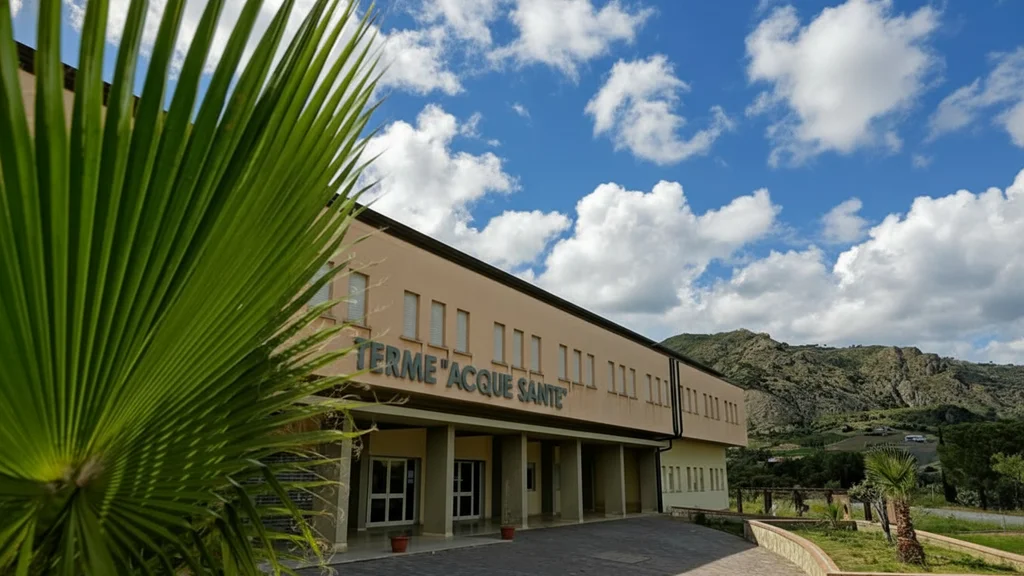
Calabria has more than beaches and seaside towns: it also has small spa resorts hidden inland. One of them is Terme di Antonimina, natural hot springs located near Locri, at the foot of Aspromonte National Park. It is a good address for travellers who want to combine thermal treatments with exploring Locride: the ancient heritage of Locri Epizephyrii, medieval Gerace and the Ionian coast. Below you will find the history of the site, a description of the waters and practical information for planning a visit.
Table of Contents
The History of Terme di Antonimina – Ancient Roots and Traditions
Terme di Antonimina, known by the name Acque Sante, meaning Holy Waters, is one of the important thermal sites in this part of Calabria. Antonimina lies in the Locride area, inland from the Ionian coast, which is why many travellers associate this spa with Locri – the nearest larger town and natural point of access. The historical background of the region is relevant here: ancient Locri Epizephyrii was one of the important cities of Magna Graecia on the Ionian coast of Calabria.
Tradition links the Acque Sante Locresi with ancient Locri Epizephyrii, although when describing the ancient use of the springs it is necessary to distinguish local memory from firmly dated evidence. The facility's official website refers to studies by Dr Accorinti from 1830, while regional sources state that the modern thermal structure, Consorzio Termale Antonimina, was established in 1870. Antonimina itself, as a settlement, has agricultural and pastoral origins, dated by the facility's website to around the 15th century. This gives the history of the baths a clear chronology: an old tradition of the waters, 19th-century studies and the later development of an organised spa.
Origins and Development of the Baths
The thermal springs around Antonimina have long been part of local memory as a place associated with healing waters and rest. Rather than attributing specific descriptions to ancient authors without precise references, it is better to accept that the tradition of using these waters in Locride is old but requires precise confirmation from sources. The most reliable reference points for the more recent history are the mention of Dr Accorinti's studies from 1830 and the date 1870, given for the modern thermal structure.
The facility is managed by Consorzio Termale Antonimina-Locri. The earthquakes of 1783 and 1908 were important in the history of Antonimina, but their direct impact on the spa buildings should be described only on the basis of specific sources. If you are planning a visit, it is best to treat the history of the baths as part of the broader Locride landscape – an area where Greek, medieval and modern traditions have intertwined for centuries.
Cultural and Medical Significance
The significance of Terme di Antonimina comes not only from the water itself but also from its location at the junction of the Ionian coast and the Aspromonte hinterland. In the practical rhythm of travel through Calabria, this place shows the region well: a morning walk through a historic town, an afternoon at the baths, and an evening return to the sea. In balneological tradition, similar centres are mainly associated with treatments supporting the respiratory tract, the musculoskeletal system and selected gynaecological indications, without making overly far-reaching medical promises.
Era |
Status and Significance |
Documentation / Source |
|---|---|---|
Antiquity (Magna Graecia) |
Local tradition links the springs to the heritage of Locride |
Requires precise source confirmation |
19th century |
In 1830 Dr Accorinti studied the thermal waters; the modern thermal structure is dated to 1870 |
Information cited by the facility and regional sources |
19th century |
Development of modern spa tradition |
To be verified in local documentation |
20th–21st century |
Spa and tourist function in Locride |
Organisational information requires current checking |
Healing Properties of Calabria's Hot Springs
The foundation of Terme di Antonimina's reputation lies in the combination of a stable water temperature and a long-standing balneological tradition. The water emerges from the spring at approximately 36°C, giving it a clearly thermal character and allowing treatments to be carried out without intensive heating. According to the Acque Sante facility, the waters are classified as thermo-mineral, isotonic, mildly sulphurous, saline-sulphate-alkaline, with traces of iodine. They emerge at a constant temperature of around 36°C and are periodically tested bacteriologically and chemically-physically.
Calabria's Hot Springs – a Source of Health
Official information from the facility states that the Acque Sante waters are bacteriologically pure and undergo periodic testing at the Institute of Hygiene of the University of Messina. The spa itself lists authorisations from the Ministry of Health: no. 2724 of 06.05.1991 and no. 2813 of 29.09.1992. In practice, thermal treatments here are primarily associated with support for the respiratory tract, the musculoskeletal system and general regeneration. It is safest to treat them as part of a programme selected according to indications, not as a substitute for medical treatment provided by a doctor.
Parameter / Component |
Characteristics |
Therapeutic Effect |
|---|---|---|
Temperature at source |
Approx. 36°C |
Muscle relaxation and thermal comfort during treatments |
Mineral composition |
Thermo-mineral, mildly sulphurous, saline-sulphate-alkaline waters, with traces of iodine |
Assessment of indications depends on medical qualification and the facility's data |
pH |
Waters described by the facility as isotonic |
Detailed parameters should be checked in current analyses |
Balneological classification |
Thermo-mineral, isotonic, mildly sulphurous |
Helps match the type of treatment to indications |
Practical application |
Baths, inhalations and other procedures depending on the offering |
Support for thermal treatments following medical qualification |
Calabrian Spa – Natural Therapy
What distinguishes hot springs from other forms of relaxation? In Antonimina, it is above all natural water therapy based on thermal-mineral waters and classic spa treatments. Inhalations and thermal procedures can be part of spa treatment, but they should not be presented as the primary therapy for asthma or allergies. It is most sensible to treat them as part of a broader programme, tailored to indications and preceded by medical qualification.
Terme Antonimina – Harmony of Body and Mind
A visit here is not only a cure for the body but also an opportunity to find calm in the peaceful Locride landscape, between the hills and the Ionian coast. The proximity of Aspromonte National Park means a stay at the baths combines well with short excursions and an unhurried exploration of the Calabrian interior. The contrast here is very concrete: warm water, green slopes and the sea nearby, without having to give up sightseeing.
Watch on YouTube
Relaxation and Regeneration at the Highest Level – Spa Treatments in Calabria
Calabria offers various forms of relaxation involving thermal water, but in the case of Antonimina it is best to stick to the specific treatment offer. The focus is usually on classic balneological procedures and spa therapy, rather than extensive wellness packages. This makes it easier to distinguish the real health offering from general regional promotion.
At Terme di Antonimina-Locri, SSN-contracted services include, among others, 12 baths, 12 baths + 12 mud therapy treatments, a cycle of 12 aerosols + 12 inhalations, and selected gynaecological treatments. As a rule, the SSN provides for one treatment cycle per year, with exceptions for protected categories. Medical qualification is usually required, which allows the appropriate type of treatment to be selected.
For the period 31.08.2026–30.11.2026, the official opening hours are listed as follows: Monday–Friday 08:00–12:00 and 16:00–19:00, Saturday 08:00–12:00, Sunday closed. The facility is accredited with the SSN; non-exempt patients pay a ticket of €55.00, partially exempt patients €3.10, and fully exempt patients €0. Officially listed cycles include, among others, 12 baths, 12 baths + 12 mud therapy treatments, 12 aerosols + 12 inhalations, and 12 irrigations. If you are using the baths privately, prices for individual treatments are still best checked directly in the facility's current price list.
The trip itself is well planned so that the baths form part of a wider day in the area. A short drive separates Antonimina from Gerace, one of the best-preserved medieval towns in Calabria with its Norman cathedral. Nearby also lies the Locri Epizephyrii archaeological park and the Costa dei Gelsomini coastline on the Ionian Sea, making it easy to arrange a half-day or full-day plan combining relaxation with discovering the region.
Journey to Terme di Antonimina: How to Reach This Calabrian Spa
Terme di Antonimina is best treated as a day-trip destination from Locri or Gerace, rather than as a place cut off from the rest of the region. The most convenient option for tourists remains renting a car, especially if you want to combine the baths with a tour of Locride and the Jasmine Coast. The route from Locri to Antonimina is roughly 10–15 km, depending on the road chosen.
Those preferring public transport can use the Taranto – Reggio Calabria railway connections. The nearest station used by tourists is Locri, and regional trains from Reggio Calabria typically take about 1 hour 20 minutes to 1 hour 40 minutes. From Locri itself to Antonimina is roughly 15–20 minutes by car.
Buses to smaller towns in this part of Calabria do exist, but timetables are worth checking locally. Services can be limited, seasonal and less convenient outside morning hours, so for a short stay a taxi remains a sensible alternative. The good news is that Gerace is just a few kilometres from Locri, making it easy to combine all three places during a single excursion.
The National Archaeological Museum and Park of Locri fits well into a plan with the baths; it is located on SS106 Jonica, Contrada Marasà, 89044 Locri. According to the Direzione regionale Musei nazionali Calabria website, the site is open Tuesday to Sunday from 09:00 to 20:00 and closed on Mondays; a full ticket costs €5.00 and a reduced ticket €2.00. The park includes, among others, the Museo archeologico nazionale, the Casino Macrì museum complex, the Greek-Roman theatre, Porta Portuense, Casa dei Leoni and the Centocamere area. This makes for a practical day: archaeology in Locri in the morning, Antonimina later, and finally a return to the Ionian coast of the Costa dei Gelsomini.
Terme di Antonimina – Frequently Asked Questions
What healing properties do the thermal waters of Antonimina have?
According to the facility, the Acque Sante waters are thermo-mineral, isotonic, mildly sulphurous, saline-sulphate-alkaline, with traces of iodine. Traditionally they are used, among other things, in baths, mud therapy and inhalations, in line with medical indications.
How much does a visit to Terme Antonimina cost?
Prices for private treatments and opening hours are best checked directly in the facility's official price list, ideally with an update date. For SSN-funded treatments, non-exempt patients pay a ticket of €55.00, partially exempt patients €3.10, and fully exempt patients €0; official cycles include, among others, 12 baths, 12 baths + 12 mud therapy treatments, and 12 aerosols + 12 inhalations.
How do I get to Terme Antonimina from Locri?
It is a short route – approximately 10–15 km, usually 15–20 minutes by car. If you are travelling by train, the most practical station is Locri; buses to Antonimina are worth checking locally, as services can be limited and seasonal.
Can I use the spa treatments without a medical referral?
Yes, in Italian thermal baths treatments can often be used privately, but medical qualification is usually required. This is a standard organisational procedure, especially when the type of treatment needs to be matched to health indications.
When is the best time to visit Terme di Antonimina?
It is most convenient to plan a visit from spring to autumn, when it is easiest to combine a stay at the baths with exploring the surrounding area. A good idea is to pair the visit with a trip to Gerace, the Locri Epizephyrii archaeological park, or an afternoon on the Costa dei Gelsomini.
Last updated: