The Norman Castle of Bova (Castello Normanno di Bova) is a striking ruin of a medieval fortress perched atop Monte Rotondo, at an elevation of approximately 827 metres above sea level. Partially carved into the rock, the castle dominates one of Calabria's most beautiful borghi – Bova, the capital of the Greek-speaking Bovesìa. Although only fragmentary ruins remain of the original structure, the site offers a 360-degree panorama of the Aspromonte mountains, the valleys below, and the distant Ionian Sea.
Table of Contents
History of the Castle – From the Normans to Earthquakes
The castle's origins date back to the Middle Ages, a period when the Normans were consolidating their power over southern Italy, displacing the Byzantines and Arabs. Around 1060 the Normans took control of Calabria; the conquest of Sicily began in 1061 and lasted until 1091, when Noto fell. The fortress on the summit of Monte Rotondo may, however, have older defensive origins that the Normans later expanded and transformed.
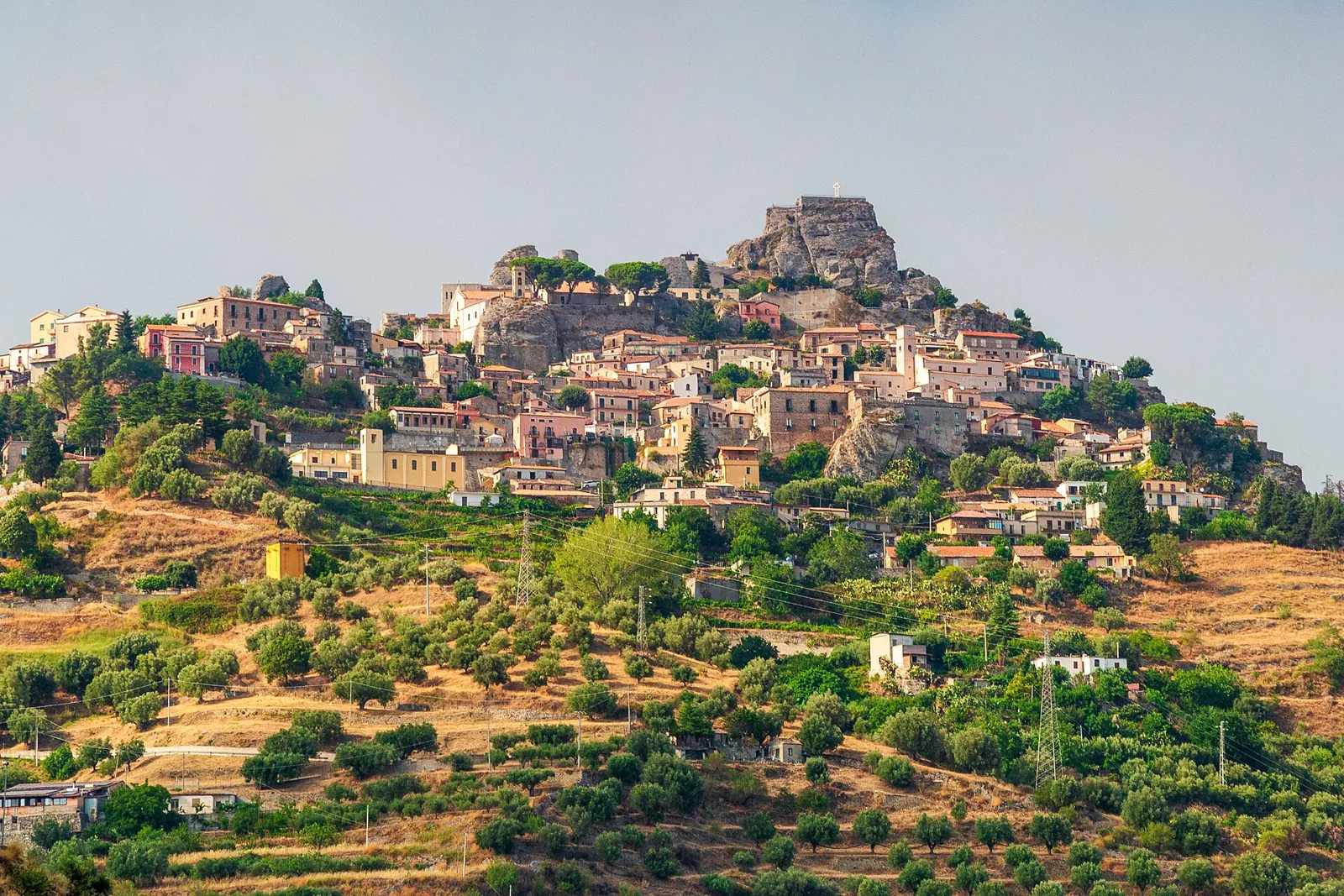
Bova lies in the Area Grecanica at the foot of Aspromonte and has a multi-layered settlement history. The castle hill is associated with earlier defensive use, which is well explained by its strategic position overlooking the Amendolea valley and the routes leading to the Ionian coast. In Calabria, the Normans often took over local fortresses and developed them on the basis of older Byzantine foundations; Roger I was active here from the 1060s, while the Kingdom of Sicily was not established until 1130 under Roger II.
The castle served a defensive function for several centuries. In 1494, the Aragonese reinforced the fortifications, adapting them to new military requirements. Bova was repeatedly affected by earthquakes, especially by the catastrophic sequence of five strong tremors between 5 February and 28 March 1783; in the case of the castle, it is safer to speak of centuries of degradation of the ruins and seismic damage, without attributing the site's entire present condition to a single factor.
Watch on YouTube
Architecture and Surviving Remains
The surviving fragments of the castle are distributed across three levels. The lowest level contains a hall accessed through a corridor. Above it are two rooms whose original purpose is difficult to determine. The most intriguing element, however, is a small rectangular chapel with a barrel vault situated on the highest level. Its walls – in both the central apse and the two lateral niches – still bear traces of frescoes in reddish tones, testifying to the sacred character of this space.
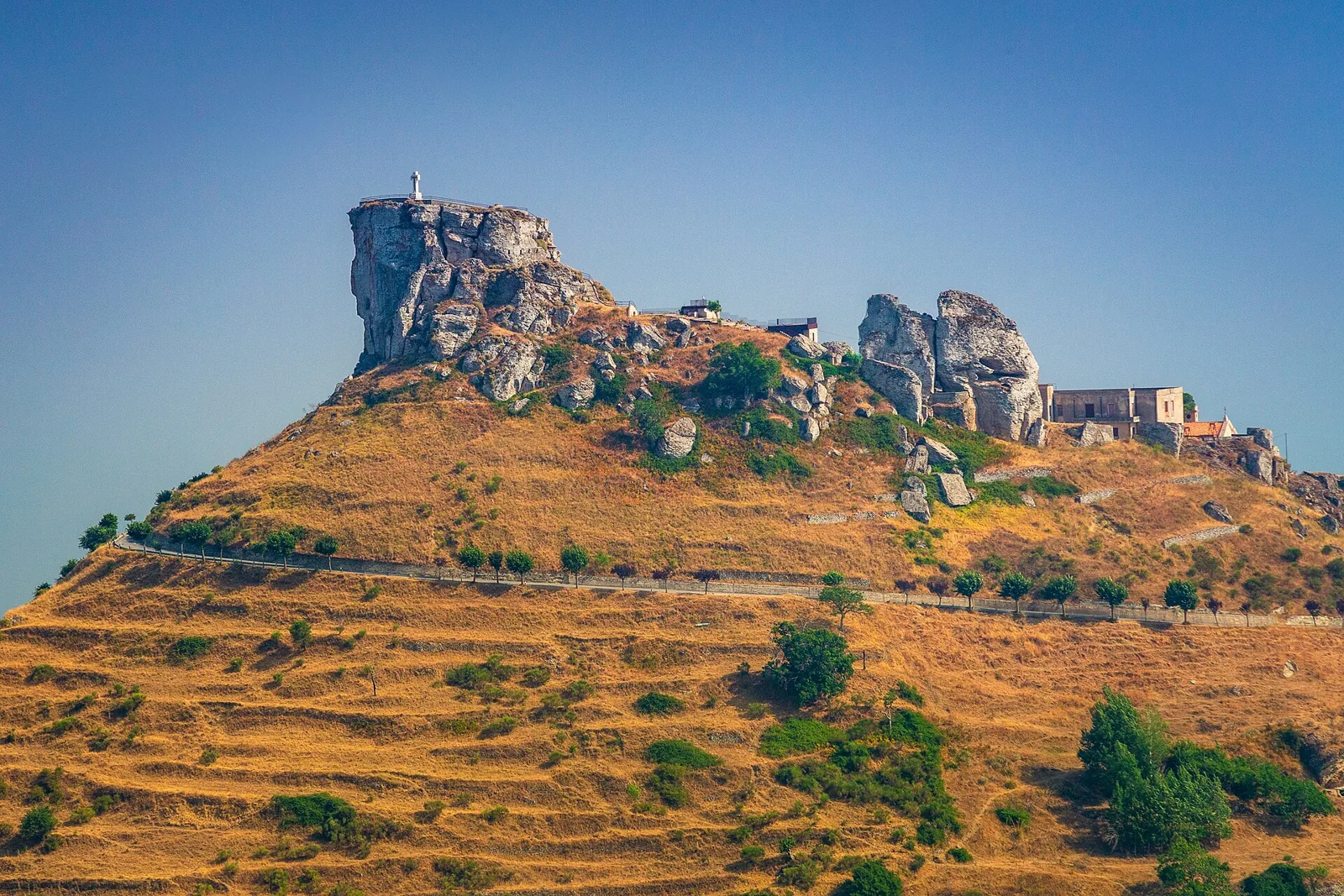
The castle's position on a commanding point above Bova allowed it to control access to the settlement and observe valleys descending towards the Ionian Sea. In the Middle Ages, such a vantage point provided the advantage of early threat detection and visual communication with other defensive positions. Today the site is a relict ruin – what survives are mainly sections of walls and rooms carved into or built against the rock, without complete volumes and without the possibility of reconstructing the full plan of the complex. The official heritage record states that the internal walls of the surviving rooms are more than 60 cm thick, while the external walls, carved into or built out from the rock, reach about 1.50 m. The surviving defensive walls also show caditoie, openings or defensive drop holes used to protect the approach to the fortifications. The town walls of Bova once adjoined the castle; one of their elements was the still-standing Torre Parcopia, located west of the settlement and the castle. The tower has a unicircular form, a wider base ring, and was built of stone and brick.
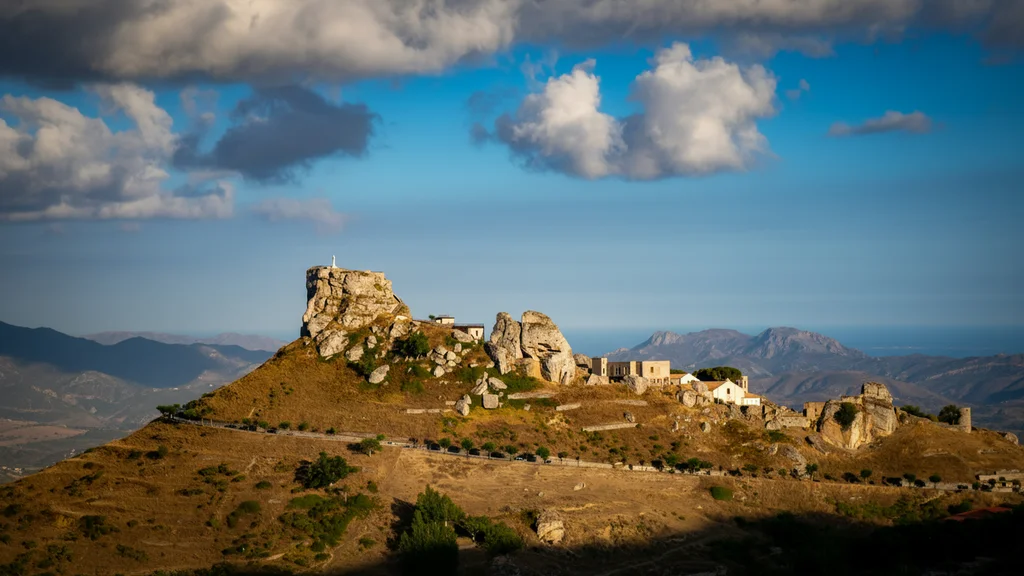
Bova – The Greek Capital of Calabria
The castle is inseparable from the history of Bova as the centre of Grecanico culture (Area Grecanica). Bova was one of the places where the Greek liturgical rite survived for an exceptionally long time, with the process of Latinisation progressing here gradually during the second half of the 16th century. Near the castle, numerous archaeological finds dating back to the Neolithic period have been discovered, confirming the ancient roots of settlement on this hilltop.
Bova is regarded as one of the main centres of Greek culture in Calabria. Bovesìa is the historic Greek-speaking area in the south-eastern part of the metropolitan area of Reggio Calabria, encompassing Bova, Bova Marina, Gallicianò, Condofuri and Roghudi, among others. The local idiom is sometimes called Calabrian Greek or Grecanico and represents a relic of the long Greek presence in the region – from ancient Magna Graecia through the Byzantine period.
The castle is also associated with the Legend of the Queen's Footprint (Orma della Regina). On a boulder near the ruins, there is a footprint with which local tradition associates a tale of hidden treasure. According to the legend, any girl whose foot perfectly matches the imprint will discover the treasure.
Practical Information
The castle ruins are freely accessible and can be reached on foot from the centre of Bova by following the route to the summit of Monte Rotondo. The official catalogue record locates the Castello normanno di Bova in Bova, in the province of Reggio Calabria, Calabria, at the coordinates 37.996255, 15.933552 in the WGS84 system. The site is owned by a public territorial body. The walk usually takes approximately 15–20 minutes; the path is steep, rocky and uneven in places, so proper footwear is essential. There is no ticket office or permanent museum infrastructure on site – the ruins are viewed from outside as a freely accessible heritage site.
A short visit to the ruins usually takes about 20–30 minutes, while with the approach and time for photographs it typically takes 45–60 minutes. Bring water and avoid the climb in full summer sun. The best time to visit is early morning or late afternoon, when the panorama over the Aspromonte and the Ionian Sea is clearest.
Bova lies inland, above the Ionian coast. The nearest major point on the rail network is usually Bova Marina, from where regional buses serve the mountain settlements of the Area Grecanica; however, timetables are limited and vary by season, so they should be checked before travelling. By car, the drive from Reggio Calabria usually takes about 1 hour 15 minutes to 1 hour 30 minutes, depending on the route and conditions.
Frequently Asked Questions
What remains of the Norman castle in Bova?
Fragmentary ruins distributed across three levels survive, including a small chapel with a barrel vault whose walls still show traces of medieval frescoes. The remains are too scarce to reconstruct the castle's full floor plan.
How do you reach the castle ruins in Bova?
A steep footpath leads from the centre of Bova to the summit of Monte Rotondo (827 m a.s.l.). The walk takes approximately 15–20 minutes. Comfortable shoes are essential – the terrain is rocky and uneven.
Why is the castle in ruins?
The castle is now a ruin as a result of centuries of degradation and seismic damage. Bova was repeatedly affected by earthquakes, especially by the sequence of five strong tremors in 1783, which struck a large part of Calabria.
What is the castle's connection to Greek culture?
Bova is one of the main centres of Bovesìa – the historic Greek-speaking area in southern Calabria. The castle grew in a place associated with long settlement continuity and the history of the Byzantine frontier, and the local Calabrian Greek tradition has survived here for centuries.
What is the Queen's Footprint?
It is a local legend associated with a boulder near the ruins, on which a footprint is said to be visible. According to tradition, any girl whose foot perfectly fits the imprint will discover a hidden treasure.
Nearby
Last updated: