The Riace Bronzes are two full-size Greek warrior statues cast in bronze around 450 BC – among only a handful of original large-scale bronze sculptures to have survived from antiquity. Discovered by chance in 1972 off the coast of Riace Marina on the Ionian Sea, they are now the crown jewels of the Museo Nazionale della Magna Grecia in Reggio Calabria and rank among the most important works of ancient art in existence. Their state of preservation and technical mastery make them icons of Classical Greek sculpture – on a par with the Parthenon friezes.
Table of Contents
Discovery of the Riace Bronzes
On 16 August 1972, Stefano Mariottini – a Roman chemist and recreational diver – was holidaying on the Ionian coast of Calabria. Snorkelling about 200 metres off the beach at Riace Marina, at a depth of just 8 metres, he spotted what appeared to be a human arm protruding from the sandy bottom. At first he thought he had stumbled upon a corpse. Only on closer inspection did he realise that beneath the sand and encrusted marine organisms lay two monumental bronze figures.
Mariottini immediately alerted the authorities. The Carabinieri secured the site, and the recovery was carried out by divers from the Carabinieri underwater unit in Messina, acting at the request of the Soprintendenza alle antichità della Calabria in Reggio Calabria. The operation was far from straightforward – each statue weighed approximately 160 kilograms and was partially buried in marine sediment. The first statue was brought to the surface on 21 August 1972, the second on 22 August 1972. Both figures were covered in centuries of marine concretion, but the bronze itself proved to be in astonishingly good condition.
How did two 5th-century BC Greek statues end up on the seabed off Calabria? The prevailing hypothesis points to a Roman ship transporting plundered artworks from Greece to Rome, forced to jettison its heavy cargo during a storm to avoid sinking. An alternative theory suggests Hellenistic-era transport, or that multiple shipwrecks occurred along this route in antiquity – the sea lane along southern Italy's coast was one of the busiest in the ancient Mediterranean.
After the discovery in 1972, the bronzes were first secured in Reggio Calabria and then underwent major conservation in Florence at the Centro di Restauro della Soprintendenza Archeologica della Toscana between 1975 and 1980. A second major conservation campaign took place between 2010 and 2013 at the Palazzo Campanella in Reggio Calabria, and the statues returned to the museum on 21 December 2013. It was precisely these works and technical studies that revealed more about their construction: they were made using the lost-wax casting technique, with numerous elements cast separately and joined, as well as inlays of copper and silver.
Who are the Riace Warriors
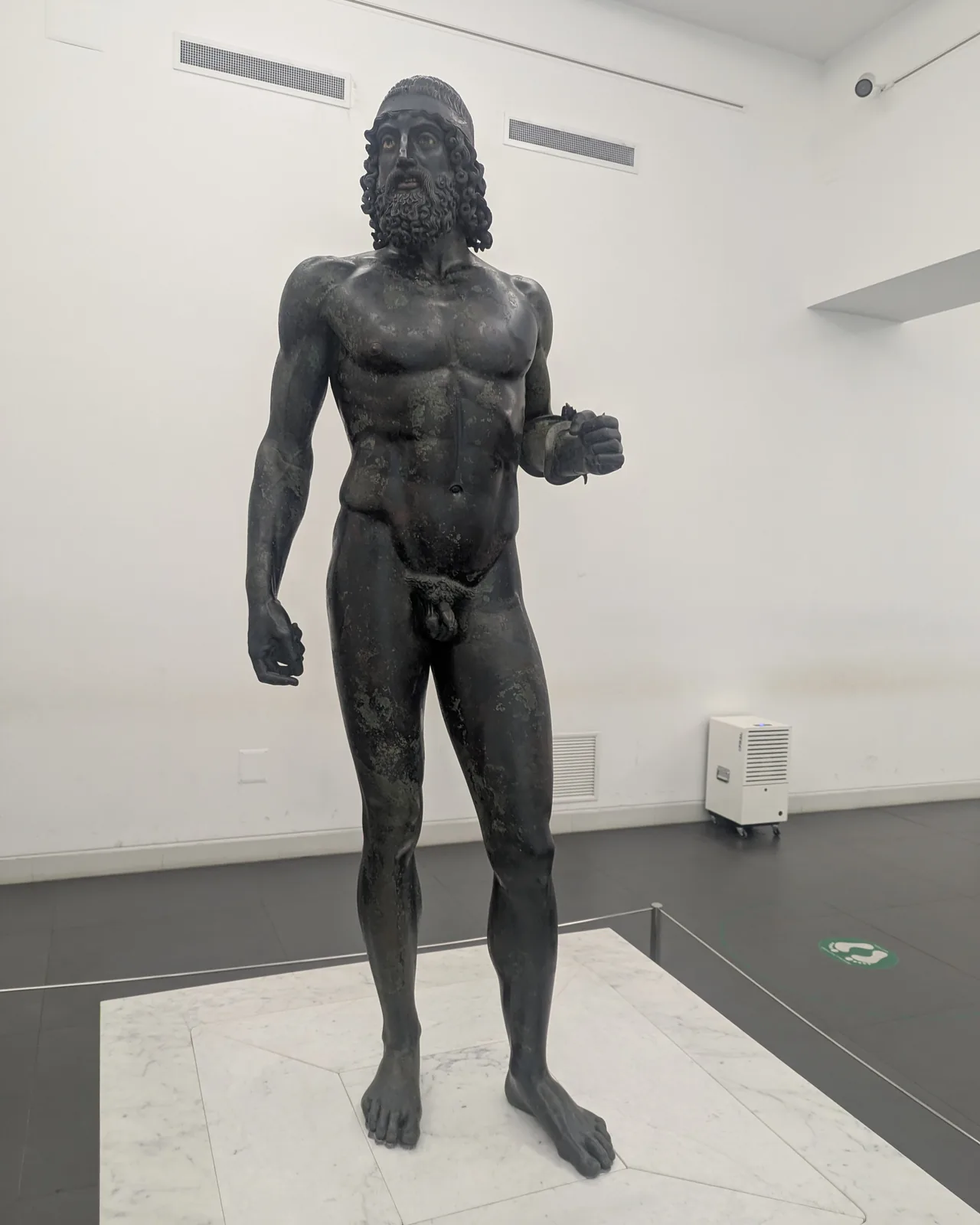
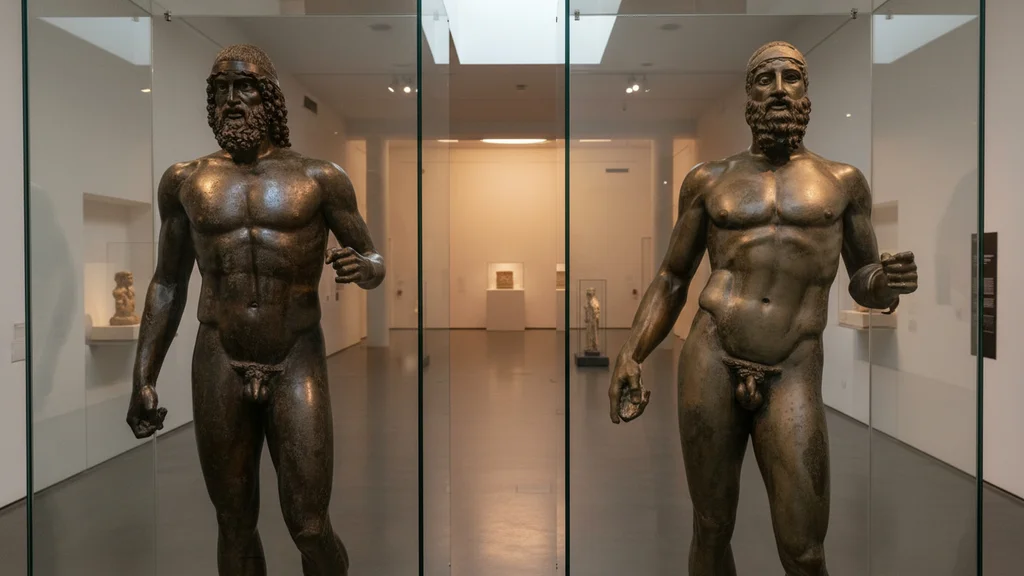
The statues depict two nude, bearded men in contrapposto – the Classical Greek stance in which body weight rests on one leg, lending the figure a natural, dynamic tension. Both warriors originally held shields and spears, now lost. Bronzo B has a head shaped for a raised helmet; in the case of Bronzo A, the presence of a helmet remains a cautious hypothesis. They are conventionally labelled Statue A (the "Young") and Statue B (the "Old").
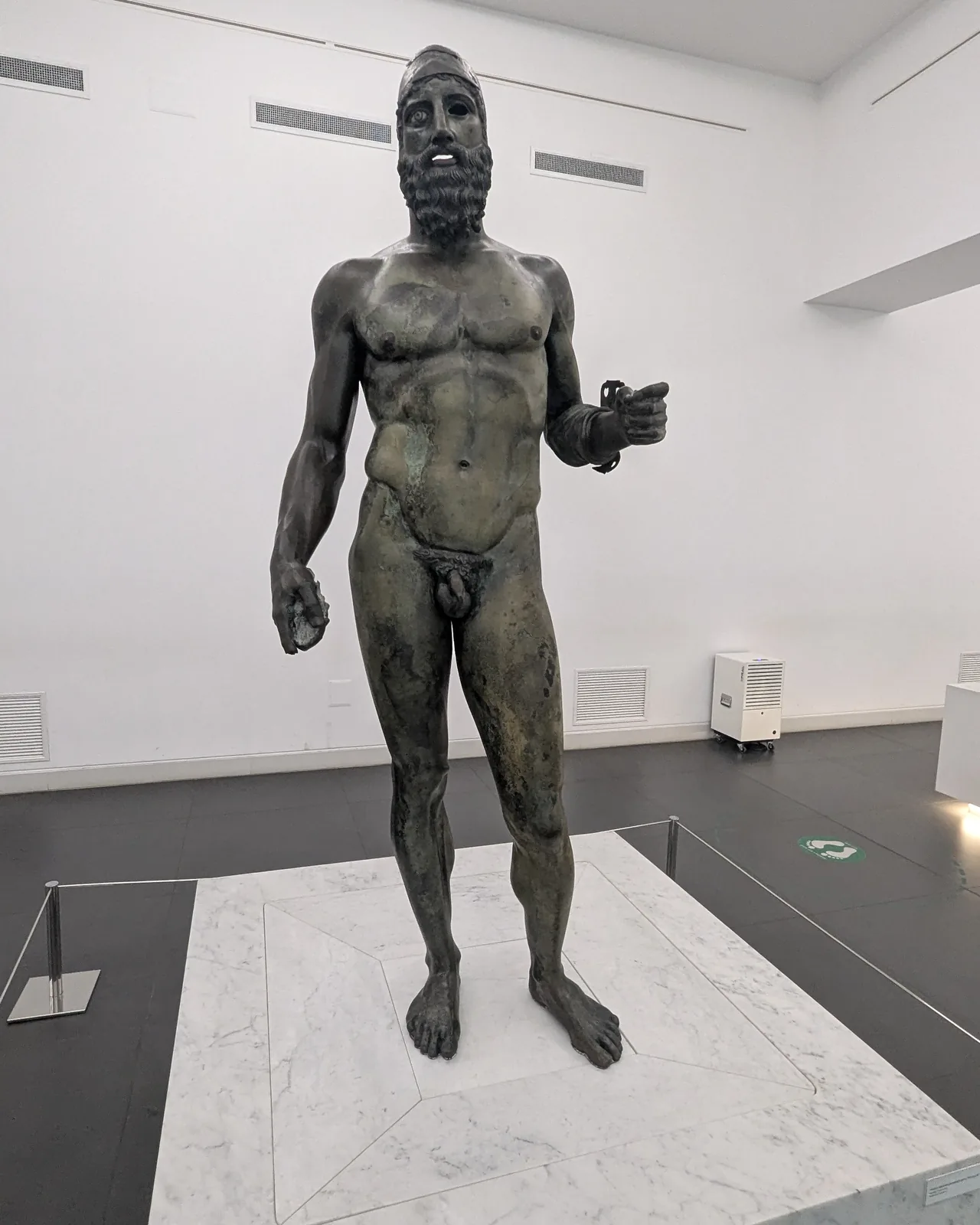
Statue A – the younger warrior – stands 1.98 metres tall. He has a more dynamic pose, a slightly turned head, and an intense facial expression. His body is athletic and muscular, with veins and tendons modelled in precise detail. Statue B – marginally shorter at 1.97 metres – adopts a calmer posture and displays more mature features, suggesting an older, seasoned commander.
Scholars generally date Statue A to c. 460–450 BC and Statue B to c. 430–420 BC, pointing to stylistic differences between the late Severe Style and full Classicism. Some analyses suggest they were not created as a pair in the same workshop and may have been grouped together secondarily during transport. In the literature, connections to the Peloponnese, Argos or Athens have been proposed, but without resolution.
The technical details astonish even modern bronze casters. The lips were fashioned from copper to give them a natural reddish hue. The teeth of Statue A were made from a sheet of silver. The eyes were originally inlaid, and their precise material reconstruction remains a matter of cautious conservation and research hypotheses. The nipples were made of copper. Technological and stylistic differences between the statues can be seen, among other details, in the treatment of the beard and hair. These details show the exceptional level of 5th-century BC Greek bronze casting.
Whom do they represent? Scholars have not reached consensus. Hypotheses include mythological heroes – Tydeus and Amphiaraus from the expedition of the Seven Against Thebes. Older or more marginal attributions to the circles of Phidias, Polykleitos, Myron or Alcamenes have also appeared in the literature, but the authorship of the Riace Bronzes remains unresolved. What is certain: the Riace Bronzes, known in Italy as Bronzi di Riace, are among the supreme achievements of ancient Greek sculpture and one of the most recognisable symbols of the heritage of Calabria and Italian underwater archaeology.
After their return to display in Reggio Calabria in December 2013, the reopening was a national event. Today they are an important element of the cultural identity of the city and region, often used in the tourist promotion of Reggio Calabria.
| Parameter | Statue A ("Young") | Statue B ("Old") |
|---|---|---|
| Height | 1.98 m | 1.97 m |
| Weight | approx. 160 kg | approx. 160 kg |
| Material | bronze (copper-tin alloy), copper, silver, ivory | bronze (copper-tin alloy), copper, ivory |
| Date | c. 460–450 BC | c. 430–420 BC |
| Discovery | 16 August 1972, Riace Marina | 16 August 1972, Riace Marina |
| Depth found | approx. 8 m | approx. 8 m |
| Technique | lost-wax casting | lost-wax casting |
Watch on YouTube
What to see at the museum
The Riace Bronzes are displayed in a dedicated room of the Museo Nazionale della Magna Grecia – in a purpose-built, climate-controlled space with an anti-seismic floor. After many years of conservation, the statues are presented in conditions that help protect the bronze from further corrosion.
The impression they make in person cannot be reproduced in photographs. Standing before these nearly two-metre-tall figures, you see every detail of the musculature, every vein on the forearm, the precisely modelled fingernails, and the expressive faces with their copper lips. The lighting in the room is carefully calibrated to bring out the bronze patina and anatomical detail.
The museum route runs through several levels of the permanent exhibition. Level A presents the beginnings of Calabria, level B the cities and sanctuaries of Magna Graecia, level C everyday life and necropolises, and level D leads from ancient Reggio to the Riace Bronzes. Level E houses temporary exhibitions, the lapidarium and the necropolis discovered in 1932 beneath the museum building.
The museum also presents the context of the discovery – photographic documentation of the recovery, tools used during conservation, and the history of research into the statues. In the same part of the exhibition, pay attention to the Bronzi di Porticello, including the Head of a Philosopher and the Basel Head. The pinakes from Locri and the collections of ceramics, coins and votive objects are displayed in other sections devoted to the cities, sanctuaries, everyday life and necropolises of Magna Graecia.
The entire museum deserves at least 2–3 hours. But even if you have only an hour to spare, a visit to the bronzes still makes sense: focus on the Bronzes room and the key parts of the Magna Graecia exhibition. It is one of those cultural experiences that alone justifies a trip to Reggio Calabria.
Practical information
Location: Museo Nazionale della Magna Grecia, Piazza De Nava 26, 89123 Reggio Calabria
On foot: The museum stands at Piazza Giuseppe De Nava, just off the northern section of central Reggio Calabria. From Lungomare Falcomatà the walk takes about 5–10 minutes, and from Corso Garibaldi about 5 minutes, depending on your starting point
Getting there: Reggio Calabria Centrale railway station is about a 20-minute walk from the museum; the closest station is Reggio Calabria Lido, about 2 minutes away on foot. From Reggio Calabria airport, city bus lines 27, 28, 113, 115, 118, 119 and 122 serve the museum
Entering the Bronzes room: Entry to the room has for years involved a microclimate stabilisation chamber and limits on visitor numbers. Arrangements may change, but assume that entry may take place in groups and require a short wait – check the museum's current regulations and their update date before your visit
Visiting time: The Bronzes room itself usually takes 20–30 minutes for an unhurried visit; the whole museum typically 1.5–2.5 hours. If time is short, a sensible minimum is about 45–60 minutes for entry, the Bronzes and the key Magna Graecia galleries
Tickets and hours: According to the official MArRC website, the museum is open Tuesday to Sunday from 9:00 to 20:00, with last entry at 19:30; it is closed on Mondays. Fares in force from 1 July 2024: standard ticket €10, reduced ticket for visitors aged 18–25 €2, free entry for under-18s and statutory categories. A MArRC SLIM ticket is also available for €5 from 18:00
Website: museoarcheologicoreggiocalabria.it
Frequently Asked Questions
Why are the Riace Bronzes so exceptional?
Only a dozen or so original full-size bronze statues survive from ancient Greece – the vast majority were melted down over the centuries for coins, weapons, or other objects. The Riace Bronzes stand out not only for their rarity but also for their extraordinary craftsmanship: anatomical detail, multi-material finishing and artistic expression place them at the very summit of ancient art.
Can I photograph the statues?
MArRC regulations allow photos and videos for personal and scholarly use only. Flash, additional lighting, tripods, selfie sticks and drones are prohibited. Publication of photos or commercial use requires permission from the museum management.
How much time do I need for a visit?
The Bronzes room itself usually takes 20–30 minutes for an unhurried viewing. The whole museum typically requires 1.5–2.5 hours, and if time is short, it is worth setting aside at least 45–60 minutes for the Bronzes and the key Magna Graecia galleries.
Who discovered the Riace Bronzes?
Stefano Mariottini, a Roman chemist and amateur diver, discovered the statues on 16 August 1972 while snorkelling off Riace Marina in Calabria. He spotted an arm protruding from the sand at a depth of about 8 metres, just 200 metres from shore. Mariottini reported the find to the Carabinieri, and professional divers carried out the recovery.
Last updated: