
Sila National Park is a unique natural enclave located in the heart of Calabria, captivating visitors with its diverse landscape, mountain massifs and lush forests. Covering approximately 73,695 hectares, the park protects the heart of the Sila plateau, which in geological and landscape terms differs radically from the stereotypical image of southern Italy. This area, often referred to as the Gran Bosco d'Italia (Great Forest of Italy), extends across three provinces: Cosenza, Catanzaro and Crotone. Picturesque lakes such as Lago di Cecita are among the main attractions, offering opportunities for active recreation amid unspoiled nature.
Protecting the unique flora and fauna of Sila National Park
Sila National Park is a natural gem presenting the most unique ecosystems of the Mediterranean basin. Both conifers and deciduous trees thrive here, creating a rich and varied landscape. The symbol of the park is the Calabrian black pine (Pinus nigra ssp. laricio), an endemic species that – thanks to its resilience – was historically used to build ship masts.
The most spectacular example of these forests is the Fallistro Biogenetic Reserve, known as I Giganti della Sila. It protects a group of 58 monumental trees, most of them Calabrian pines over 350 years old, reaching heights of up to 45 metres. In the world of fauna, a key role is played by Canis lupus italicus – the Apennine wolf – which, after near-extinction in the mid-20th century, successfully rebuilt its population in the inaccessible forests of the plateau.
The park's forests are home to red deer, fallow deer and the characteristic black squirrel, a specific Calabrian subspecies with dark fur. Scientific research has confirmed that the air on the plateau is among the cleanest in Europe, due to the absence of industrial emissions and the vast forest mass.
Geological evolution of the Sila plateau – from glacial formations to the modern landscape
The Sila plateau has a fascinating geological history dating back to the Hercynian orogeny some 300 million years ago. Unlike the limestone Apennines, the Sila massif is composed of ancient crystalline bedrock, including granites, gneisses and mica schists. The current shape of the plateau is the result of intense tectonic uplift, which isotopic research shows is still ongoing at a rate of approximately 1 mm per year.
| Park sector | Highest peak | Altitude (m a.s.l.) | Main lakes |
|---|---|---|---|
| Sila Greca | Monte Altare | 1,653 | Cecita (partial) |
| Sila Grande | Monte Botte Donato | 1,928 | Arvo, Cecita, Ariamacina |
| Sila Piccola | Monte Gariglione | 1,764 | Ampollino, Passante |
The erosion of crystalline rocks has produced unique weathering forms such as spheroidal granite boulders. The frontal moraines and loess deposits characteristic of the plateau are evidence of the glacial and periglacial processes that shaped today's landscape. The plateau's geological history is recognised by UNESCO, which declared Sila a Biosphere Reserve.
Adventure on the trails of Sila National Park – trekking and outdoor activities
Sila National Park offers impressive landscapes across three main sections: Sila Piccola, Sila Grande and Sila Greca. With altitudes exceeding 1,000 m a.s.l., the region provides a unique microclimate that encourages hiking in summer and transforms the park into a winter sports resort in the colder months. Sila's winter scenery recalls Scandinavian landscapes – with snow-covered pine forests and frozen lake surfaces.
Hikers can enjoy the Colli Perilli trail (10.8 km) for a harmonious contact with nature, while cyclists tackle the 41.6 km route around Lake Arvo. The Lorica resort on Monte Botte Donato features a modern gondola that carries visitors to 1,928 m a.s.l., offering a panoramic view of the entire Calabria region.
In winter, the park offers excellent skiing conditions at the resorts of Camigliatello Silano and Palumbosila. A popular attraction is the year-round bobsleigh run in Lorica, providing thrilling descents at a controlled pace. This makes Sila the most important winter sports centre in southern Italy.
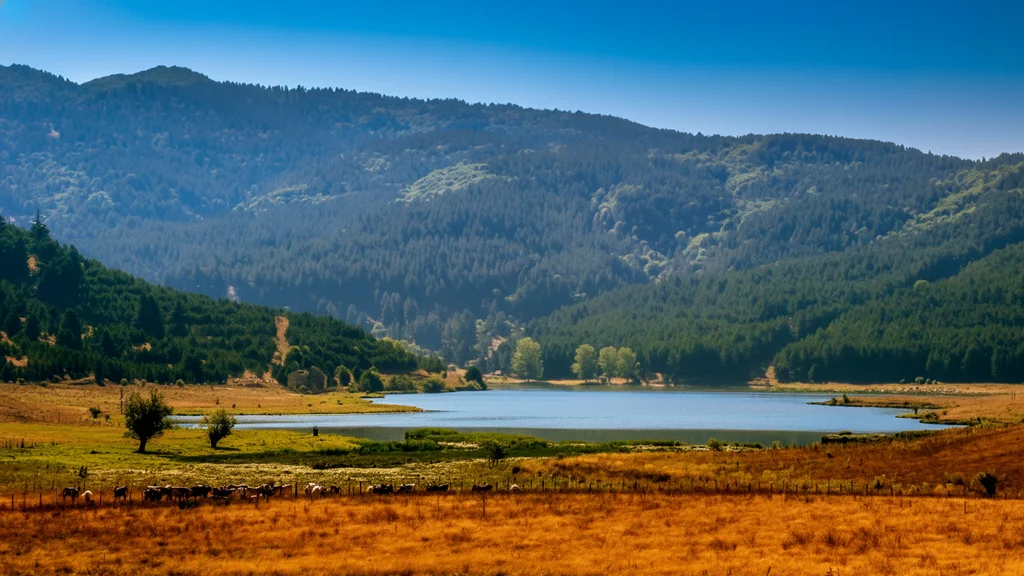
Sila National Park – natural and cultural heritage of Calabria
Sila National Park is not just nature – it is also a mosaic of cultures and traditions closely tied to the history of settlement on the plateau. The largest town in the region, San Giovanni in Fiore, was founded by Abbot Joachim of Fiore, the renowned medieval thinker. The heart of the town is the monumental Florense Abbey, a fine example of austere Cistercian architecture that still draws pilgrims and historians.
The northern section, Sila Greca, is home to the Arbëreshë communities, descendants of Albanian settlers from the 15th century. Byzantine traditions, a unique dialect and colourful folk costumes are preserved to this day. Sila National Park plays a key role in promoting slow tourism, combining landscape exploration with local craftsmanship – artistic weaving and goldsmithing.
In the Sila Piccola sector, Villaggio Mancuso stands out with its unique Swiss-Tyrolean style architecture. A cultural symbol is the Albergo delle Fate (Fairy Hotel), built almost entirely of wood, which in the past hosted some of the biggest names in Italian cinema.
The impact of human activities on biodiversity in Sila National Park
Sila National Park is an ecosystem where the conservation strategy rests on the harmonious coexistence of people and nature. A key challenge is sustainable water resource management, particularly with regard to lakes such as Cecita, which serve hydroelectric functions.
Lake Cecita also holds great archaeological significance – during drought periods, the remains of a prehistoric elephant (Elephas antiquus) and traces of Neanderthals have been discovered on its bed. Promoting ecotourism aims to minimise the negative human impact while supporting a local economy built on certified products.
The region's gastronomy supports biodiversity: the cultivation of Sila Potato (Patata della Sila PGI) at altitudes above 1,000 m a.s.l. and traditional grazing of Podolica cattle help preserve natural mountain meadows. Caciocavallo Silano PDO cheese is inseparably linked to local pastoralism, demonstrating that traditional farming can support the protection of a valuable landscape.
Practical tips – transport and logistics in Sila National Park
The city of Cosenza is the natural gateway to the park, offering convenient bus connections managed by Ferrovie della Calabria. Line 385A links Cosenza with Camigliatello Silano in approximately 50 minutes, making the park easily accessible for visitors without a car.
A remarkable tourist attraction is the historic Treno della Sila – a steam train with carriages from the 1920s, running to the highest railway station in Europe at 1,404 m a.s.l. A journey on this heritage train is a unique opportunity to admire viaducts and forests the way travellers did a hundred years ago.
| Lake | Main activities | Unique features |
|---|---|---|
| Cecita | Fishing, archaeology | Elephant palaeontological site |
| Arvo | Rowing, bike boat, zip-line | Close to Lorica resort |
| Ampollino | Year-round tourism, skiing | Oldest dam on the plateau |
| Ariamacina | Birdwatching, trekking | Legambiente Nature Reserve |
Frequently Asked Questions
Where is Sila National Park?
The park is situated in the heart of Calabria, southern Italy, and extends across three provinces: Cosenza, Catanzaro and Crotone.
What is worth seeing in Sila National Park?
The main attractions include the giant pines of the Fallistro Reserve, lakes Arvo and Cecita, the Florense Abbey in San Giovanni in Fiore, and the Cupone Visitor Centre.
How to get to Sila Park from Cosenza?
The best options are Ferrovie della Calabria buses (line 385A) or driving along the SS 107 national road, which takes approximately 35–45 minutes.
Can you do winter sports in Sila?
Yes, the main ski resorts are Camigliatello Silano and Lorica, offering downhill and cross-country slopes as well as modern lift infrastructure.
What lakes are in Sila Park?
The main lakes are Cecita (the largest), Arvo (active tourism hub), Ampollino and Ariamacina, known for excellent birdwatching conditions.
Top Attractions of Sila Park
I Giganti della Sila
The Fallistro Biogenetic Reserve with 58 monumental Calabrian pines over 350 years old, reaching heights of up to 45 metres.
Lake Arvo and Lorica
The active tourism hub – rowing, zip-line, and a gondola to Monte Botte Donato (1,928 m) with a panoramic view of all Calabria.
Treno della Sila
A historic 1920s steam train running to the highest railway station in Europe at 1,404 m a.s.l. – a journey through time.
Florense Abbey
A monumental Cistercian abbey in San Giovanni in Fiore, founded by the medieval mystic Joachim of Fiore.
Lake Cecita
The largest lake in the park with a unique palaeontological site – prehistoric elephant remains were discovered on its bed.
Camigliatello Silano
The main tourist hub of Sila Grande – a hiking base in summer and a ski resort in winter.
How to get to Sila National Park
The nearest airport is Lamezia Terme (SUF) with connections from Warsaw, Milan and Rome. From the airport to Cosenza is approximately 45 minutes by car or bus.
From Cosenza via the SS 107 (Silana-Crotonese) to Camigliatello Silano – approx. 30 km, 35–45 min. A scenic road; GPS navigation recommended.
Ferrovie della Calabria, line 385A: Cosenza – Camigliatello Silano (approx. 50 min). A convenient option for visitors without a car.
The historic Treno della Sila (steam train) runs on the Camigliatello – San Nicola Silvana Mansio route. Seasonal departures – an ideal option as a tourist attraction in its own right.