
Pollino National Park, the largest among Italy's protected areas, captivates travellers with its rugged, natural beauty. Located on the border between Calabria and Basilicata, this conservation giant covers an impressive 192,565 hectares, making it one of the most complex ecosystems in the entire Mediterranean basin. It offers extraordinarily diverse landscapes – from the mighty peaks of Monte Pollino to picturesque gorges and caves, fascinating remnants of ancient glaciers. Its unique ecosystems, listed as a UNESCO Global Geopark, represent not only a natural treasure but also an invitation to active outdoor recreation.
The Development of Pollino National Park – Conservation and Natural Heritage
Established at the meeting point of southern Italy's regions, Pollino National Park is an exceptionally important area for protecting unique ecosystems in the Southern Apennines. Although the first legislative projects aimed at valorising this territory appeared as early as 1958, the park's full administrative bodies were ultimately established in 1993–1994. This delay reflected the evolution of Italian ecological thinking and the need to harmonise the interests of as many as 56 municipalities within its territory. The park's headquarters are located in Rotonda, which serves as the central logistical hub for the entire region.
The park's highly varied terrain – particularly the watersheds of six major rivers, mountain massifs and glacial formations – is essential for preserving local biodiversity. A decisive role is played by the protection of endemic species such as the Bosnian pine (Pinus heldreichii) and the rare Italian pear. These species, together with the ancient beech forests of Cozzo Ferriero and Pollinello inscribed on the UNESCO World Heritage List, are the most precious elements of Europe's natural heritage.
| Administrative Parameter | Value / Description |
|---|---|
| Total Area | 192,565 ha |
| Area in Calabria | 103,915 ha |
| Area in Basilicata | 88,650 ha |
| Number of Municipalities | 56 |
| Park Headquarters | Rotonda (PZ) |
The park's development initiatives focus on promoting sustainable tourism, including managing trails such as the Civita trekking route and exploring Bosco Magnano. These efforts aim to reduce the negative impact of visitors on delicate ecosystems through appropriate education and infrastructure. Thanks to these endeavours, Pollino National Park is becoming an important model for nature management in southern Italy, combining environmental protection with the needs of local communities.
The Significance of Pollino National Park for the Region
Pollino National Park plays a strategic role in the local ecosystem as well as in the economy and culture of surrounding communities. As Italy's largest national park, it forms a natural bridge between the Tyrrhenian and Ionian Seas, influencing the microclimate of the entire peninsula. Over the years it has become a model for other conservation initiatives, effectively protecting unique life forms including the region's icon – the Bosnian pine known as Pino loricato.
Beyond protecting flora and fauna, the park stimulates local tourism, which is of fundamental importance to the regional economy. Hiking trails leading through the highest peaks attract thousands of nature-seekers every year, supporting local crafts and catering services. The Arbëreshë communities, descendants of Albanian refugees, bring a unique cultural colour to the region, preserving their traditions in villages such as Civita and Frascineto.
For the residents of surrounding villages, the park is a source of identity, connecting the present with a rich historical past. The presence of ancient roads and archaeological sites such as the Grotta del Romito – with evidence of human presence from the Palaeolithic – enriches the cultural life of communities. In the face of climate change, sustainable management of Pollino's resources is becoming an inspiration for other regions seeking models of effective heritage conservation.
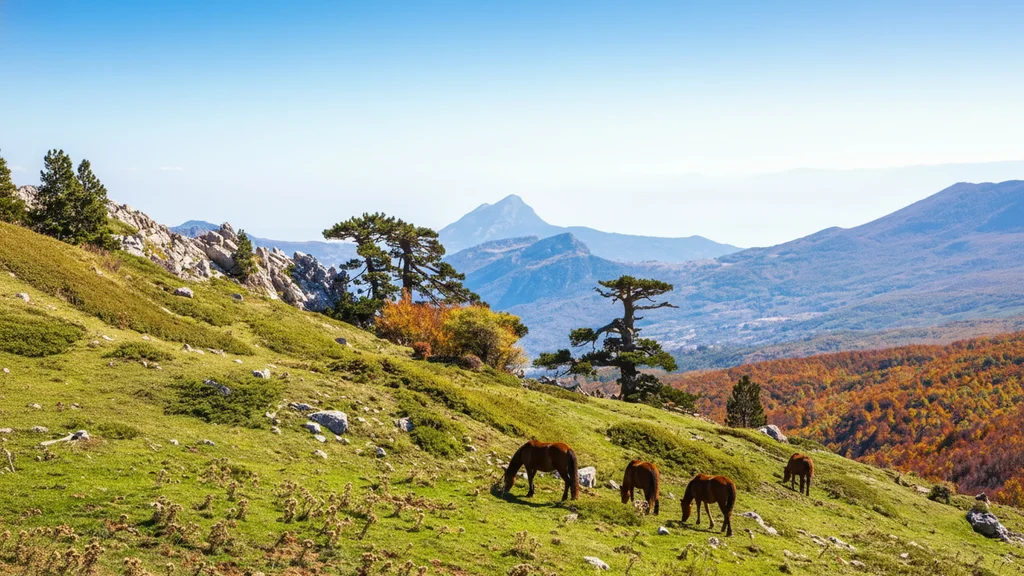
Unique Fauna and Flora of Pollino National Park – Italy's Biodiversity Treasures
Pollino National Park is one of the most important reservoirs of life in Southern Europe, where over 2,000 plant species occur. The altitudinal variation means you can encounter both Mediterranean vegetation and alpine meadows. The most fascinating recent discovery is Italus – a Bosnian pine estimated to be 1,230 years old, making it the oldest scientifically confirmed tree in Europe.
Botanical Diversity
The park's flora is a mosaic of unique habitats, from deciduous forests in the valleys to alpine meadows on the peaks. The lower zones are dominated by holm oaks, while higher up European beeches and black pines reign. Pino loricato, the park's symbol, grows above 1,500 m a.s.l., displaying remarkable resistance to frosts reaching as low as –45 degrees Celsius. This species, a Tertiary relict, has characteristic bark resembling the armour of a Roman legionary.
Wildlife
Over 70 mammal species and 300 bird species form an extraordinarily complex ecosystem, dominated by the Apennine wolf. The park is also home to the elusive Eurasian otter, inhabiting the crystal-clear waters of the Lao and Sinni rivers. A faunal curiosity is the Calabrian dormouse, a rare rodent that reaches the southern limit of its European range precisely here.
| Species | Ecological Significance |
|---|---|
| Apennine Wolf | Apex predator, symbol of the region's wildness |
| Eurasian Otter | Indicator of the highest river water quality |
| Golden Eagle | Nests on inaccessible limestone cliffs |
| Spectacled Salamander | Italian endemic, bioindicator of habitat quality |
Extraordinary Natural Wealth and Rock Formations in Pollino National Park
The geological history of this area dates back to the Mesozoic era, and the modern landscape is the result of the collision of the African and European tectonic plates. Dolomitic limestone and sandstone form monumental structures that earned the park UNESCO Global Geopark status in 2015. Deep canyons such as the Gole del Raganello are the result of aggressive water erosion, creating vertical walls stretching 13 kilometres.
Geological Formations
The rich relief includes numerous caves and caverns that provide fascinating testimony to Apennine orogenic processes. The park's river systems, led by the Lao river, have carved spectacular gorges into the rock, a paradise for scientists and extreme nature enthusiasts. The limestone massifs of Pollino and Orsomarso give the mountains a rugged character, contrasting with the green valleys of the Sinni and Esaro rivers.
Biodiversity and Flora
In terms of natural wealth, Pollino stands out with approximately 1,800–2,000 plant species, one in five of which is endemic. The aforementioned Bosnian pine, Pino loricato, is a living fossil whose silhouettes – often twisted by the wind – give the landscape an almost surreal appearance. The park also protects rare amphibians such as the yellow-bellied toad and the spectacled salamander, which find shelter in humid beech forests.
Tourism and Recreation in the Heart of Pollino National Park
Pollino National Park is a true paradise for hiking enthusiasts, offering the highest peaks in southern Italy. The roof of the region is Serra Dolcedorme, reaching 2,267 m a.s.l., from which on a clear day you can see both seas surrounding the peninsula. The park's orography encompasses five peaks exceeding 2,000 metres, guaranteeing high-mountain experiences for much of the year.
Hiking Trails and Natural Attractions
A popular destination is Monte Pollino (2,248 m a.s.l.), whose name may derive from the Roman god Apollo. One of the most scenic spots is Serra di Crispo, known as the Garden of the Gods, where the most impressive specimens of Bosnian pines grow. For adrenaline seekers, the Lao river offers some of Italy's best rafting conditions, flowing through the pristine lands of the province of Cosenza.
Recreation and Rest
Besides trekking, the park offers mountain biking, birdwatching and winter snowshoeing on the Piano Ruggio plateaus. The refuge network, though varied, requires advance planning – it is worth checking the status of facilities such as Rifugio Fasanelli and Rifugio Biagio Longo. Base towns such as Civita, Morano Calabro and Castrovillari make excellent starting points, offering unique cuisine based on local Poverello white beans and Senise peppers.
Challenges in Managing Pollino National Park – Conservation and Sustainable Development
Managing Italy's largest protected area requires balancing nature conservation with tourism development. Heavy tourist presence in places such as the Raganello gorges requires strict regulations to prevent the degradation of unique ecosystems. Park managers must also contend with the risk of fires and droughts, which in the era of climate change threaten Bosnian pine populations.
An additional challenge is cooperation with local communities regarding land use, pastoralism and traditional hunting. This dialogue is essential to preserve cultural heritage such as the culinary and linguistic traditions of the Arbëreshë minority, while enforcing strict environmental protection standards. Pollino's sustainable development rests on promoting so-called slow tourism, encouraging deep engagement with nature without destroying it.
Pollino National Park – Frequently Asked Questions
Where is Pollino National Park located?
The park is located on the border between the Calabria and Basilicata regions in southern Italy, covering the provinces of Cosenza, Potenza and Matera.
Why is Pollino unique among Italy's national parks?
It is Italy's largest national park (over 192,000 ha), holds UNESCO Global Geopark status, and protects the oldest tree in Europe – the Italus pine.
Which peaks can you climb in Pollino?
The most important summits include Serra Dolcedorme (2,267 m a.s.l.), Monte Pollino (2,248 m a.s.l.) and Serra del Prete (2,181 m a.s.l.).
What is the Bosnian pine and where can you see it?
It is a rare tree species (Pinus heldreichii), the park's symbol, characterised by bark resembling armour. The finest specimens grow in the so-called Garden of the Gods on Serra di Crispo.
How should you best plan a visit to Pollino Park?
It is best to arrive by car (motorway A3), choose a base in towns such as Rotonda or Civita and use the services of certified park guides.
Main Attractions of Pollino National Park
Serra Dolcedorme
The park's highest peak (2,267 m a.s.l.). In good weather you can see both the Tyrrhenian and Ionian Seas simultaneously.
Gole del Raganello
A spectacular 13 km canyon carved by the river through limestone. A paradise for canyoning enthusiasts and wildlife lovers.
The Italus Pine
The oldest scientifically confirmed tree in Europe (approx. 1,230 years old). It grows in the so-called Garden of the Gods on Serra di Crispo.
Civita – Arbëreshë Village
A unique village inhabited by descendants of Albanian refugees, preserving their original culture, language and traditions.
Rafting on the Lao River
Some of the best rafting conditions in Italy. The river flows through pristine lands in the province of Cosenza.
How to Get to Pollino National Park
The nearest airports are Lamezia Terme (approx. 100 km) and Naples (approx. 170 km). From both, a hire car is the most convenient option.
Motorway A3 Salerno–Reggio Calabria, exits at Lauria Norte, Frascineto or Morano Calabro depending on your destination within the park.
SITA services from Cosenza and Potenza to Castrovillari and Rotonda on the park's outskirts. Internal transport is limited – plan your onward journey carefully.
Ferrovie della Calabria line from Cosenza. Castrovillari station is approx. 20 km from the park centre. From there by taxi or local bus.