
Costa Viola, known as the Violet Coast of Calabria, is one of the most fascinating stretches of coastline in southern Italy, extending approximately 35 kilometres along the province of Reggio Calabria. Thanks to the distinctive violet-blue hues of the Tyrrhenian Sea and its picturesque cliffs, it attracts travellers seeking authenticity and tranquillity away from the crowds. The region forms the south-western tip of the Italian Peninsula, where the massive Aspromonte mountain formations meet the depths of the Strait of Messina, creating a landscape of almost mythical character.
Top Attractions of Costa Viola – From Beaches to Historic Villages
Costa Viola, a region with precisely defined geographical boundaries, offers wonderful experiences both for beach lovers and history enthusiasts. The northern end of the coastline is marked by the town of Palmi, perched on rocky terraces, while the southern tip is Villa San Giovanni, a key transport hub and gateway to nearby Sicily. Between them lie towns of unique character, such as Seminara and Bagnara Calabra, which together form the cultural mosaic of this unspoilt corner of Italy.
Beaches and Coves – Crystal-Clear Water and a Chromatic Phenomenon
The beaches of Costa Viola are among the most beautiful in Italy, with crystal-clear water that attracts divers and snorkelling enthusiasts. Marinella di Palmi beach is an ideal destination for families, offering a sandy shoreline with all necessary facilities. For those seeking seclusion, the Cala Janculla cove near Seminara – accessible only on foot or from the sea – captivates with its abundance of underwater caves and rock formations.
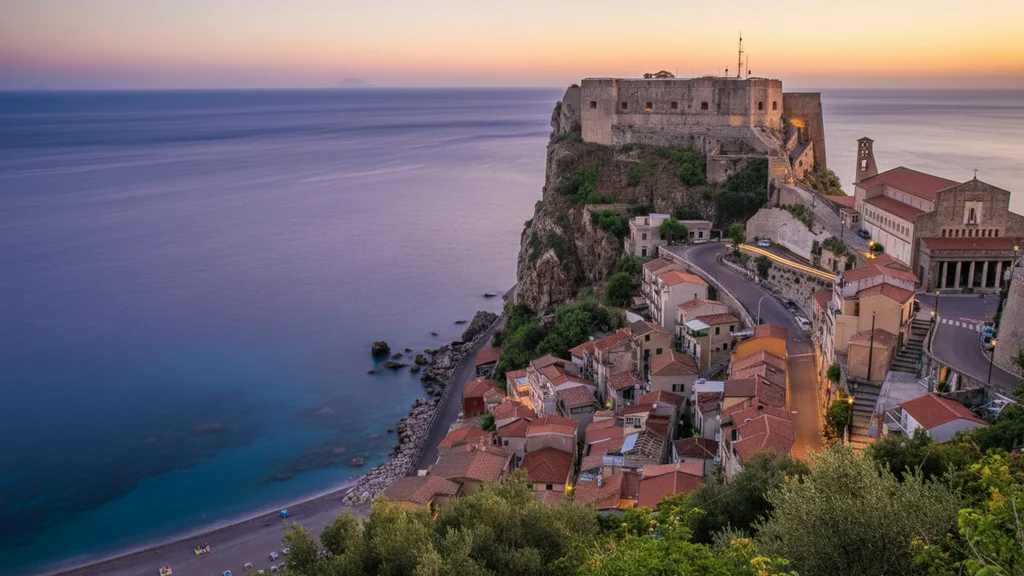
The uniqueness of the local waters is tied to the region's name, the authorship of which tradition attributes to the Greek philosopher Plato, who visited these lands in the 4th century BC. Plato observed that at sunset the landscape becomes tinged with shades of violet, which modern science explains by the presence of specific algae and the refraction of light amplified by volcanic emissions from nearby Stromboli. This unique chromatic spectacle is most intense during the golden hour, when the deep green of the Mediterranean scrub blends with the dark blue of the sea.
| Contributing Factor | Description of the Violet Colour Phenomenon |
|---|---|
| Marine algae | Specific species of seaweed colouring the water at sunset |
| Light refraction | Play of light and reflections in specific atmospheric conditions in the evening |
| Volcanic emissions | Sulphur particles from Stromboli intensifying the purple tones of the sky |
Charming Villages and Landmarks on Costa Viola
Palmi, regarded as the cultural capital of the region, has much to offer in terms of historical attractions and spectacular viewpoints. Walking its streets, you can sense the influences of Normandy, Byzantium and ancient Greece, and a visit to the Casa della Cultura allows you to explore the legacy of artists such as Leonida Repaci. Another fascinating place is Bova, known as Greek Calabria, which attracts visitors with its unique Greko dialect and the historic Cathedral of Santa Maria de Terra.
Planning a visit to Costa Viola means choosing between natural beauty and deeply rooted history that sets this region apart from commercial destinations. For active travellers, an excellent goal is Monte Sant'Elia, rising to 600 metres above sea level and offering a panorama encompassing three active volcanoes: Etna, Stromboli and Vulcano. It is here that nature meets the sacred, creating one of the most evocative balconies overlooking the Tyrrhenian Sea.
Living Traditions and Culture of the Violet Coast
Costa Viola is a place rich in traditions that reflect the strong ties of the local community to their turbulent past. The region's inhabitants proudly preserve religious festivals and unique craftsmanship that has survived centuries in almost unchanged form. The authenticity of Calabrian culture is palpable at every step, from the bustle of fishing quarters to solemn processions carrying massive sacred structures.
Festivals and Religion
Religious festivals unite the local community in celebration, and the most important of them is undoubtedly the Varia di Palmi, held on the last Sunday of August. It is a monumental structure over 15 metres tall and weighing 20 tonnes, carried by 200 bearers, which has been inscribed on the UNESCO list of Intangible Cultural Heritage. Equally significant is the pilgrimage to the Sanctuary of Our Lady of Polsi, drawing the faithful from across the Aspromonte region, a moment of deep spiritual experience and local folklore.
Mediterranean Cuisine and the Swordfish Tradition
The culinary tradition of the Violet Coast is built on products known throughout the world, such as bergamot and spicy nduja. However, the true king of local tables is swordfish, caught in the Strait of Messina using distinctive boats called feluca. The iconic dish of the region is Pesce spada alla Bagnarota, where succulent slices of fish are braised in a sauce of Tropea red onions, capers and Ottobratica black olives.
Local Crafts and Ceramics
Craftsmanship has always defined the identity of the local people, and the town of Seminara is renowned for its artistic ceramics production. This tradition includes the creation of characteristic apotropaic masks, which according to local beliefs ward off evil from homes. Many of these handmade objects become unique souvenirs, combining practical use with the ancient Byzantine and Greek aesthetic.
Music and Dance
The tarantella, Calabria's traditional dance, plays a key role during local festivities, creating an atmosphere of shared joy and celebration. The melodies of this spirited dance echo across town squares, serving as a bridge connecting generations and recalling a slower pace of life. This music, full of passion and energy, is the best proof that Costa Viola has preserved its soul despite the passage of time.
Ecosystems and Nature of the Violet Coast – Costa Viola's Treasures
The natural uniqueness of the Violet Coast stems from its specific microclimate and proximity to active volcanism, which influences the richness of its flora and fauna. Although the landscape is dominated by rugged cliffs, they conceal habitats for rare plant and animal species. The nature of this region fascinates scientists studying the ecosystems of southern Italy, offering a mosaic of habitats from the marine depths to the mountain slopes of Aspromonte.
Vegetation and Landscapes of Costa Viola
Cliffs dropping straight into the sea create unique conditions for Mediterranean scrub, which in spring fills the air with the intense scent of herbs. The region is renowned for its terraced cultivation, where steep slopes host vineyards described as heroic due to the difficulty of the harvest. The violet-blue hues of the sea, particularly visible at sunset, form a backdrop for ancient olive trees, such as the famous Ulivarella in Palmi, growing alone on a rock surrounded by waves.
Fauna and Optical Phenomena
In the waters of Costa Viola you can find not only swordfish but also rare coral, while the sky above the cliffs is the domain of birds of prey. One of the most extraordinary natural phenomena is the Fata Morgana – a superior mirage regularly observed in the Strait of Messina. Thanks to temperature inversion, observers on the coast can see distorted images of Sicily hovering above the horizon, a sight that for centuries inspired both fear and wonder among sailors.
Beaches of Costa Viola – Hidden Gems of Calabria
Costa Viola offers a diverse range of beaches that differ from the sandy shores of the northern part of the region. Dark sand, gravel and pebbles predominate, keeping the water crystal-clear even in rougher seas. Every cove holds a unique story, combining relaxation in the sun with the mythical backdrop of the tales of Scylla and Charybdis.
- Scilla and Chianalea – known as the Little Venice of the South, where fishermen's houses rise directly from the water and the majestic Castello Ruffo towers above the beach.
- Cala Janculla near Seminara – considered one of the most beautiful beaches in Italy, accessible almost exclusively from the sea, offering absolute silence amid towering cliffs.
- Tonnara di Palmi – an easily accessible beach, famous for the Ulivarella rock formation and excellent bathing conditions.
- Bagnara Calabra – a long sand-and-pebble beach with a developed promenade, ideal for families and lovers of local gastronomy.
Costa Viola as a Driver of the Local Economy
This picturesque stretch of coastline has long been a dynamic force in the economic development of the province of Reggio Calabria, relying on tourism and traditional agriculture. The tourism sector generates between 60 and 70% of local GDP. In 2022 alone, the number of overnight stays reached 320,000, generating revenues of around 120 million euros, with projections for the coming years pointing to a continuing upward trend.
Beyond tourism, the cultivation of bergamot remains an economic pillar, with exports reaching a value of 50 million euros in 2024. Infrastructure development, including the modernisation of the SS18 national road and investment in the port of Villa San Giovanni, facilitates the movement of goods and travellers. By combining modern logistics with traditional fishing, Costa Viola is becoming an increasingly important point on the economic map of southern Italy.
Historical and Mythical Heritage of the Violet Coast
Costa Viola is a region where history is inextricably intertwined with mythology, creating a unique cultural identity for its inhabitants. Over the centuries, this place has witnessed Byzantine, medieval and Aragonese influences, still visible today in local architecture and legends. Every cliff and every sea cave seems to tell the story of ancient gods and heroes who, according to Homer, navigated these treacherous waters.
Byzantine and Medieval Heritage
In Seminara stands the monastery of Saints Elias and Filarete, a living symbol of Byzantium's historical influence on Calabria. Greek Orthodox rites are still practised there, which is exceptional in this part of Italy. Also worth mentioning are the ruins of the 17th-century Mezzatesta castle, which dominates the surrounding landscape, recalling the turbulent history of coastal defence against Turkish and pirate raids.
Archaeology and Mythical Roots
The Barritteri archaeological area, full of Greek rock inscriptions, is a fascinating field of study for historians and archaeologists. Meanwhile, the myth of Scylla and Charybdis, described in the Odyssey, lends Scilla an air of mystery that draws lovers of classical literature. It is precisely the combination of dramatic geological formations with the human imagination that has, for centuries, imbued them with magical meaning, making the Violet Coast a truly exceptional place in all of Italy.
Frequently Asked Questions About Costa Viola
Where exactly is Costa Viola located?
Costa Viola stretches along the Tyrrhenian Sea in the province of Reggio Calabria, at the south-western tip of the Italian Peninsula, covering a stretch of approximately 35 km from Palmi to Villa San Giovanni.
Where does the name Violet Coast come from?
The name comes from the distinctive violet hue of the water at sunset. Tradition attributes its coining to Plato, and the phenomenon results from a combination of marine algae, light refraction and volcanic dust from Stromboli.
What are the most important towns in the region?
Key towns include Scilla (with the Chianalea district), Bagnara Calabra (famous for its nougat and swordfish), Palmi (cultural centre) and Seminara (known for its Byzantine ceramics).
Which beaches on Costa Viola are worth visiting?
The most notable are Marina Grande in Scilla, the wild Cala Janculla near Seminara (accessible from the sea), Marinella di Palmi and Tonnara di Palmi with its famous Ulivarella rock.
What is the best way to reach the Violet Coast?
The most convenient option is the A2 motorway (exits for Palmi, Bagnara or Scilla) or the Trenitalia regional train, which runs along the seafront. The nearest airports are Reggio Calabria and Lamezia Terme.
Top Attractions of Costa Viola
Scilla and Chianalea
The Little Venice of the South – fishermen's houses rising from the water and the majestic Castello Ruffo towering above the beach.
Monte Sant'Elia
Viewpoint at 600 m above sea level with a panorama of three active volcanoes: Etna, Stromboli and Vulcano.
Palmi – Cultural Centre
Rocky terraces with sea views, the Casa della Cultura and a historic centre with Greek-Byzantine influences.
Cala Janculla
One of Italy's most beautiful wild beaches, accessible from the sea, surrounded by high cliffs and underwater caves.
Varia di Palmi
A monumental UNESCO-listed spectacle – a 20-tonne structure carried by 200 bearers on the last Sunday of August.
Seminara – Ceramics and Monastery
Famous apotropaic masks in artistic ceramics and the monastery of Saints Elias and Filarete with its Byzantine tradition.
How to Get to Costa Viola
The nearest airports are Reggio Calabria (REG, ~20 km from Scilla) and Lamezia Terme (SUF, ~70 km from Palmi). Car hire or train connections are available from both airports.
Take the A2 Salerno–Reggio Calabria motorway – exits for Palmi, Bagnara Calabra or Scilla. The SS18 national road runs along the entire coastline with sea views.
Trenitalia regional service on the Reggio Calabria–Palmi line runs along the Tyrrhenian seafront. Stations at Scilla, Bagnara Calabra and Palmi – all with beach access.
Ferrovie della Calabria regional buses connect Reggio Calabria with Palmi and intermediate towns. A cheaper option than the train, though slower and less comfortable.