
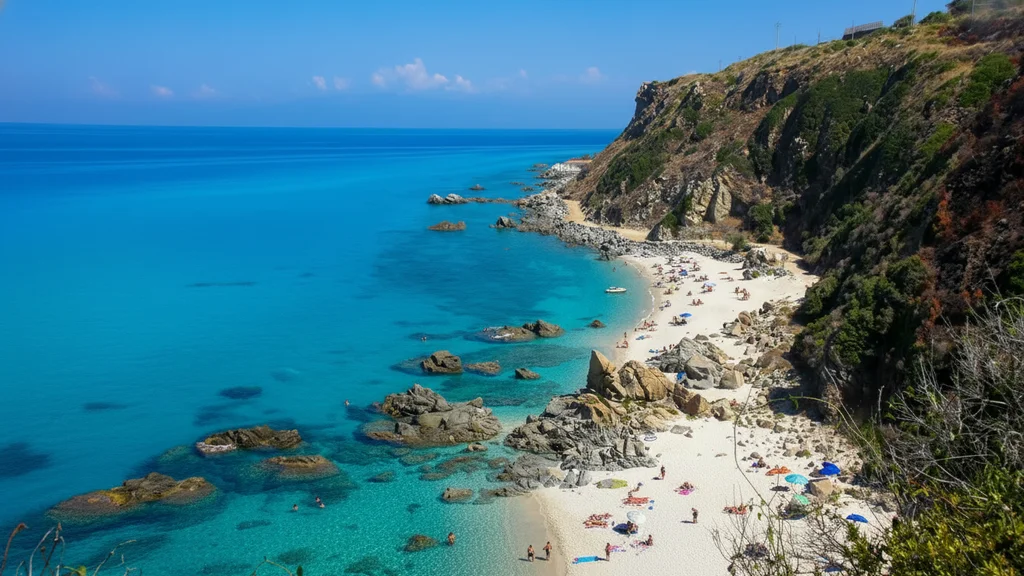
Capo Vaticano is an exceptional corner of Calabria that attracts visitors from around the world with its charm. This rocky cape, located in the municipality of Ricadi in the province of Vibo Valentia, is the geographical and cultural keystone of the region known as Costa degli Dei – the Coast of the Gods. The picturesque, rocky coastline and crystal-clear water make it an ideal destination for nature lovers and active holidaymakers. Visitors are drawn not only by spectacular views and a distinctive atmosphere, but also by the unique flora and fauna and rich local culture that lend further appeal to this place.
The Evolution of Tourism in Capo Vaticano – From Strategic Outpost to Holiday Destination
Capo Vaticano has a fascinating tourism history dating back to the 16th century. Originally serving as a strategic high point with a watchtower built in 1562, Capo Vaticano was defended against Turkish pirates. The geological foundation of the cape is a specific type of white-grey granite, which, owing to its crystalline properties and resistance to marine erosion, is the subject of interest from research centres around the world. The history of this place is linked not only to defence, but also to deeply rooted spirituality, as evidenced by the Grotta di San Ciriaco.
The origin of the name Vaticano is deeply rooted in ancient tradition and refers to the Latin vaticinium, meaning prophecy or oracle. As noted by Giuseppe Berto, the celebrated writer who settled on the cape, in antiquity priests who foretold the future resided on the clifftop known as Mantineo. This mystical aura has survived the centuries, making Capo Vaticano a place of particular spiritual significance. The current appearance of the San Ciriaco cave is the work of the local Barone family in the 19th century.
Tourism development gathered pace in modern times, when the charm of wild beaches with golden and white sand attracted visitors seeking more tranquil shores. The maximum height of the cliffs in this area reaches approximately 124 metres above sea level, which determines the character of the landscape and the accessibility of the coastline. The transparent water and picturesque views are a magnet for snorkelling, diving and other forms of active recreation.
| Geographical Parameter | Value/Description |
|---|---|
| Municipality | Ricadi |
| Province | Vibo Valentia |
| Maximum elevation | 124 m above sea level |
| Main rock formation | White-grey granite |
| Coastal area | Costa degli Dei (Coast of the Gods) |
Flora and Fauna of Capo Vaticano – Hidden Treasures of Calabria
Capo Vaticano is renowned not only for its dramatic cliffs but also for its diverse flora and fauna, which provide ideal habitats for numerous species. The cape's vegetation is a classic example of Mediterranean maquis, which evolved in response to high temperatures and soil salinity. Particularly noteworthy is Erica multiflora – the many-flowered heath, which blooms from November to March, making the region botanically attractive even in winter. This shrub reaches up to 2.5 m in height and possesses valuable pharmacological properties.
The area of Capo Vaticano features rich beds of seagrass known as Posidonia oceanica. This underwater vegetation plays a fundamental role in the coastal ecosystem, providing shelter for small fish and other marine creatures. The cape's cliffs are also a habitat for prehistoric ferns and dwarf palms (Chamaerops humilis). Myrtle, juniper and rosemary fill the air with essential oils, which is particularly noticeable during morning walks along the coast.
Thanks to conservation strategies and efforts to preserve its natural beauty, this place remains one of the most unspoilt corners of southern Italy. Those interested in the local ecosystem can visit the Museo del Mare in Capo Vaticano, which houses a rich collection of molluscs and marine biology specimens.
Climate in Capo Vaticano – Seasonal Attractions for Visitors
The climate of Capo Vaticano significantly contributes to the exceptional appeal of this region throughout most of the year. The Mediterranean climate with warm summers and mild winters is conducive to both beach holidays and off-season tourism. On average, more than 300 sunny days per year are recorded here, virtually guaranteeing good weather for leisure tourism.
Summer – Time for the Beach
In summer, during July and August, temperatures frequently exceed 30°C, attracting beach and swimming enthusiasts. Capo Vaticano is known for its crystal-clear water and beautiful beaches such as Spiaggia di Grotticelle. August is the month with the highest water temperature, reaching 26°C, which is perfect for long swims in the sea. Due to the high popularity of the area at this time, finding a parking space after 9:00 am can be challenging.
Spring and Autumn – Ideal for Sightseeing
Spring (April–June) and autumn (September–October) offer milder conditions with temperatures ranging from 20 to 28°C. This is an excellent time to explore the surrounding cliffs and the Belvedere del Faro viewpoint, from which the Aeolian Islands are visible. The water maintains a temperature above 23°C until the end of October, allowing the swimming season to be extended with far fewer crowds. September is also the time for food festivals dedicated to local specialities.
Winter – A Quiet Time on the Southern Coast
In winter, Capo Vaticano is characterised by mild temperatures of around 10–15°C. While this is not the best time for beach lovers, these conditions are perfect for visiting nearby towns and exploring local culture. Calabria's climate makes Capo Vaticano an excellent year-round destination, and winter walks among blooming heathland have their own unique, rugged charm.
Water Sports and Recreation – Activities in Capo Vaticano
In the picturesque region of Capo Vaticano, the crystal-clear water and impressive cliffs create ideal conditions for a wide range of water sports. In the Bay of Riaci, at a depth of approximately 30 metres, lies a shipwreck from the First World War, making this a priority destination for diving tourism and underwater photography.
For those who prefer lighter activities, snorkelling at Spiaggia Formicoli offers a glimpse of the remains of the ancient Roman port of Forum Erculis. The Taxi Boat service plays a key role in mobility, regularly transporting visitors to beaches inaccessible from land, such as Praia i Focu. These excursions allow the discovery of hidden caves, including the famous Grotta dello Scheletro.
Tennis courts are available for sports enthusiasts, and a bicycle hire service allows exploration of the scenic surroundings of the cape. In the evenings, guests can enjoy a rich entertainment programme including live music and themed evenings. This variety makes a holiday in Capo Vaticano an unforgettable experience for both couples and families.
Culture and Traditions of Capo Vaticano – Spiritual and Culinary Heritage of Calabria
Capo Vaticano is a place where culture and traditions are exceptionally deeply rooted in history. The region draws inspiration from ancient Mediterranean civilisations, as reflected in the MU.RI. project – Museo Diffuso di Ricadi. This network consists of five thematic units documenting the history and economy of the region, including the Museo del Mare and the Museo della Cipolla Rossa in San Nicolò di Ricadi.
Religion as a Social Pillar
The Catholic faith plays a key role in the life of the Capo Vaticano community and surrounding villages. The symbolic Piedigrotta church in Pizzo, hewn into a seaside rock, is an example of deep spirituality and local piety. The Byzantine Cattolica di Stilo bears witness to a rich tradition combining Greek and Italian influences, making it one of the most precious sacred monuments in all of Calabria.
Local Cuisine – A Taste of Tradition
Calabrian cuisine is built on ingredients of intense flavour, such as the famous Cipolla Rossa di Tropea IGP – though the name suggests Tropea, it is the fields around Capo Vaticano where this onion is actually grown. Pecorino del Monte Poro PDO is one of the finest sheep's cheeses in the Mediterranean basin, produced according to recipes dating back to the 16th century. Aged cheeses are often rubbed with olive oil and chilli, giving them a characteristic, spicy profile.
Historical Heritage
In the surroundings of Capo Vaticano, historical buildings such as Castello Murat in Pizzo and Torre Marrana in Brivadi recall the turbulent past. The Museo delle Torri focuses on the coastal defence system against Saracen raids, offering visitors both knowledge and performances in an ancient amphitheatre. This unique blend of old and new ensures that Capo Vaticano retains the spirit of the traditional Italian South, despite its growing tourist popularity.
Capo Vaticano – A Hidden Gem Among Italian Coastlines
Capo Vaticano represents a unique alternative to Italy's better-known tourist regions. The cliffs and picturesque coves create unforgettable landscapes which, combined with views of the Aeolian Islands, offer ideal conditions for relaxation. The main observation point is the Belvedere del Faro, from where, in good visibility, one can see the smoking volcano Stromboli and the Strait of Messina.
Attractions such as nearby Tropea – known for its charming clifftop old town – further enrich the region's offer. Access to Capo Vaticano is facilitated by the Trenitalia regional rail service connecting the cape to Ricadi station, served by trains from Lamezia Terme airport. For those who value the wild character of the Italian South, Capo Vaticano is an undeniable treasure.
Frequently Asked Questions About Capo Vaticano
Where is Capo Vaticano?
Capo Vaticano is located in southern Italy, on the western coast of Calabria, in the municipality of Ricadi (province of Vibo Valentia). It lies on the Costa degli Dei (Coast of the Gods), approximately 10 km south of the famous Tropea.
What beaches are near Capo Vaticano?
The main beaches are Spiaggia di Grotticelle (considered the most beautiful), Praia i Focu (accessible mainly from the sea), Baia di Riaci (with a shipwreck) and Spiaggia Formicoli with the ancient ruins of a harbour.
How do you get to Capo Vaticano?
The best option is to fly to Lamezia Terme airport (SUF) and then take a Trenitalia regional train to Ricadi station. You can also hire a car – the drive from the airport takes approximately 60–70 minutes.
What is worth seeing beyond the beaches at Capo Vaticano?
Worth visiting are the lighthouse and Belvedere del Faro viewpoint, the Museo del Mare, Torre Marrana, and the nearby towns of Tropea with its charming clifftop old town and Pizzo with its church hewn from rock.
When is the best time to visit Capo Vaticano?
The ideal time is June or September, when temperatures are pleasant (25–28°C), the water is warm, and crowds are smaller than at the peak of the season (July–August).
Top Attractions of Capo Vaticano
Belvedere del Faro
Viewpoint at the lighthouse with a panorama of the Aeolian Islands, the smoking Stromboli and the Strait of Messina.
Spiaggia di Grotticelle
The cape's most beautiful beach – white sand, turquoise water and granite cliff-caves creating an unparalleled setting.
Baia di Riaci – Diving
A First World War shipwreck at 30 m depth – one of the most interesting diving spots on the Calabrian coast.
Taxi Boat – Wild Beaches
Boats transporting visitors to the land-inaccessible beaches of Praia i Focu and to the hidden Grotta dello Scheletro.
Museo del Mare
A rich collection of molluscs and marine biology specimens – part of the MU.RI. network (Museo Diffuso di Ricadi).
Tropea
A charming clifftop old town with sea views, just 10 km from Capo Vaticano – one of the most beautiful towns in Calabria.
How to Get to Capo Vaticano
Lamezia Terme airport (SUF) is the closest, approximately 60–70 minutes away. Alternatively, Reggio Calabria airport (REG), ~90 minutes. Car hire and train connections are available from both airports.
Take the A3 Salerno–Reggio Calabria motorway, exit at Pizzo/Vibo Valentia, then follow the SS522 coastal road along the Costa degli Dei. The drive from Lamezia Terme takes approximately 60–70 minutes.
Trenitalia regional service from Lamezia Terme to Ricadi station (Capo Vaticano). The train runs along the Tyrrhenian coast, journey time 60–90 minutes.
Ferrovie della Calabria regional buses connect Tropea and Vibo Valentia with the cape. A cheaper option than the train, though slower – recommended as a complement to the train journey.