
Stilo, known as the Città del Sole (City of the Sun), is a picturesque town in Calabria that draws visitors with its extraordinary historical and cultural heritage. Set on a hilltop at the foot of Monte Consolino, it offers sweeping views over the valley and coastline, and stands at the heart of the ancient Byzantine province. Discover this Byzantine gem, which dazzles with unique monuments from the Byzantine and Norman eras, and learn about its connection with the philosopher Tommaso Campanella. For history and culture enthusiasts, as well as cycling fans, Stilo is an undiscovered attraction of Calabria, home to just 2,800 residents, guaranteeing an intimate atmosphere for exploration.
Byzantine heritage of Stilo – its influence on the culture of Calabria
Stilo, hidden in the green hills of Calabria, is one of the most important centres of Byzantine culture in southern Italy. Its breathtaking views and extraordinarily rich cultural heritage attract numerous travellers and researchers eager to understand the phenomenon of the so-called Basilian-Greek culture. For centuries this region served as a refuge for monks fleeing from the East, which resulted in the unique survival of Calabrian Greek right up to the 17th century.
The influence of Stilo on the culture of Calabria cannot be overstated, as the town was a key point on the spiritual map of the region. Its medieval sacred buildings are not merely architectural monuments but living testimony to the cultural transformations of the region, where Eastern ritual met Latin structure. The preservation of these unique structures allows us to explore the complex history of Calabria, shaped by diverse influences over millennia, from antiquity to the late Middle Ages.
It is worth noting that today's Stilo, with its views over magnificent valley and coastal landscapes, makes an excellent base for exploring the surrounding area, including the Stilaro river. Its architectural heritage and significance as a cultural centre make it not merely a tourist attraction, but above all an important point on the historic trail of Magna Graecia. Through its unique architecture and history, Stilo shows how Byzantine influences left their mark on the identity of this region, making it one of the most precious gems of southern Italy.
The significance of Stilo's architectural heritage
A magnificent example of Byzantine architecture that has survived in this part of Italy is undoubtedly the Cattolica di Stilo. It is the only such perfectly preserved Byzantine oratory in southern Italy outside Sicily, which gives it world-class status. This building, erected on a square plan, is an official candidate for inscription on the UNESCO World Heritage List, and entrance to its interior typically costs between four and five euros.
Cattolica di Stilo – a jewel of Byzantine architecture
This small church, dating from the turn of the 9th and 10th centuries, is considered a true architectural jewel built in the style of a Greek cross inscribed within a square. The charm and uniqueness of the Cattolica di Stilo lie in its harmonious proportions and the distinctive use of brick and stone, visible in the five characteristic domes covered with terracotta tiles. Its construction was inspired by Eastern styles, a reminder of Calabria's wide-ranging commercial and cultural contacts with Byzantium and of influences flowing from Armenia and the Peloponnese.
The interior of the church conceals fascinating details, such as four ancient columns taken from the ruins of the Greek city of Kaulon, which support the dome structure. On one of these columns, an Arabic inscription from the 11th century was found, testifying to the extraordinary cultural interweaving of the region and the presence of Islamic influences. The walls are adorned with layered frescoes dating from the 10th to the 15th century, rediscovered only in 1927, depicting austere images of saints in the Eastern tradition.
Historical significance and cultural influences
Remaining away from the main trade routes, Stilo was able to develop its own distinctive architectural style, a testament to the fusion of traditions. Thanks to its location between the Tyrrhenian and Ionian seas, the town played an important role in history as guardian of the heritage of a Greek colony that flourished from the 8th century BC. Contemporary epigraphic research confirms that the local community fluently combined Latin, Greek, and Oriental elements over the centuries.
| Feature | Technical details | Significance |
|---|---|---|
| Construction | Brick and stone (9th–10th century) | Byzantine durability and aesthetics |
| Floor plan | Greek cross inscribed in a square | Symbolism of divine harmony |
| Details | 5 domes, ancient columns | Unique in Italy |
| Inscriptions | Kufic script (Arabic) | Evidence of multiculturalism |
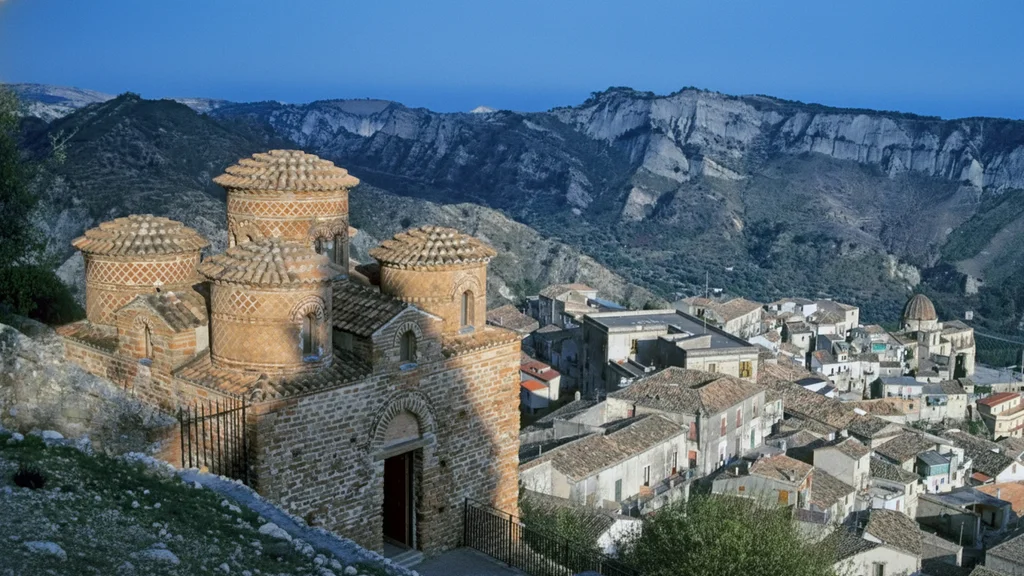
Fusion of styles – Byzantine and Norman architecture in Stilo
Stilo, charmingly set in the hills, has drawn history lovers for centuries with its unique fusion of architectural styles. One of the most important monuments attesting to the turbulent history of this small town is the Cathedral of St Lawrence (Duomo), dating from the 14th century. This building is an excellent example of the synthesis of Byzantine-Norman architecture, although its current form also bears traces of later rebuilding in granite, characteristic of the local centro storico.
Characteristics of the monuments
The cathedral is an architectural masterpiece, combining Romanesque austerity with Byzantine precision, making it a mandatory stop on any visit. Its structure and interior are characterised by simplicity, where every space serves to emphasise the spiritual message, and the entrance portal captivates with its craftsmanship. It is worth examining the details of the façade, which draw on Norman-Sicilian classicism, recalling the power of the dynasties that ruled these lands after the fall of Byzantium.
Above the town rise the majestic ruins of the Norman castle, built by Roger II on the summit of Monte Consolino. The castle is reached by a scenic Via Crucis path of 14 stations, beginning right beside the Cattolica. The ascent takes about 30 minutes, and the reward for the persistent is a breathtaking panorama of the entire Ionian coastline and the Stilaro river winding below.
Stilo – the influence of Tommaso Campanella's philosophy on the town's heritage
Tommaso Campanella, who lived from 1568 to 1639, was one of the most important intellectuals of the Renaissance, and his connection with Stilo gives the town an additional spiritual dimension. This philosopher, who spent 27 years in prison for his beliefs and participation in a conspiracy against the Spanish, was born here. This tragic yet inspiring life made Stilo a symbol of the struggle for freedom of thought and social justice.
His most famous work, The City of the Sun (Civitas Solis), is a utopian vision of a society governed by the wise, founded on knowledge and harmony. Although Campanella wrote it in the gloom of a Neapolitan prison, many scholars believe that the topography of his ideal city – situated on a hill and surrounded by walls – was inspired by the steep slopes of Stilo. Today the town houses a museum dedicated to the thinker, and visitors can also see the monastery of San Domenico, where his cell is preserved.
When visiting Stilo, it is impossible not to feel the presence of the great thinkers who shaped European philosophy of the state. The town appeals not only visually, with its Byzantine architecture, but also invites intellectual exploration along the traces of the Inquisition process and Renaissance utopias. This combination of the austere granite of the buildings with the soaring ideas of Campanella makes this place a unique point on Italy's cultural map.
Stilo – a cultural gem of Calabria
Stilo is a true jewel for history lovers and an essential point on the tourist map of the region. Beyond the town itself, it is worth paying attention to its surroundings, which offer a window into ancient times. Just 15 kilometres from Stilo lies Monasterace, where visitors can admire the ruins of Kaulon – an ancient Greek polis – and the famous dragon mosaic discovered directly on the beach.
Tourist trails exploring history and nature
Stilo delights visitors with its diversity of trails, which ideally combine the beauty of nature with rich cultural heritage. A popular route leads through the Parco delle Serre, giving access to spectacular natural wonders such as the Marmarico and Pietra Cupa waterfalls. These are among the highest and most picturesque cascades in southern Italy, ideal for those seeking respite on hot days.
Following the Magna Graecia trail, travellers can plan a longer expedition: from Stilo, through Locri Epizephirii, all the way to Reggio Calabria. It is in the regional capital that the famous Bronzi di Riace are displayed, ancient sculptures retrieved from the sea, which provide the perfect conclusion to the historical story of Calabria's Greek roots. Such a route allows one to fully understand the evolution of art and architecture over more than two thousand years.
Practical tips for visitors
The optimal time to visit Stilo is spring and autumn, when the weather is ideal for trekking on Monte Consolino. The best way to reach the town is by car, as this gives the freedom to combine it with nearby Gerace, considered one of the most beautiful villages in Italy. For those using public transport, the nearest railway station is at Monasterace, from where local buses run, though their frequency can be limited.
Stilo – a cycling mecca in the heart of Calabria
Stilo successfully combines its natural assets with culture, becoming an attractive destination for cycling enthusiasts. Its setting on the slopes of the Aspromonte means the cycling routes are demanding, but offer unforgettable views over the Ionian Sea. Initiatives such as “Progetto Calabria Bike” promote the region through e-bike rental, allowing less experienced cyclists to tackle the steep climbs up to the Cattolica.
As part of local infrastructure projects, a “Stilo Cycling Hub” has been established, providing technical support and maps of routes connecting Stilo with Bivongi and Pazzano. Cyclists appreciate these trails for the absence of crowds and the opportunity for direct contact with local folklore in mountain villages. Riding through the Stilaro valley is not just a sport, but above all a journey through the centuries, where every bend reveals a new watchtower or Byzantine hermitage hidden in the rocks.
Stilo – Byzantine gem of Calabria: frequently asked questions
What is the Cattolica di Stilo and why is it unique?
The Cattolica di Stilo is a small Byzantine church from the 9th–10th century, built on a Greek cross plan with five domes. It is unique for its distinctive architecture, well-preserved frescoes, and Arabic inscriptions on ancient columns, making it one of the most important Byzantine monuments in Italy.
How do I get to Stilo – is there a train?
There is no railway station in Stilo itself. The nearest stop is Monasterace-Stilo, located on the coast about 15 km from the town. From the station, you can reach central Stilo by local bus or taxi, but the most convenient option is to travel by car.
How long does it take to visit Stilo?
A basic visit to the centre and the Cattolica takes about 2–3 hours. If you plan to climb to the Norman castle via the Via Crucis path and visit the Tommaso Campanella museum, it is worth setting aside a full day, or a minimum of 5–6 hours.
Can Stilo be combined with a visit to Locri or Gerace?
Yes, Stilo is close to other gems of Calabria. Gerace is about an hour away by car, and the archaeological park at Locri is about 45 minutes. This is a popular route that allows you to explore the legacy of Magna Graecia and the Norman era in a single day.
Who was Tommaso Campanella and what is his connection with Stilo?
Tommaso Campanella was a famous Renaissance philosopher and theologian, author of the utopian work “The City of the Sun”. He was born in Stilo (more precisely in Stignano, which then belonged to Stilo), and the town still honours his memory through monuments and a dedicated museum.
What other Byzantine cultural sites are worth visiting in Calabria?
Beyond Stilo, it is worth visiting Rossano with its Oratorio di San Marco and the famous Codex Purpureus, the baptistery at Santa Severina, and the monastery of San Giovanni Theristis near Bivongi, which remains an active centre of Orthodox Christianity.
Main attractions
Cattolica di Stilo
The only perfectly preserved Byzantine oratory in southern Italy (9th–10th c.). Five domes, frescoes from the 10th–15th century, and Arabic inscriptions on ancient columns.
Cathedral of St Lawrence (Duomo)
14th-century cathedral – a fine example of the synthesis of Byzantine-Norman architecture in the heart of historic Stilo.
Norman castle on Monte Consolino
Ruins of Roger II's castle on the mountain summit. Reached via the Via Crucis path (approx. 30 min) – panoramic views of the entire Ionian coastline.
Monastery of San Domenico – Campanella's cell
The monastery where Tommaso Campanella stayed. A museum dedicated to the philosopher – author of “The City of the Sun”.
Ruins of Kaulon – Monasterace
15 km from Stilo – an ancient Greek polis from the 5th century BC with the famous dragon mosaic discovered directly on the beach.
Marmarico and Pietra Cupa waterfalls
In the Parco delle Serre – among the highest cascades in southern Italy. Perfect for day trekking excursions.
How to get there
Lamezia Terme (SUF) – approx. 100 km (~1h 15 min). Reggio Calabria (REG) – approx. 90 km (~1h 10 min). Both with domestic connections.
Monasterace-Stilo station on the Ionian coast (15 km from Stilo) – Reggio Calabria–Taranto line. Taxi or bus to the centre from the station.
Local buses from Monasterace station to Stilo centre – limited frequency. Check the timetable before travelling.
Route SS106 (Ionian coast), then SP road climbing to the hill. The most convenient option – allows Stilo, Gerace, and Locri to be combined in one day.