
Locri, known in antiquity as Lokroi Epizephyrioi, was one of the great pillars of Magna Graecia civilisation. This Greek colony, founded around the 8th century BC by settlers from the Gulf of Corinth on the Ionian coast of Calabria, continues to fascinate researchers with its rich and complex history. Its strategic position between the Tyrrhenian and Ionian Seas made Locri a target of interest for the great powers of the ancient world, while today it offers a combination unique even in Italy – the transition from ancient ruins to a sandy beach takes just 15 minutes on foot. The evocative remains of this city draw visitors from across the world, offering an unparalleled blend of history, culture and landscape, where the echoes of Nossis’s poetry still resonate among the olive groves.
The Foundation of Locri – Foundations of Greek Culture in Italy
The Origins of Locri – Myth and History
Locri Epizephirii, one of the oldest Greek colonies in Magna Graecia, is a fascinating example of the inseparable intertwining of mythology and historical fact. The founding of Locri is dated precisely to around 673–660 BC, coinciding with a period of intense Greek cultural expansion across southern Italy. The history of this colony begins with myths surrounding Evanos, son of Epeus, who according to tradition led settlers from the Ozolian Locrians of central Greece. Support was said to have come from Callirrhoe, daughter of the king of Croton, underscoring the immense importance that legends held in legitimising ancient migrations.
There is, however, a second – more prosaic yet equally fascinating – account of the city’s origins, transmitted by Aristotle. According to this version, Locri was founded by a group of servants and lower-class individuals who fled Greece with their mistresses while their husbands were occupied with war. This duality of origins – aristocratic versus plebeian – shaped the unique social identity of a city that at its peak may have numbered as many as 25,000 inhabitants.
Greek Roots and Strategic Choices
Locri was settled predominantly by people from Ozolia and Opuntian Locris, but also from Zakynthos and Rhodians. The settlers chose the Ionian coastline for its strategic position between the Gulf of Squillace and the Strait of Messina. The name “Epizephirii” refers directly to this location – it means “beyond the west wind” (Zephyr), distinguishing the new settlement from its ancestral Locris in Greece. This placement guaranteed not only sea access but also protection from potential invaders, thanks to the mountain shelter of the Sila massif.
Locri’s Influence on Magna Graecia
Locri rapidly became one of the main political and cultural centres of the region. Its significance is underlined by the introduction of the unique legal system devised by Zaleucus, who created one of the first written law codes in the western world. This code, known for its severity and pursuit of absolute social order, introduced principles including the law of retaliation (an eye for an eye) and other regulations that later influenced law in other colonies such as Croton and Catana. It was here, in 643 BC, that the concept was born that law should be fixed and known to all – not dependent on the whim of a judge.
Culture and Religion – the Legacy of Locri
Locri also became renowned for its flourishing cult of Aphrodite Epizephyris. The Temple of Aphrodite in Locri was one of the most important places of worship in Magna Graecia. Equally significant was the cult of Persephone, confirmed by finds from the Mannella sanctuary. Nor can one overlook the figure of Nossis, who lived at the turn of the 4th and 3rd centuries BC and was called the “Sappho of Italy”. Her poetry, often dedicated to women and Aphrodite herself, is a rare and precious example of a female voice in ancient literature, proving that Locri was a centre not only of stern law but of refined Hellenistic art that radiated throughout all of Italy.
Economy and Trade – the Strength of Locri
Thanks to its position on the Ionian coast and the fertile soils of Calabria, Locri developed as a significant trading centre. The production of olives, wine and grain formed the basis of the local economy, and the monetary system with its distinctive designs emphasised the colony’s independence and economic self-sufficiency. These factors made Locri a strategic point on the regional trade map, exchanging goods with neighbouring civilisations and peoples across the Mediterranean basin.
Locri on the Ionian Sea – Key Role in Greek Colonial Strategy
Locri’s Strategic Geographic Assets
Locri’s position on the Ionian Sea was of enormous strategic importance in the context of Hellenistic expansion across southern Italy. Not only its natural defensive conditions but also its trading potential made it the main point of reference in the region.
Defensive Position and Natural Terrain
The unique topography around Locri – rocky coastline and steeply rising cliffs – provided the city with excellent protection against attack. Herodotus described Locri as an almost impregnable fortress, a description repeatedly confirmed by its history of wars with neighbouring cities such as Croton. Natural barriers facilitated defence, and the absence of broad plains made it additionally difficult for besiegers to take up positions.
Control of Trade Routes
Locri’s strategic position enabled control over sea routes, particularly thanks to proximity to the important trading centres of Sicily and Greece. Archaeological finds – ceramics and coins – point to intensive trade with other colonies, forming the basis of the city’s economic development. Locri was a central hub for exchange of goods such as olive oil, wine and grain. It is worth noting that diving off Capo Bruzzano still reveals traces of the ancient port that once teemed with life.
Involvement in Regional Conflicts
Locri played a decisive role in numerous conflicts fought in this part of the ancient world. Over the centuries the city rivalled its neighbours, maintaining its influence through strong maritime alliances. During the war with Croton and subsequent clashes with Syracuse, Locri could swiftly obtain support thanks to its strategic coastal position. Its alliance with Dionysius of Syracuse strengthened the city’s defensive and offensive capabilities, making Locri one of the most powerful Greek colonies in southern Italy.
Influence on Regional Development
Locri was not only militarily but also economically and culturally significant within Magna Graecia. Its influence was felt throughout the region, and numerous archaeological finds continue to provide information about its rich civilisational heritage. Although modern architecture and urban development have transformed the landscape, the remains of this ancient centre still stand and continue to attract both archaeologists and visitors interested in the heritage of Locri Epizephyrii.
The Code of Zaleucus – Foundation of Ancient Greek Jurisprudence
The Code of Zaleucus – Innovation and Historical Significance
Zaleucus, one of the first known lawmakers, was active in the 7th century BC in Locri. His work on the codification of law was pioneering in the Greek world of the time and had a profound influence on the subsequent development of European legal systems. Active around 643 BC, he anticipated later Athenian reforms, becoming the first Western lawmaker to understand the importance of the written word in legal proceedings.
At a time when Greek city-states known as “poleis” were beginning to systematise their internal regulations, Zaleucus was introducing revolutionary changes in legislation. Lokroi Epizefyri, the colony he led, needed clear and unified principles, and so Zaleucus drew up one of the first known written legal codes. His code not only regulated everyday life in the city but also served as a model for other Greek lawmakers.
Key Features of Zaleucus’s Legislation
The Code of Zaleucus was distinguished by several key characteristics:
- Systematisation and structure – Zaleucus sought to create a comprehensive legal system covering all aspects of social and family life. Criminal, property and family law were organised in a uniform manner, facilitating interpretation and application.
- Equality before the law – One of the main principles of the code was that all inhabitants were subject to the same laws regardless of their social standing – a significant step forward compared to the earlier tradition of customary law.
- Severity of penalties – The Code of Zaleucus was known for its rigorous punishments, aimed at ensuring order and respect for the law in the colony. Although some penalties were harsh, they served a preventive function in colonial society.
Legacy of Zaleucus
Although many details of Zaleucus’s life and work are shrouded in legend, his contribution to the development of legal systems is indisputable. Legend holds that Zaleucus was so devoted to the rule of law that when his own son broke a law punishable by blinding, the lawmaker ordered one of his son’s eyes and one of his own to be put out, to satisfy the letter of the law while preserving his heir’s sight. The bronze tablets found in the archives of Zeus at Locri confirm the strong bureaucratic and legal tradition of the city, and contemporary historians regard Zaleucus as a pioneer of legal codification whose work underpins the modern understanding of the rule of law.
The Cult of Aphrodite in Locri – from the Heart of Religion to the City’s Identity
At the heart of Locri Epizefiroi, the cult of Aphrodite played a significant role that extended beyond traditional religious boundaries, deeply influencing the social, economic and cultural life of the city. Aphrodite, goddess of love and fertility, was not merely an object of veneration but a symbol that integrated diverse aspects of urban life. Alongside her, the cult of Persephone was extremely strong – confirmed by finds from the Mannella sanctuary.
Religious and Social Pathways
The Temple of Aphrodite in Locri was one of the pillars of her cult. Drawing worshippers from all corners of Magna Graecia, it formed the foundation of the city’s religious life and a point of reference for its identity. Celebrations associated with the cult – processions and festivals – were an inseparable part of the civic calendar, attracting pilgrims. Women frequently played essential roles as priestesses and participants in rituals – which corresponds perfectly with the poetry of Nossis, who created her works in precisely this religious context.
Economic Impact and Artistic Inspiration
The significant influx of pilgrims visiting the Temple of Aphrodite supported the local economy. Revenue generated by the cult – in the form of offerings and gifts – contributed to the city’s economic development. The cult of Aphrodite also found expression in art: sculptures and ceramic painting inspired by the goddess were widespread in Locri. Particularly noteworthy are the famous “pinakes” – terracotta votive tablets, often depicting scenes of Persephone’s abduction by Hades – which are a unique testament to local theology and aesthetics.
Syncretism and Identity
Locri, as a place where Greek traditions and local influences intermingled, offered a space for the formation of a unique cultural identity. The cult of Aphrodite served as a bridge between the Greek past and the local Italian context, binding diverse elements into a single identity that distinguished Locri from other cities of southern Italy and cemented its position as an important cultural centre of Magna Graecia.
The Archaeological Heritage of Locri – Testament to Ancient Greek Culture
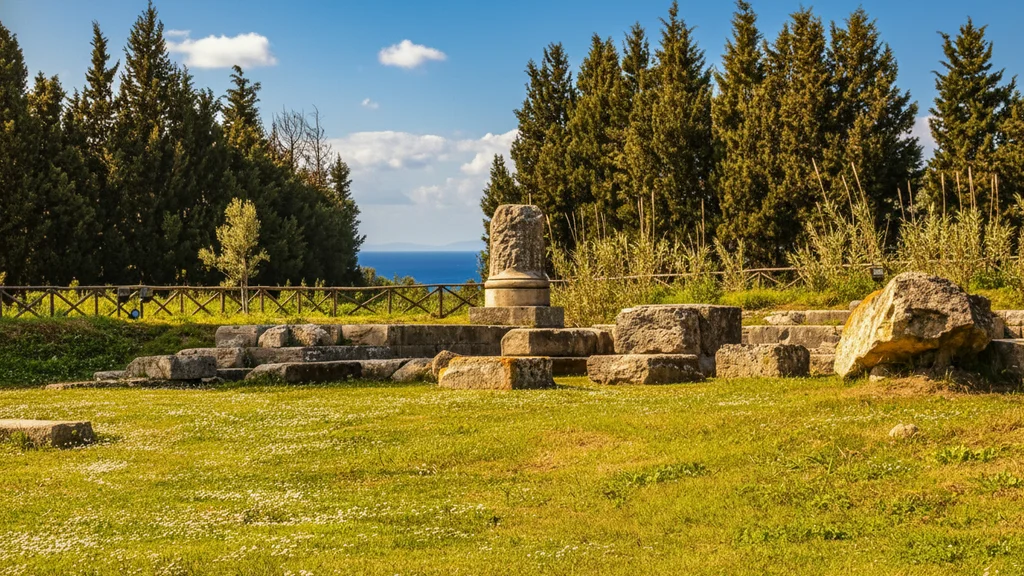
Locri offers a rich archaeological heritage that constitutes a key source of information about ancient Greek colonies in Calabria. The remains of the city – temple ruins and a necropolis – allow us to understand how life functioned in this distant past. The archaeological park extends across a vast area, and a visit requires careful planning: it is best to allow 2 to 3 hours, avoiding the midday heat in summer.
Temple Ruins and Important Sacred Structures
Particularly noteworthy are the temples found at Locri, which still testify to the religious practices of the ancient inhabitants. The Temple of Olympian Zeus, one of the earliest Doric structures in the area, underlines the importance of his cult. The Temple at Marasà (5th century BC), in the Ionic style, is striking for its monumentality. The quality and quantity of votive objects – items entrusted to the gods – reflect the high aesthetic and religious standards of the city.
| Archaeological Sector | Function and Main Finds | Dating |
|---|---|---|
| Marasà | Ionic temple; religious centre | 6th–5th century BC |
| Mannella | Sanctuary of Persephone; source of the famous pinakes | 5th century BC |
| Centocamere | Residential and craft district | 7th–3rd century BC |
| Theatre | Greco-Roman theatre built into a natural slope | 4th century BC |
Museum Finds and Their Cultural Significance
The terracotta decorative plaques known as pinakes contain mythological and religious scenes, bearing witness to the influence of Greece on Magna Graecian art. These plaques, alongside refined deity figurines, are precious examples of Greek art. It is worth noting that some of the most valuable collections – including the famous statues of the Dioscuri – are held in the National Archaeological Museum of Reggio Calabria, but the local park museum still holds an impressive collection of bronze tablets inscribed with city laws.
Practical Visiting Information
The archaeological park and museum are typically open Wednesday to Sunday, 09:00–20:00 (ticket offices close at 19:00). The site is closed on Mondays and Tuesdays. A combined ticket grants access to both the excavation area and the museum. Sturdy footwear is essential – the terrain is extensive and uneven, with little shade in summer, so it is advisable to bring water and plan your visit for the morning or late afternoon.
Costa dei Gelsomini – a History Scented with Jasmine
Calabria’s Jasmine Heritage
The Locride region, in which Locri is situated, is more broadly known as the Costa dei Gelsomini – the Jasmine Coast. This poetic name is no accident: from the 1920s through to the 1970s, a stretch of coastline approximately 90 kilometres long was the world centre of jasmine cultivation (Jasminum grandiflorum). At its peak in the mid-1940s, Calabria supplied nearly 40% of the world’s demand for jasmine essence, which went directly to French perfume houses and became the base for some of the world’s most luxurious fragrances.
The Gelsominaie – Women Who Built a Legend
The history of the Jasmine Coast is above all a story of the gelsominaie – the jasmine pickers. Their work was extraordinarily demanding and became a symbol of the toil and determination of local women. Harvesting had to take place at night, typically from 3:00 in the morning, because the delicate flowers lost their precious aromas in sunlight. Young girls and women, often working barefoot and bent double, picked thousands of tiny flowers before dawn. These women became the pioneers of the struggle for workers’ rights in southern Italy, bringing about the signing of the first collective agreements in the sector in the late 1950s.
Modern Locri and the Region Today
Today the jasmine industry has given way to tourism and other agricultural production – bergamot and olive cultivation – but the memory of those times remains vivid. Modern Locri is a city of around 12,000 inhabitants that comes alive in summer through events such as the Locri Jazz Festival held in August. Visitors are drawn by the beaches recognised for the purity of their waters: neighbouring Roccella Ionica and Siderno regularly receive the Blue Flag award, while the beaches of Marina di Locri offer relaxed seaside leisure with views over the crystal-clear Ionian Sea.
Getting Around – Locri as a Base and the Gem of Gerace
Gerace – Escape to Higher Ground
Just 10 kilometres from the coast rises the medieval town of Gerace, known as the “little Florence of Calabria”. Its existence is inseparably linked to the decline of ancient Locri. When in the 7th–8th centuries AD the coastline became dangerous due to Saracen raids and spreading malaria, the inhabitants of Locri fled inland to a safe hilltop and founded Gerace. A visit to both places in a single day closes a historical loop – from ancient power on the shore to a medieval fortress on the rock. The most convenient way from Locri to Gerace is by taxi (around 15 minutes).
Transport and Recuperation
Locri is excellently connected with the rest of the region thanks to the railway line running along the coast. Trains from Reggio Calabria run an average of 13–16 times a day, and the journey takes 70 to 90 minutes, making Locri an ideal destination for a day trip. For those seeking recuperation after sightseeing, the area offers the Terme di Antonimina (“Acque Sante Locresi”). These thermal springs, known since Roman times, offer sulphurous waters at 36°C, beneficial for rheumatic and dermatological conditions and the perfect complement to an active day of exploration.
Locri – Frequently Asked Questions
What is Locri Epizefiri and why is it worth visiting?
Locri Epizefiri is an ancient Greek colony in Calabria, founded in the 7th century BC, renowned for Zaleucus’s first written law code and the cult of Persephone. It is worth visiting for the unique combination of an extensive archaeological park with temple ruins and a theatre, alongside beautiful beaches on the Ionian Sea just 15 minutes’ walk away.
How long should I allow for visiting the archaeological park at Locri?
A thorough visit to both the archaeological park and the museum requires 2 to 3 hours. The site is extensive and the most interesting areas – such as the Marasà temple and the theatre – are some distance apart. It is best to plan your visit for the morning or late afternoon, particularly in summer.
What are the beaches at Locri like – is it worth going just for the beach?
The beaches at Locri and across the Costa dei Gelsomini are sandy, wide and less crowded than in other parts of Italy. While the beach itself is attractive, the greatest value of Locri lies in the possibility of combining seaside relaxation with a visit to world-class heritage sites within 15 minutes’ walk.
How do I get to Locri by train from Reggio Calabria?
Getting there is very straightforward thanks to the Trenitalia railway line running along the Ionian coast. Trains from Reggio Calabria Centrale run many times a day from early morning to evening, with a journey time averaging 1 hour 10 minutes to 1.5 hours. A ticket costs around 10 euros.
Can Locri and Gerace be visited on the same day?
Yes – this is a very popular and highly recommended combination. Gerace is just 10 km from Locri. The ideal plan is to visit the archaeological park at Locri in the morning, then take a taxi or bus to medieval Gerace for an afternoon stroll and dinner with views over the sunset.
What is the Costa dei Gelsomini?
The Costa dei Gelsomini – the Jasmine Coast – is the name for a stretch of coastline in the province of Reggio Calabria, including the area around Locri. The name derives from the historic jasmine cultivation that in the mid-20th century formed the basis of the local economy, supplying essence to the global perfume industry – including French fashion houses.
Main attractions
Locri Epizefiri Archaeological Park
Extensive ruins of a Greek colony from the 7th century BC. The Marasà temple, Sanctuary of Persephone, Greco-Roman theatre and necropolis. Combined ticket with the museum. Allow 2–3 hours; best visited in the morning.
National Museum of Locri
Collections from the excavations: bronze tablets inscribed with Zaleucus’s code, the famous pinakes (terracotta votive plaques from Mannella), ceramics and coins. Part of the collection is complemented by the museum in Reggio Calabria.
Marina di Locri Beaches
Sandy, wide beaches on the Costa dei Gelsomini with crystal-clear Ionian Sea water. Just 15 minutes’ walk from the archaeological ruins – combining history with seaside relaxation.
Gerace – 10 km from Locri
A medieval hill town founded by refugees from ancient Locri. The largest Romanesque church in Calabria (11th century) with a 9th-century crypt, and over 100 churches in the village.
Capo Bruzzano – Ancient Port Underwater
Diving off Capo Bruzzano reveals traces of Locri’s ancient port beneath the Ionian Sea surface. A unique experience for history enthusiasts and divers alike.
Terme di Antonimina
Thermal springs known since Roman times – sulphurous waters at 36°C, beneficial for rheumatic conditions. The ideal complement to an active day of sightseeing. Located 15 km from Locri.
How to get there
From Reggio Calabria: 13–16 services daily, journey approx. 70–90 min, ticket approx. €10. Locri station is in the town centre, 15 min walk from the beach and the archaeological park entrance.
Motorway A3/E45 to Reggio Calabria, then SS106 along the Ionian coast. From Reggio approx. 90 km (around 1 h 15 min). Parking at the museum and on the beach.
Nearest airports: Reggio Calabria (REG) – 90 km; Lamezia Terme (SUF) – 130 km, with more connections. From both airports, the most convenient option is car or taxi.
Regional buses along the Ionian coast connect Locri with Reggio Calabria, Siderno and Caulonia. To Gerace (10 km) there is a local bus or taxi service.