
In the heart of Calabria, just a few kilometres from the shores of the Ionian Sea, lies Gerace. This small town, whose labyrinthine cobbled streets conceal a thousand years of history, is a true delight for lovers of medieval architecture and culture. Picturesque views, monuments unchanged for centuries, and an authentic atmosphere make Gerace an essential stop on every traveller's map of southern Italy. This compact town is ideally suited for a relaxed half-day visit, and during the tourist season a special shuttle train runs from the lower car park.
Sacred Architecture of Gerace – The Influence of Medieval Genius on Calabria
Introduction to Gerace's Sacred Wonders
Gerace, a remarkable medieval town in the scenic region of Calabria, is a genuine treasure trove of Romanesque-Byzantine sacred architecture. Its monuments bear witness to the turbulent history of this corner of the world – from Byzantine influence, through Norman invasions, to the dominance of the Sicilians and the Angevins. The town is sometimes called the City of 128 Churches, which, given its current population of around 3,000, represents an astonishing ratio of sacred buildings per inhabitant.
Outstanding Sacred Monuments
The foremost landmark is the Cathedral of Santa Maria Assunta, founded by the Normans in the 11th century on the foundations of an earlier Byzantine basilica. It is the largest Romanesque church in the whole of Calabria, built between the 11th and 12th centuries. Legend has it that it was erected on the very edge of a cliff, to serve as a spiritual and physical barrier protecting the townspeople from Saracen raids.
The cathedral's interior conceals a remarkable 9th-century crypt containing no fewer than 26 ancient columns taken from the ruins of nearby Locri. This majestic structure enchants with its blend of Lombard-Romanesque and Byzantine elements, while the frescoes adorning its interior rank among the finest in the region. Admission to the cathedral costs around €3, and visitors should remember that appropriate attire is required in this holy place.
Another significant landmark is the Church of San Giovanni di Gerace (San Giovannello). Its Byzantine architecture, with its characteristic dome and apses, is an excellent example of Eastern influence on Calabrian sacred architecture. Other notable buildings include Santa Maria del Porto and the church of San Francesco, which impresses with its richly decorated interior and features characteristic of the Norman period.
Cultural Influence on Calabria and Southern Italy
The sacred architecture of Gerace shaped the cultural identity and urban planning of southern Italy. Architectural models and stylistic solutions – such as the characteristic bell towers and biforate windows – became templates for other towns in Calabria and Sicily. A visit to Palazzo Marafioti is highly recommended, where the diocesan museum displays a rich collection of sacred art and liturgical vestments.
The foundation of Gerace's sacred buildings was not only a response to religious and defensive needs, but also transformed this picturesque town into a renowned spiritual centre. Gerace proudly bears the title of Borghi più belli d'Italia, confirming its status as one of the most beautiful settlements in the entire country, preserving its unique urban layout for centuries.
The Norman Castle of Gerace – Defence and Power in Medieval Calabria
The Norman castle of Gerace, one of the most important examples of medieval Italian defensive architecture, stands on a strategically positioned hilltop. Built in the 11th century by the Normans following their victories in southern Italy, the castle incorporates innovative fortification elements. The scenic Via Caduti sul Lavoro trail leads to the castle ruins, offering breathtaking panoramas over the Locri valley and the Ionian Sea.
Defensive and Military Function
From a historical perspective, the castle played a crucial role in defence against both Arab and Byzantine raids. The structure, with its imposing walls and towers, enabled effective protection of the territory. With walls up to 2.5 metres thick and approximately 10 metres high, the castle was virtually an impregnable fortress. Defensive towers, including the cylindrical main tower, along with elements such as moats and barbicans, underline the advanced nature of the fortifications.
Administrative and Residential Centre
The castle at Gerace also served as the centre of local power, being the seat of the Norman counts. It was the venue for audiences and judicial sessions, as well as the hub of the local economy, which engaged in trade in olive oil and silk, among other goods. The residential halls were richly furnished and decorated with frescoes, testifying to the extraordinary importance of this place in Calabria's feudal structure.
Symbolism and Religious Significance
The Norman dominance in Calabria, symbolised by the castle, had not only a military-political dimension but also a religious one. Inside the castle there was a chapel, an expression of Christian influence and an important element in the Christianisation of this part of Italy. Ongoing archaeological and historical research on the castle continues to shed light on its many functions and its significance in the context of Norman expansion in medieval Italy.
Cultural Traditions and Festivals in Gerace – the Heart of Calabrian Identity
Main Religious Festivals
Gerace is renowned for its deeply rooted religious tradition, which manifests itself in numerous feast days. Particularly in August, the eagerly anticipated Feast of the Madonna della Rupe, the town's patron saint, takes place. The celebration includes a procession carrying the image of the Virgin Mary from the sanctuary to the cathedral, accompanied by concerts and the Calabrian tarantella.
During Holy Week, the processions of the Brotherhood of the Four Crosses are deeply moving. The penitents carry decorated crosses in black robes, in an atmosphere filled with mysticism and polyphonic chanting. During Holy Saturday, the ceremony of the Vara takes place, engaging the entire community in a profound experience of the Easter mystery.
Folk and Cultural Traditions
Craft production, including majolica ceramics, is an integral part of Gerace's cultural landscape. At the end of July, the town comes alive with the Il Borgo Incantato festival (the Enchanted Village), which brings together street artists, musicians, and craftspeople from around the world. This is the ideal moment to see the town buzzing with the life and energy of contemporary art set against a medieval backdrop.
Gerace is characterised by the production of specialities such as 'nduja, a spicy sausage, and morzeddu, a traditional stew. The local Greco di Bianco wine is highly prized and considered one of the oldest wines in Italy. In summer, as part of the Estate Geracese events, concerts and performances showcasing local musical and dance traditions are held in squares such as Piazza del Tocco.
Gerace in the Byzantine Era – Strategic Centre of Calabria
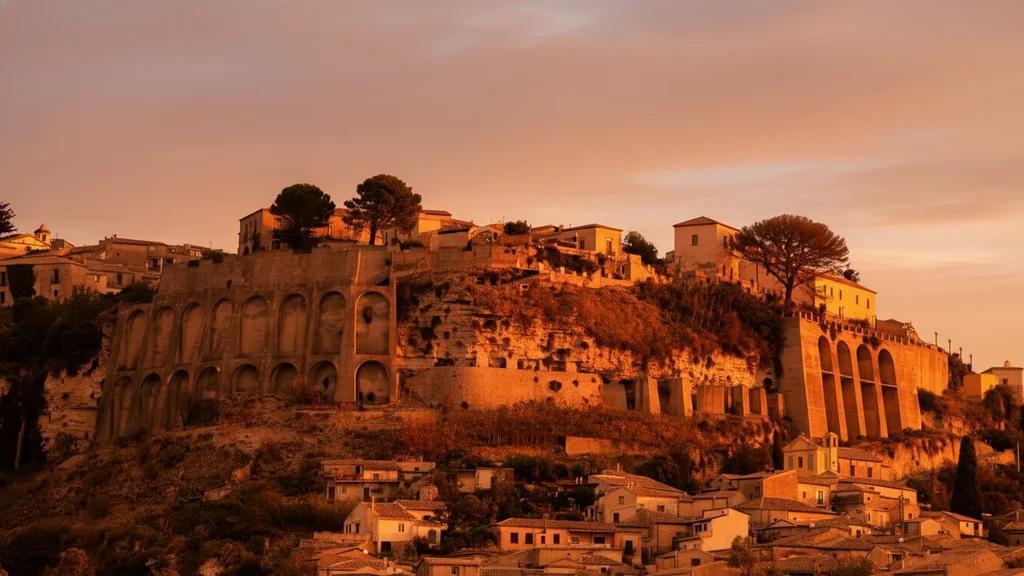
During the Byzantine period, Gerace was an important strategic point on the map of southern Italy. Its geographical position, just 10 kilometres from the Ionian coast, allowed control over maritime trade routes. Its location at an altitude of 400 metres above sea level made it an ideal vantage point, protecting against sudden attacks from both sea and land.
Defensive features and urban planning. High walls and a system of fortifications effectively protected the town against attacks, particularly the waves of Arab raids. A unique feature of Gerace's urban layout are the so-called cozzo streets, built vertically, which were designed to facilitate the rapid drainage of rainwater and hinder the movement of invaders. Over time, the town became the seat of local Byzantine authorities, further underlining its administrative importance.
Trade and cultural networks. As part of the Byzantine infrastructure in Italy, the town supported the spread of Eastern culture and art. The medieval architecture of this period continues to attract scholars thanks to its unique character, combining the austerity of a fortress with the refinement of Byzantine detail. Gerace played a significant role in the trade exchange network, serving as a safe haven for merchants travelling along the coast.
Gerace – A Flavourful Guide to Calabrian Specialities
Gerace is a paradise for lovers of traditional cuisine, blending Byzantine and local influences. The local kitchen is built around products such as olive oil, 'nduja, and peperoncino. Be sure to try the local pecorino cheese and the traditional dish pasta chjina – a richly stuffed pasta baked with meat, cheese, and eggs – which is the pride of local home cooks.
| Speciality | Description |
|---|---|
| 'Nduja | Spicy, soft pork sausage with a generous amount of chilli. |
| Pasta chjina | Stuffed pasta baked with meat, cheese, and eggs. |
| Greco di Bianco | Sweet dessert wine of amber colour with an ancient lineage. |
| Pecorino | Hard sheep's cheese with an intense flavour, ideal with red wine. |
In the local restaurants you can savour authentic Calabrian 'nduja, served in the traditional way on bread. Look out for traditional ceramics from Mammola, which are often used to serve these local delicacies. Thanks to the combination of its historic heritage and unspoilt natural beauty, Gerace is a place where every bite tells its own unique story.
Gerace as a Base for the Locride Region
Thanks to its location, Gerace makes an ideal base for exploring the Locride region. It lies just 10 km from the ancient site of Locri, making it easy to plan an action-packed day of sightseeing. A suggested itinerary includes a morning visit to Gerace, an afternoon at the Locri Epizephiri archaeological park, and an evening on the beach at Marina di Locri.
For those with more time to spare, other gems of the region lie within a 40-kilometre radius. A visit to Caulonia and Stilo, famous for the Byzantine Cattolica di Stilo, is well worthwhile. The region offers a unique blend of the mountain landscapes of Aspromonte with the blue of the Ionian Sea, creating a setting that is perfect for the most discerning travellers.
Gerace – Frequently Asked Questions
How do you get to Gerace – is a car necessary?
A car is by far the most recommended mode of transport, offering full independence. You can also travel by train to Locri station and then take a local bus or taxi, which covers the 10-kilometre stretch in around 15 minutes.
How long does it take to visit Gerace?
Gerace is a compact town, so a relaxed half-day (around 4–5 hours) is sufficient to see the main sights such as the cathedral and the castle. However, it is worth staying longer to enjoy lunch at one of the local trattorias.
Can Gerace and Locri be visited in one day?
Yes, combining these two destinations in a single day is very popular and logistically straightforward. They are only 15 minutes apart by car, making it easy to explore medieval Gerace in the morning and the archaeological park at Locri in the afternoon.
When does the Il Borgo Incantato festival take place in Gerace?
The main summer edition of the Il Borgo Incantato festival usually takes place at the end of July (often around 26–28 July). There is also a winter edition of the event, held at the end of December.
What should you buy in Gerace as a souvenir?
The best choices are local majolica ceramics, bergamot products (essential oils, liqueurs), and food specialities: pecorino cheese, spicy 'nduja, or a bottle of the rare Greco di Bianco wine.
Is there an admission charge for the Gerace cathedral?
Yes, admission to the cathedral typically costs €3. Additional charges may apply for visiting the Diocesan Museum, which houses the cathedral treasury.
Main attractions
Cathedral of Santa Maria Assunta
The largest Romanesque church in Calabria (11th–12th c.) with a crypt featuring 26 ancient columns from Locri. Admission ~€3.
Norman Castle
11th-century ruins perched on a rocky summit, with panoramic views over the Locri valley and the Ionian Sea. Reached via Via Caduti sul Lavoro.
Church of San Giovannello
A gem of Byzantine architecture with a characteristic dome and apses – one of the oldest churches in the region.
Diocesan Museum
Palazzo Marafioti houses a rich collection of sacred art, liturgical vestments, and the cathedral treasury.
Il Borgo Incantato
Summer festival (end of July) featuring music, street art, and craftwork. A winter edition is held in December.
How to get there
Motorway A2/E45, exit Locri, then SP1 approx. 10 km uphill to Gerace. From Reggio Calabria ~1h 15 min (70 km).
Reggio–Taranto line to Locri station, then taxi or bus to Gerace (~15 min).
Lamezia Terme (SUF): ~1h 30 min by car (110 km). Reggio Calabria (REG): ~1h 15 min (70 km).
Autolinee Ferlaino services connect Gerace with Locri and Siderno. In season – an additional shuttle runs from the lower car park.