
Cosenza, often called the Athens of Calabria, is a place of extraordinary historical and cultural richness. Located in southern Italy, this charming city is a fascinating base for travellers seeking authentic experiences, far from the commercial bustle of the north. Its historic centre, influences from ancient Greece, and a unique blend of tradition and contemporary art make it stand apart. Discover the secrets of Cosenza and find out why this regional intellectual hub draws visitors from around the world.
Historical heritage of Cosenza – from antiquity to the present day
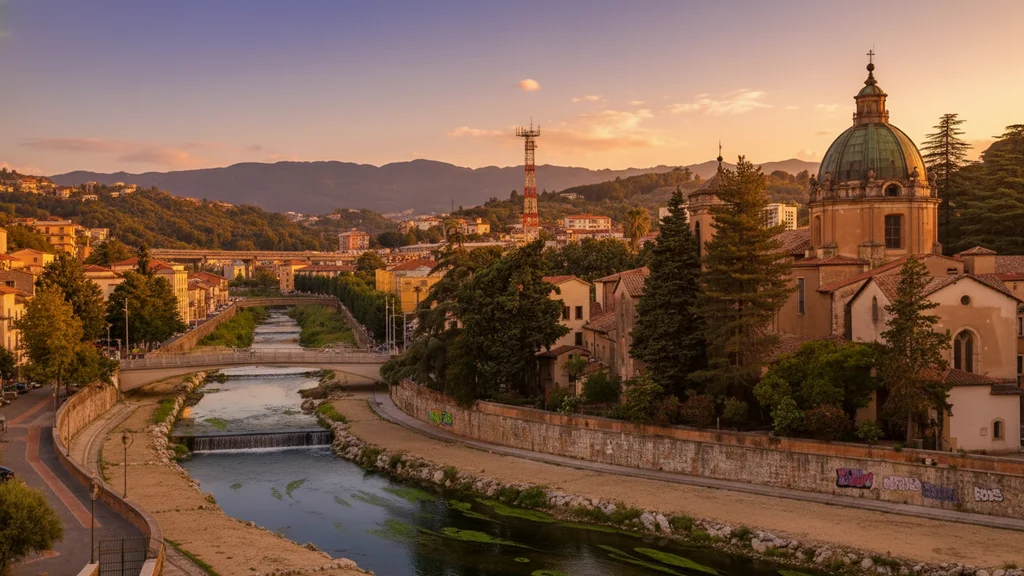
Cosenza, picturesquely situated in the valley between the rivers Crati and Busento, radiates a history that spans centuries. Its foundations reach back to pre-Christian times, when as Consentia it served as the capital of the Bruttian Confederation. Like every ancient Italian city, its walls bear witness to the rise and fall of powers, making it a fascinating destination for anyone who loves the past.
Prehistoric origins and the Middle Ages
The origins of Cosenza date back to the period when it was one of the most important centres of Bruttian culture, the ancient inhabitants of Calabria. The city was repeatedly destroyed by earthquakes, but its reconstruction stands as a beautiful testament to the determination and courage of its people. In the Middle Ages, Cosenza attracted attention as a religious and political centre where Byzantine, Norman, and later Spanish influences converged. A defining moment for the city's identity came in 410 AD, when, according to legend, Alaric, King of the Visigoths, was buried together with his legendary treasure in the waters of the river Busento.
Castello Normanno-Svevo and Swabian power
The dominant historical monument of Cosenza is the monumental Castello Normanno-Svevo. Built by the Normans in the 11th century, it was expanded by Emperor Frederick II of Hohenstaufen, who added its distinctive octagonal tower. The castle rises above the city on the Pancrazio hill, offering a panorama of the entire Crati valley and the distant peaks of the Sila plateau. Today the fortress is not only a historical attraction but also a symbol of Cosenza's identity – a place from which one can see both the old and the new city at once.
The present day and its challenges
Today Cosenza, as a dynamic academic centre home to the University of Calabria, continues to attract young people from around the world. However, its strategic location between two rivers also brings challenges, particularly related to the risk of flooding. Recent weather events have forced local authorities to take evacuation measures, highlighting the need for constant adaptation to changing environmental conditions. Despite these difficulties, the city is undergoing a renaissance, combining the revitalisation of Cosenza Vecchia with bold architectural projects in the new part of the metropolis.
Cosenza – gems of architecture and culture
Cosenza, the heart of Calabria, captivates with the dualism of its urban structure. A walk through its streets is a journey through the centuries, where the medieval, somewhat austere architecture of Cosenza Vecchia contrasts with the modern Corso Mazzini. Can one imagine a better combination than a thirteenth-century cathedral and sculptures by Salvador Dalí just a short walk apart?
The historic centre and Cosenza Vecchia
In the historic heart of the city, narrow winding streets lead visitors between majestic palaces. The Cathedral of Santa Maria Assunta, inscribed on the UNESCO list, houses a Byzantine icon of the Madonna del Pilerio and the mausoleum of Isabella of Aragon. This is where the city's religious heart beats, and the austere Romanesque-Gothic façade is a reminder of the power of former dynasties. Nearby is Piazza XV Marzo, where a statue of the philosopher Bernardino Telesio stands proudly, surrounded by the neoclassical Teatro Rendano.
Museums and the open-air MAB
Art lovers will find in Cosenza a project unique on a European scale – the Museo all'Aperto Bilotti (MAB). This remarkable open-air gallery on Corso Mazzini displays works by such masters as Salvador Dalí, Giorgio de Chirico, and Amedeo Modigliani. For those who prefer classical exhibitions, the National Gallery in Palazzo Arnone presents works by Mattia Preti, while the Museum of the Bruttians and Oenotrians, housed in the former monastery of S. Agostino, offers the richest archaeological collection in the region.
| Attraction | Type | Key element |
|---|---|---|
| Cathedral (Duomo) | UNESCO heritage | Icon of the Madonna del Pilerio |
| Castello Svevo | Defensive fortress | View over the Crati valley and Sila |
| MAB | Open-air museum | Sculptures by Dalí and de Chirico |
| Palazzo Arnone | Art gallery | Works by Mattia Preti |
| Teatro Rendano | Neoclassical theatre | Regional opera centre |
Cuisine of Cosenza – authentic flavours of the Bruzio region
The gastronomy of Cosenza is the quintessence of the Calabrian atmosphere, built on ingredients of strong, uncompromising character. The traditional cuisine of this region is rooted in the concept of cucina povera, using simple, local ingredients in a masterly way. The narrow streets of the old town fill with the aroma of fried potatoes and fragrant cured meats, which every local takes great pride in.
Local specialities and traditional dishes
The cornerstone of the local menu is lagane e ceci – wide pasta served with chickpeas, garlic, and olive oil, one of the oldest dishes in all of Italy. Fish lovers must try baccalà alla cosentina, salt cod prepared with potatoes, olives, and the indispensable peperoncino. One should also not overlook the famous 'nduja and sopressa, which taste best in the small trattorias of Cosenza Vecchia, where time seems to pass more slowly.
The sweet side of Cosenza
For dessert lovers, Cosenza has prepared Varchiglia alla monacale – a pastry filled with almond paste and chocolate, whose recipe dates back to the 14th century. During the festive season, cuddrurieddri – fried potato doughnuts – take centre stage and have become a symbol of local street food. The flavour of these dishes is inseparably linked to the history of the region, blending Arab, Spanish, and Greek influences into one coherent culinary whole.
Cosenza as a base – Sila and Pollino National Parks
Thanks to its central location, Cosenza is an ideal starting point for exploring the wild nature of Calabria. Just 30–40 minutes by car separates the city from Sila National Park, which covers an area of 73,000 hectares. It is a land of great lakes, such as Arvo and Ampollino, and dense pine forests where the Apennine wolf can still be encountered.
Nature and active recreation
In winter, Camigliatello Silano becomes a winter sports hub, and in summer it offers respite from the coastal heat. The Sila mountains are a paradise for hiking and mountain biking enthusiasts, offering landscapes that are more reminiscent of the Alps than typical southern Italy. It is also worth heading north to Parco Nazionale del Pollino, where picturesque villages such as Morano Calabro and Altomonte await, considered among the most beautiful in Italy.
The coast and strategic location
For those who long for the sea, the Tyrrhenian coast is reachable in under half an hour. Cosenza offers a unique experience – in the morning one can walk across the snow-covered Sila peaks, and in the afternoon savour an espresso on the beach in Diamante or Paola. This geographical diversity is why Cosenza is chosen by discerning travellers who want to experience Calabria comprehensively, combining culture, history, and nature.
University of Calabria – the academic heart of Calabria
The University of Calabria, known as Università della Calabria (Unical), is one of the most important academic centres in southern Italy. Located in Rende, immediately adjacent to Cosenza, it forms a modern contrast to the historic core of the city. Founded in 1972, the university has become an engine of innovation in a region that historically struggled with economic marginalisation.
History and development
Unical was part of a decentralisation strategy in higher education, aimed at supporting less developed regions of Italy. The modern campus, inspired by American models, is unique in the country for its bridge-like structure. In the 1990s the university became a leader in technical sciences, attracting students from across the Mediterranean basin to Cosenza, revitalising the local economy and culture.
Economic and social impact
The significance of Unical is enormous – it generates substantial revenue for the region and contributes to job creation by supporting startups. Calabria benefits from the academic presence and activity of the university, which bridges the tradition of the “Athens of Calabria” with modern AI laboratories and space research. It is precisely thanks to this institution that Cosenza is not merely a city of memories, but a living, vibrant centre of knowledge that is shaping the future of southern Italy.
Cosenza – Athens of Calabria: frequently asked questions
Is Cosenza worth visiting?
Absolutely. Cosenza offers an authentic Italian experience without the tourist crowds, combining unique UNESCO heritage, a modern open-air sculpture gallery, and outstanding regional cuisine.
What should I see in Cosenza Vecchia – the old town?
The key highlights are the 11th-century Cathedral (Duomo) with the icon of the Madonna del Pilerio, the Swabian Castle (Castello Svevo) on the Pancrazio hill, Teatro Rendano, and the historic Gran Caffè Renzelli.
How do I get to Cosenza from Naples and Reggio Calabria?
From Naples, the fastest option is by train (approx. 3h) or by car on the A2 motorway. From Reggio Calabria, direct regional trains run regularly, with a journey time of 2.5 to 3 hours.
Is Sila National Park close to Cosenza?
Yes, the Sila mountains are just 30–45 minutes by car from the city centre, making Cosenza an ideal base for day trips into the wild.
What should I eat in Cosenza – what are the typical regional dishes?
Be sure to try lagane e ceci (pasta with chickpeas), 'nduja, fried potatoes patate ‘mpacchiuse, and the local dessert Varchiglia alla monacale.
How much time do I need to explore Cosenza?
One intensive day is enough for the city itself, but to soak up the atmosphere of the region and visit the nearby Sila Park, it is worth planning at least 2–3 nights.
Main attractions
Cathedral of Santa Maria Assunta
Romanesque-Gothic cathedral on the UNESCO list, housing a Byzantine icon of the Madonna del Pilerio and the mausoleum of Isabella of Aragon.
Castello Normanno-Svevo
11th-century castle on the Pancrazio hill, expanded by Frederick II. Panoramic views over the Crati valley and the Sila massif.
MAB – Museo all'Aperto Bilotti
Unique open-air sculpture gallery on Corso Mazzini with works by Dalí, de Chirico, and Modigliani.
Palazzo Arnone – National Gallery
Art gallery housing a collection of Calabrian and Italian painting, including works by Mattia Preti and Umberto Boccioni.
Teatro Rendano
Neoclassical 19th-century theatre on Piazza XV Marzo – the region's centre of opera and cultural life.
Museum of the Bruttians and Oenotrians
Archaeological museum in the former monastery of S. Agostino – the richest collection of artefacts from Calabria's prehistoric past.
How to get there
Lamezia Terme (SUF) – approx. 60 km, ~45 min by car. Domestic and seasonal charter connections.
Flixbus and Marino Bus from Naples (approx. 4h) and Rome (approx. 6h). Bus station at Piazza Matteotti.
A2 motorway (Salerno–Reggio Calabria), exits Cosenza Nord or Cosenza Sud. Parking available near the San Vito stadium.
Cosenza station – connections to Reggio Calabria (approx. 2.5h), Naples (approx. 3h), and Rome (approx. 5h) via Trenitalia.